Showing posts with label Rahul Dravid. Show all posts

Tuesday, September 21, 2021

Matthew Hayden, one of the hardest hitting opening batsmen in history. Excerpt from Indra Vikram Singh’s book ‘Don’s Century’


For long his colleague Matthew Hayden sizzled in the first-class game, but fizzled at the highest level. His successes for Queensland did not translate into performances of any note for Australia. His first stint was mediocre and he was dropped. The big man continued to persevere, scoring heavily in domestic cricket, finally making his breakthrough at the age of 29 in the 2000-01 series in India. It has been forgotten that in that big turnaround in the Kolkata Test, engineered by the Herculean partnership between V.V.S. Laxman and Rahul Dravid, Hayden was a star performer for Australia with scores of 97 and 67. Since then the southpaw did not look back. Each year from 2001 to 2005 he hit up 1000 Test runs. Forging highly successful left-handed opening partnerships, with Adam Gilchrist in the One-dayers and Justin Langer in Tests, Hayden played a key role in Australia’s golden run.

The big bully advanced menacingly down the pitch, almost intimidating the bowlers like a giant caveman brandishing a chunky club. He did actually club the ball with his booming drives, rasping cuts and thundering pulls. The most menacing hitter since Ian Botham, Hayden slammed pacemen and spinners alike. His one weakness was his tendency to play a shot too many in his quest to dominate the bowling, thereby often giving his wicket away.

In their heyday this century, the Australians came to be hailed for their quick scoring. This was mainly courtesy the rousing starts Hayden gave with his partners. In the Tests they would hammer the new ball around and Australia invariably clocked four runs an over. In the shorter version, Hayden and Gilchrist would knock up six to seven runs an over in the first fifteen overs with the field in. That was the foundation for the incredible success Australia achieved during his fruitful days at the top of the order.

Hayden’s moment of euphoria, of course, was when he broke Lara’s Test record, blasting 380 against Zimbabwe at Perth on October 10, 2003. The bowling may have been ordinary, but it was a terrific display of hitting. Hayden struck 38 fours and 11 sixes - 218 in boundaries alone - off just 437 balls in 10 hours and 22 minutes. He took 208 deliveries to reach his hundred, and then just 229 more for the rest of his 280 runs. The Perth wicket was not as fast and bouncy as of yore, and with the ball coming nicely on to the bat, Hayden made merry. India’s former captain S. Venkataraghavan, who was umpiring that match told The Times of India, “He’s just so uninhibited. Nothing seemed to bother him.”

Just over six months later on April 12, 2004 Lara snatched the record back. Hayden bludgeoned his way through to 8625 runs at an average of 50.73 with 30 hundreds in his 103 Tests. In the One-dayers Hayden slammed 6133 runs at an average of 43.80, and a strike-rate of 78.96. An essential part of Ponting’s all-conquering World Cup team, Hayden hit the then fastest century in the competition off 66 balls against South Africa at St. Kitts in 2007. He also had the highest aggregate in that tournament with 659 runs at an average of 73.22 with three hundreds in 11 matches. One of the hardest hitting opening batsmen in history, Hayden’s contribution to Australian cricket has been matched by few.

(Author Indra Vikram Singh can be contacted on email singh_iv@hotmail.com).

Don’s Century

Published in India by Sporting Links

ISBN 978-81-901668-5-0

Fully illustrated

Paperback French Fold 11 x 8.5 x 0.4 inches

Weight 480 grams

188 pages


Available on Amazon at an attractive price: https://www.amazon.in/dp/8190166859  

Indra Vikram Singh's other books available on Amazon: https://www.amazon.in/s?k=Indra+Vikram+Singh&i=stripbooks&rh=p_6%3AA3HSV0N9AV7NOK&dc&qid=1602408830&rnid=1318474031&ref=sr_nr_p_6_1

Monday, July 26, 2021

Ricky Ponting, the quintessential Aussie. Excerpt from Indra Vikram Singh’s book ‘Don’s Century’


A batsman who has occupied the no. 1 slot over the last few years is Ricky Ponting. For years the Australians said he was as good as Tendulkar, but this was often dismissed as jingoism. In his early days he seemed to be a brash young man, the naughty boy of the team. He also lived in the shadow of the Waugh twins. The mischievous look remains, but as he matured - which coincided with being handed the captaincy - Ponting quickly scaled the peak. In 2003 he hit up 1503 runs in 11 Tests at 100.20 per innings. In 2005 he amassed 1544 runs in 15 Tests at an average of 67.13, the sole batsman to notch up 1500 runs in a calendar year twice.

Not surprisingly for an Australian, Ponting is the best batsman today against pace. Forever looking to get on to the front foot with an exaggerated pick up of the bat, he is quick to rock back and pull or hook. He has not always been happy against spin. Steve Waugh’s famous ‘final frontier’ series of 2000-01 in India was miserable for Ponting. Young off-spinner Harbhajan Singh mesmerised him, claiming his wicket in all five innings for 0,6,0,0,11.

In the 2007-08 series in Australia, Harbhajan again troubled Ponting, dismissing him cheaply in the first Test at Melbourne, and then again in the first innings at Sydney. One got the impression that the Australians pressed charges against Harbhajan because they wanted to shift his focus away from the game. Whatever the truth, Harbhajan did not bother Ponting again in the series.

Despite this, there can be no denying that Ponting has been the best batsman in the world in recent years. Having become the seventh to reach 10,000 Test runs - now stationed at 10,099 - with an average of 58.37 and 35 hundreds, Ponting would be vying with the likes of Tendulkar, Rahul Dravid and Jacques Kallis to pass Lara’s record aggregate and set new benchmarks.       

In One-day Internationals Ponting has crossed 11,113 runs, more than 5000 runs behind Tendulkar, with an average of 43.24, strike-rate of 80.43 and 26 centuries. His moment of glory in One-dayers came in the final of the 2003 World Cup at Johannesburg when he virtually finished the match even before India batted. His unbeaten 140 with a record 8 sixes ensured that the ICC World Cup stayed with Australia.

Ponting’s captaincy record in the World Cup is magical. His team won 22 matches in a row - 11 each in 2003 and 2007 - a feat that is unlikely to be matched. Just as Steve Waugh’s side had a hiccup in India in 2000-01, Ponting’s outfit lost the Ashes in 2005. That was the first time Australia lost the Ashes since 1986-87, after winning an unprecedented eight successive series against the Old Enemy. Ponting’s team then bounced back at home, reclaiming the Ashes in style by 5-0 in 2006-07. His side also equalled the feat of Steve Waugh’s men by winning 16 Tests in a row in that acrimonious game at Sydney in 2007-08, full of umpiring howlers.

Of late the sheen has worn off a bit in Ponting’s career. His form has dipped somewhat, and there were even calls to sack him from the captaincy after that controversial Sydney Test. Peter Roebuck went to the extent of writing that Ponting had turned the Australian team into a “pack of wild dogs.” That might be going a bit too far, but his side lost the One-day triangular finals 2-0 to India. With his wrist surgery lately, clearly, there are a few challenges ahead of Ponting.

(Author Indra Vikram Singh can be contacted on email singh_iv@hotmail.com).

Don’s Century

Published in India by Sporting Links

ISBN 978-81-901668-5-0

Fully illustrated

Paperback French Fold 11 x 8.5 x 0.4 inches

Weight 480 grams

188 pages


Available on Amazon at an attractive price: https://www.amazon.in/dp/8190166859  

Indra Vikram Singh's other books available on Amazon: https://www.amazon.in/s?k=Indra+Vikram+Singh&i=stripbooks&rh=p_6%3AA3HSV0N9AV7NOK&dc&qid=1602408830&rnid=1318474031&ref=sr_nr_p_6_1

Wednesday, September 16, 2020

The elegant and consistent Greg Chappell. Excerpt from Indra Vikram Singh’s book ‘Don’s Century’


Greg Chappell had class stamped all over him. Tall, upright, elegant with a high backlift, he was one of the finest on-drivers the game has seen. Consistent and unyielding, he has been a serious student of the game. Chappell scored a hundred on Test debut at Perth. He impressed with the amount of time he had to play his strokes even on that fast track against a hostile English pace attack of John Snow, Peter Lever and Ken Shuttleworth. He reached his century amid a flurry of strokes before he was dismissed for 108.

A decade-and-a-half later, in his final Test against Pakistan at Sydney, Greg Chappell needed 68 runs to equal Bradman’s Australian record aggregate of 6996 runs. Chappell passed The Don’s mark, became the first from his country to log up 7000 Test runs, and notched up a century, the only batsman to score hundreds in his first and last innings. He bid adieu to the game with a magnificent 182. Two other greats retired along with him after this Test - Dennis Lillee and Rodney Marsh. They came together and they went together. Call it destiny if you will, but things have a way of unfolding in amazing fashion. Nobody could have planned it that way. The plot is always scripted elsewhere.

When the Rest of the World, replacing South Africa, visited Australia in 1971-72, Greg Chappell was in commanding form, hitting up 425 runs in three matches at an average of 106.25. In the Wellington Test of 1973-74 against New Zealand, Greg Chappell emulated compatriot Doug Walters, Lawrence Rowe and Sunil Gavaskar by scoring a double century and century. Brian Lara emulated the feat in 2001-02. Chappell’s 247 not out and 133, totalling 380 runs, was the highest scored in a Test match until Graham Gooch hit up 333 and 123 against India at Lord’s in 1990. In that Wellington game, elder brother Ian Chappell scored 145 and 121.   

In 1975-76 Greg Chappell took over the Australian captaincy from Ian. It was a keenly-awaited six-Test series between the 1975 One-day World Cup champions West Indies and runners-up Australia, a terrific match-up between classy batting line-ups and fearsome pace attacks. The Aussies prevailed and how; they walloped Clive Lloyd’s side 5-1, the only defeat being at Perth where Roy Fredericks blazed to that scintillating 169. Greg Chappell hit a hundred in each innings again, 123 and 109 not out at Brisbane. In the Sydney Test he hit up an unbeaten 182. 

Kerry Packer intervened for two seasons between 1977-79 and Chappell was lost to the international game, like so many other stalwarts. He returned to captain Australia, later only in home series. A useful medium-pace change bowler, Chappell was a composed fielder, particularly in the slips. If his grandfather, former Australian captain and Bradman contemporary, Victor Richardson, was the first fielder to take five catches in a Test, against South Africa at Durban in 1935-36, Greg Chappell was the first to pouch seven in the same Test, against England at Perth in 1974-75. He finished with 122 Test catches, surpassing Colin Cowdrey’s record of 120. Later several others held more, with Rahul Dravid being the current record-holder with 207 catches in 157 Tests. 

The one faux pas in his career was when as captain he asked the bowler, his younger brother Trevor, to underarm the last delivery of the third One-day final of the World Series Cup against New Zealand on February 1, 1981. There was massive public outrage and the New Zealand prime minister shot off a telegram to his Australian counterpart, accusing the Aussie team of cowardice. The fallout was that underarm bowling, eclipsed since the days of a young W.G. Grace, was finally consigned to the pages of history. Chappell was crucified. This singular mindless act has sometimes returned to haunt Greg Chappell, but was really an aberration in the career of a dignified batsman. He finished with 7110 runs in 87 Tests, 24 hundreds and an average of 53.86. Greg Chappell was a class act.

(Author Indra Vikram Singh can be contacted on email singh_iv@hotmail.com).

Don’s Century

Published in India by Sporting Links

ISBN 978-81-901668-5-0

Fully illustrated

Paperback French Fold 11 x 8.5 x 0.4 inches

188 pages


Available on Amazon at an attractive price  
https://www.amazon.in/dp/8190166859

Monday, April 29, 2019

Road to the Cricket World Cup 2019. Awesome Tendulkar towers in mother of all battles. Excerpt from Indra Vikram Singh’s book ‘The Big Book of World Cup Cricket’

INDIA v PAKISTAN
SuperSport Park, Centurion, 1 March 2003


So often has Sachin Tendulkar pounded the bowlers into submission, and dominated top-class attacks to win matches off his own explosive bat. But has there been something like this? Consider the scene. It is a high-voltage match in the World Cup, no less, against arch-rivals Pakistan, who desperately need a win in order to qualify for the next stage. And the target is 274. This is not for the faint-hearted, or for those with ordinary ability. But then, it is really just the sort of challenge that the greats of sport revel in. Tendulkar once again rose to the occasion, stamping his pedigree on cricket’s big show of 2003.  

He said he came out to bat with a blank mind. He also stated that the moment he stroked Wasim Akram through the covers right off the sweet spot, he knew it was going to be his day. It took just three deliveries for the genius to realise what a beauty of a wicket it was and that his own Midas touch was intact enough to enable him essay yet another glittering innings. His partner Virender Sehwag too dared to square-cut the last ball of that opening over off the front foot for another four.

The pacy Shoaib Akhtar came on at the other end and promptly hurled a wide down the leg-side. The fourth ball was fast and short outside the off-stump, and Tendulkar got under it. His furious slash and the speed of the ball sent it sailing into the stands at backward point. The incensed, though seemingly chastened, speedster pitched the next one up but the direction was just a bit awry on the other side, and the little blaster whipped it to the square-leg boundary. The last delivery looked a good one but Tendulkar, now master of the situation, drove it past mid-on for another four. He had established ascendancy in a matter of two overs. Akhtar was taken off after one over that cost 18 runs. The stands were abuzz. This was indeed going to be electric.

The fifty came up in five overs. Waqar Younis dismissed Sehwag and Sourav Ganguly at 53 off successive deliveries. Tendulkar was in a different zone, zooming to his own fifty in 37 balls. He treated every bowler with disdain, flicking Waqar, executing a sweetly timed straight drive off Abdul Razzaq, and crafting a skillful on-drive to Shahid Afridi’s leg-spin, to recount a few of his dozen exquisite boundaries. His only real blemish was when he drove a bit early and Razzaq grassed the ball at mid-off.  

Mohammad Kaif helped add 102. Tendulkar got cramps but refused a runner till he was almost immobile. “Only I know how hard I have hit the ball and where it will go. A runner cannot anticipate this,” he explained. A man with immense faith in his own prowess would not risk someone ruin his precious innings. Now hobbling, he fended at a vicious Akhtar bouncer and was caught on the off-side for 98. He had faced just 75 deliveries and hit 12 fours and a six. India were already 177 in the 28th over, with the bowling decimated. Rahul Dravid and Yuvraj Singh ushered in an easy win. Writing in The Times of India, Wasim Akram saluted the maestro: “He has a great eye, but on this pitch, he seemed to have all the time in the world to select the right shot and play it to perfection…..he showed that he is capable of unforgettable strokeplay, which makes him the larger-than-life figure he is.” It was another page in the saga of Sachin Tendulkar.

Pakistan: 273 for 7 wickets (50 overs)
India: 276 for 4 wickets (45.4 overs)

(Author Indra Vikram Singh can be contacted on email singh_iv@hotmail.com).

Follow his blogs:

Indra Vikram Singh’s books are available at attractive prices on Amazon:

The Big Book of World Cup Cricket 1975-2011
Published in India by Sporting Links
ISBN 978-81-901668-4-3


Crowning Glory
Published by Sporting Links
ISBN 978-81-901668-6-7


Don’s Century
Published in India by Sporting Links
ISBN 978-81-901668-5-0


A Maharaja’s Turf
Published in India by Sporting Links
ISBN 978-81-901668-3-6


Indra Vikram Singh’s forthcoming books:

Indian Spring, on India’s triumph in the cricket World Cup 2011

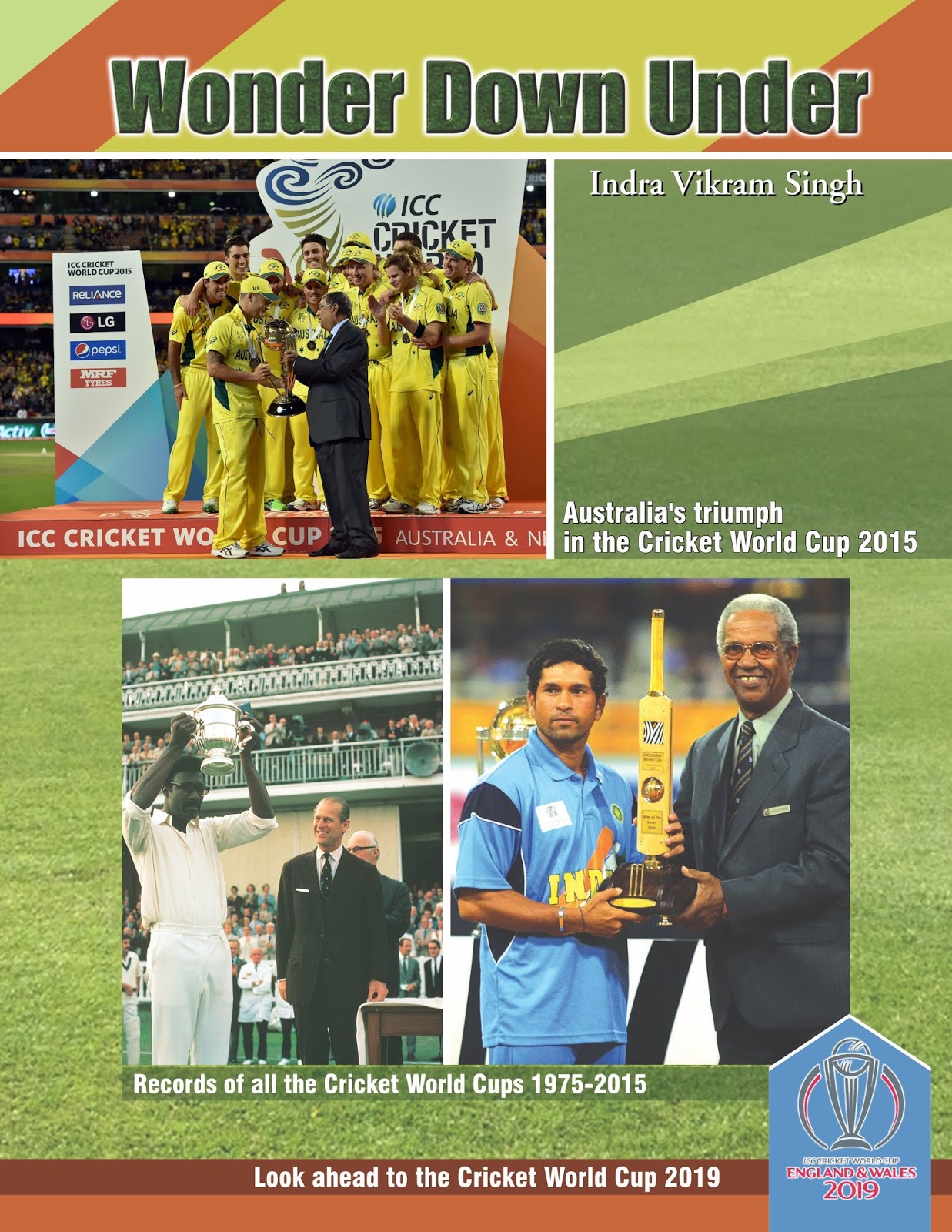
Wonder Down Under, special souvenir on the cricket World Cup 2015

Wednesday, August 20, 2014

The Cricket World Cup - Memorable Performances…..7 : Excerpt from ‘The Big Book of World Cup Cricket 1975-2011’ by Indra Vikram Singh

DRAVID AND GANGULY POST 
ALL-TIME RECORD PARTNERSHIP

County Ground, Taunton  •  26 May 1999


Strangely, while others were finding it difficult to score a century, Indian batsmen were reeling off hundreds after hundreds in this tournament. Sachin Tendulkar and Rahul Dravid had just flayed the Kenyan bowling, and set up a plethora of records. If that was an unprecedented high in the World Cup, Dravid and Sourav Ganguly reached the pinnacle in terms of partnerships in all One-day Internationals, when India met holders Sri Lanka.

After Sadagopan Ramesh was dismissed in the first over, Ganguly and Dravid sparkled. Dravid, the accomplished technician, surprisingly set the early pace with a flurry of brilliant strokes. Ganguly, the smooth timer, picked up the cue later and launched a blistering attack like which had rarely been seen before.

They were both revelations. Ganguly was hitherto known for his silken strokes on the off-side. He was awkward, if not ungainly, while playing the ball - almost following it around - on the on-side. This was particularly marked when pace bowlers dug the ball into his ribs. There were no such inelegant jabs in this match. Once he cut loose, his big-hitting - straight and over long-on - took one’s breath away. One never knew the ‘Prince of Kolkata’ could hit so long and hard. Again it was brilliant timing.

Dravid had always been known as a copybook batsman in the Sunil Gavaskar-Sanjay Manjrekar tradition. He would often get bogged down, unable to rotate the strike. Here, on this true wicket at Taunton, Dravid went on an uncharacteristic stroke-playing binge from the very start. As he played his wristy shots to perfection, with the willow doing his bidding every time, he looked almost like a table tennis maestro relishing his forehand and backhand chops that had the opponent running hither and thither.

In terms of pure statistics it was mind-boggling. Dravid became the second batsman in the World Cup to carve back-to-back centuries, having hit an unbeaten 104 against Kenya in the previous match. Mark Waugh had achieved the feat in 1996. With Ganguly also scoring a hundred, this was the third instance of two batsmen hitting tons in the same World Cup innings after Desmond Haynes and Vivian Richards in 1987, and Dravid and Tendulkar three days earlier.

As Dravid also kept wickets in the match, his 145 was highest by a wicketkeeper in the World Cup, overtaking David Houghton’s 142 in 1987. Ganguly’s 183 was India’s highest in One-day Internationals, surpassing Kapil Dev’s 175 in the 1983 World Cup. It was second-best in the World Cup after Gary Kirsten’s 188 not out in 1996, and fourth in all One-day Internationals behind Saeed Anwar’s 194 and Vivian Richards’ 189.

Ganguly hit 7 sixes, equalling Vivian Richards’ World Cup record set in 1987 and Sachin Tendulkar’s Indian record in all One-day Internationals, which he smashed against Australia in 1998. Coupled with his 17 fours, Ganguly had now hit the maximum runs in boundaries in a World Cup knock. "Once I realised the pitch was good for playing shots, I just did not think of curbing myself", said a delighted Ganguly. Ricky Ponting broke this mark, blasting 8 sixes in the 2003 final.

Ganguly and Dravid added 318, the first triple-century partnership in One-day Internationals. The previous best World Cup stand was 237 between Dravid and Tendulkar in their last match. The highest-ever stand in One-day Internationals was 275 between Mohammad Azharuddin and Ajay Jadeja against Zimbabwe in 1998. Sourav Ganguly and Rahul Dravid surpassed these and re-wrote the record books with their exhilarating batting.

(Author Indra Vikram Singh can be contacted on email singh_iv@hotmail.com).

The Big Book of World Cup Cricket 1975-2011

ISBN 978-81-901668-4-3

Distributed in India by Variety Book Depot, Connaught Place, New Delhi, Phones + 91 11 23417175, 23412567

Available in leading bookshops, and online on several websites.