Showing posts with label Yuvraj Singh. Show all posts

Sunday, August 16, 2020

Mahendra Singh Dhoni’s finest hour; India’s triumph in the World Cup 2011

It appeared almost inevitable that India would win the 2011 World Cup. A billion Indians seemed to believe that the team would certainly win, and the team itself desperately wanted to win it for its billion fanatical followers and for one peerless and inspirational representative of God himself, Sachin Tendulkar. The team had been steadily ascending the ladder of success since its heart-wrenching ouster from the 2007 World Cup. One by one, things began falling into place. Tendulkar toiled not only to regain the magical touch of yore but also to scale peak after peak. An efficient back-up staff led by the taciturn and hard-nosed Gary Kirsten engineered the side into a fighting machine. A young, razor-sharp, unflappable and versatile skipper Mahendra Dhoni arrived to steer the ship deftly through calm as well as stormy seas.

Blessed with arguably the greatest batting line-up in history, the team crafted one success after another, rising to no. 1 status in Test matches for the first time in its chequered history of 78 years, hovering around that position in One-day Internationals as well, holding its own at home as well as overseas, and all this after having won the inaugural ICC World Twenty20 that same year of 2007. The victorious side defied conventional wisdom by clinching matches and series on the strength of its powerful batting, either posting unattainable totals or chasing down impossible targets. There was always enough depth as well as bench strength to tide over even acute crises, and to cover up for the sketchy and often profligate bowling. The captain and team management made skillful use of the embarrassingly limited bowling resources, which ultimately proved adequate in home conditions. The much-derided fielding proved equal to the task, and the end result was an inspired outfit that carried the day despite a bit of a stutter in the early stages. Even these hiccups had a silver lining, for they helped fine-tune the playing eleven and to temper the arrogance of the middle-order batsmen.

There were other fancied sides too, the Sri Lankans, favoured in familiar conditions, with strong batting and balanced bowling; the South Africans, whose day some experts believed had finally come, boasting the best pace attack in the world, a complete bowling line-up on paper, replete with allrounders, and a fine array of batsmen to go with their customary top-class fielding; and the Australians, never ones to be counted out as they showed in 2007 despite sliding down the order and obvious depletion in resources, still possessing top-quality fast bowlers but little else. The dark horses were Pakistan, unpredictable as ever, and they did threaten all the way until their ouster by the relentless Indians in an emotionally-charged semi-final.   

On behalf of the minnows, the heartening performance came from the plucky Irish along with a glorious hand by Holland’s Ryan ten Doeschate. This itself makes out a case for the inclusion of some associate member nations in the future World Cups. The idea to have just ten teams is perhaps a sound one but the bottom two teams among those with One-day international status should compete in the ICC qualifying tournament with the associate members to earn the right to play in the World Cup.

Despite the odd flutter, the eight top teams took their appointed places in the quarter-finals. As expected, that is where the real action began. After Pakistan disdainfully swept aside the once-mighty West Indies, India stopped the incredible Cup-winning run of an Aussie outfit in decline. Then came possibly the biggest shock of the tournament. The unheralded and grossly underrated Kiwis skittled out the Proteas to add yet another chapter to the bemusing saga of a handsome-looking side that invariably flatters to deceive in this showpiece event. To complete the picture, Sri Lanka were as contemptuous of England as Pakistan were of the West Indies earlier.

There were, not surprisingly, three sub-continental teams in the semi-finals. New Zealand did battle hard, as is their wont, but Sri Lanka were too good in the end. The Kiwis have now played six of the ten semi-finals without once breaching this penultimate barrier. The other semi-final was really a war and a carnival rolled into one, simply the most heart-stopping sporting event held anywhere. India prevailed over Pakistan in a most curious encounter, and the fireworks at the end would have one believe that the Cup itself had been won that night.

It was an engrossing final but a relatively sedate affair. Sri Lanka were worthy opponents, equalling Australia’s highest losing score of 1975 in a World Cup final. India, irresistible as they were by now, cruised to the title amid wild jubilation. Dhoni’s emphatic hit over the long-on boundary with plenty to spare only reaffirmed the belief of so many. India became the first team to win the World Cup on home soil, the crowning glory to Sachin Tendulkar’s astonishing career and to the team’s triumphant run of recent years.  


The final:

Wankhede Stadium, Mumbai, 2 April 2011

India won by 6 wickets

Sri Lanka: 274 for 6 wickets in 50 overs (Tillakaratne Dilshan 33, Kumar Sangakkara 48, Mahela Jayawardene 103 not out, Nuwan Kulasekara 32)

India: 277 for 4 wickets in 48.2 overs (Gautam Gambhir 97, Virat Kohli 35, Mahendra Singh Dhoni 91 not out)

Man of the Match: Mahendra Singh Dhoni

Player of the Tournament: Yuvraj Singh


(Excerpt from Indra Vikram Singh's book 'Crowning Glory'. The author  can be contacted on email singh_iv@hotmail.com).

Follow his blogs: 

https://singhiv.wordpress.com/  

https://indravikramsingh.blogspot.com/


Saturday, May 18, 2019

Road to the Cricket World Cup 2019. Fairy-tale crescendo on home turf. Excerpt from Indra Vikram Singh’s book ‘Indian Spring’

INDIA v SRI LANKA (FINAL)
WANKHEDE STADIUM, MUMBAI, 2 APRIL 2011

Gautam Gambhir
Mahendra Singh Dhoni
Sachin Tendulkar


A supremely confident Indian team appeared to be peaking at the right time. Such was the din at the Wankhede Stadium that none at the toss heard skipper Kumar Sangakkara’s call correctly, and the coin had to be flipped again. The Sri Lankan innings was built around a superb hundred by Mahela Jayawardene. Even as Tillakaratne Dilshan and Sangakkara forged a 43-run second-wicket stand in just over 10 overs, the innings got impetus when the classy Jayawardene walked in. He put on 62 with Sangakkara at a-run-per-ball, and another 57 with Thilan Samaraweera at about the same rate, bringing up his own fifty off 49 balls.     

Sri Lanka took the Powerplay only in the 46th over at 211 for five. Nine runs came off Zaheer Khan’s over and eleven off Munaf Patel with 2 fours. Nuwan Kulasekara slammed Zaheer over mid-wicket for a six, and Jayawardene hit two cracking boundaries to raise his century off 84 deliveries. But Kulasekara was run out. In the final over Thisara Perera smashed Zaheer for 2 fours and then a six off the last ball. The final 5 overs yielded 63 runs. Jayawardene leapt in joy. Sri Lanka had equalled the highest losing total of 274 in a World Cup final. No team batting second had scored so many in a World Cup final, but every team with a centurion in the final had won the Cup. This was not for the fain-hearted!  

‘Slinger’ Malinga trapped Virender Sehwag leg-before second-ball. The stunned silence turned into a mighty roar as Gautam Gambhir glided his first delivery to the boundary. After a couple on the off-side, Sachin Tendulkar drove Kulasekara straight in trademark fashion and then cut him for boundaries, to bring the house down. He then lost strike for a while. Sure enough he nicked Malinga, and Sangakkara grabbed it, flinging himself to his right. Tendulkar was not to score his 100th hundred in the World Cup final. The crowd gave him an extended standing ovation. But there was despondency too as India were 31 for two, with a mountain to climb. Gambhir and Virat Kohli regrouped, rotating the strike, coupled with the odd boundary. They then struck Kulasekara for a four each in the 12th over. India started to breathe easier, but this was an all-or-nothing game with lots of serious work to be done. The pair batted with maturity, bereft of histrionics. The left-hander clocked his half-century in 56 balls. Kohli was beginning to open out when he drove hard at Dilshan who took a brilliant return catch. They had put on 83 in 15.3 overs, priceless in this situation. 

Dhoni resolutely promoted himself, perhaps intending to retain the left-right pairing too. He began studiously, striking a boundary only off his 25th ball. Progress was steady; Dhoni hammered one through the covers to reach fifty off 52 deliveries. Gambhir by now was 90, and India 204 for three after 38 overs. Runs now came easily but Gambhir sent shock-waves, trying to smash one, only to be bowled for 97. He had played anchor in the high-voltage game, his 122-ball knock comprising 9 boundaries. Yuvraj Singh joined in with 52 required off 52 balls. Dhoni rocketed one over point for a six. They raised the tempo in the 47th over with a boundary each. Dhoni hit Malinga for two more fours in the next over. With 5 runs to get in two overs, Dhoni nonchalantly lofted the ball above long-on into the stands. He returned triumphant with 91 off 79 balls studded with 8 fours and 2 sixes. Dhoni lifted the Cup; the joyous teammates hoisted Tendulkar. Kohli remarked famously: “He has carried the burden of the nation for 21 years. It was time we carried him.” Dreams do come true.      

Sri Lanka 274 for 6 wickets (50 overs) 
India 277 for 4 wickets (48.2 overs)
  
(Author Indra Vikram Singh can be contacted on email singh_iv@hotmail.com).

Follow his blogs:

Indra Vikram Singh’s books are available at attractive prices on Amazon:

The Big Book of World Cup Cricket 1975-2011
Published in India by Sporting Links
ISBN 978-81-901668-4-3


Crowning Glory
Published by Sporting Links
ISBN 978-81-901668-6-7


Don’s Century
Published in India by Sporting Links
ISBN 978-81-901668-5-0


A Maharaja’s Turf
Published in India by Sporting Links
ISBN 978-81-901668-3-6


Indra Vikram Singh’s latest books:

Indian Spring, on India’s triumph in the cricket World Cup 2011

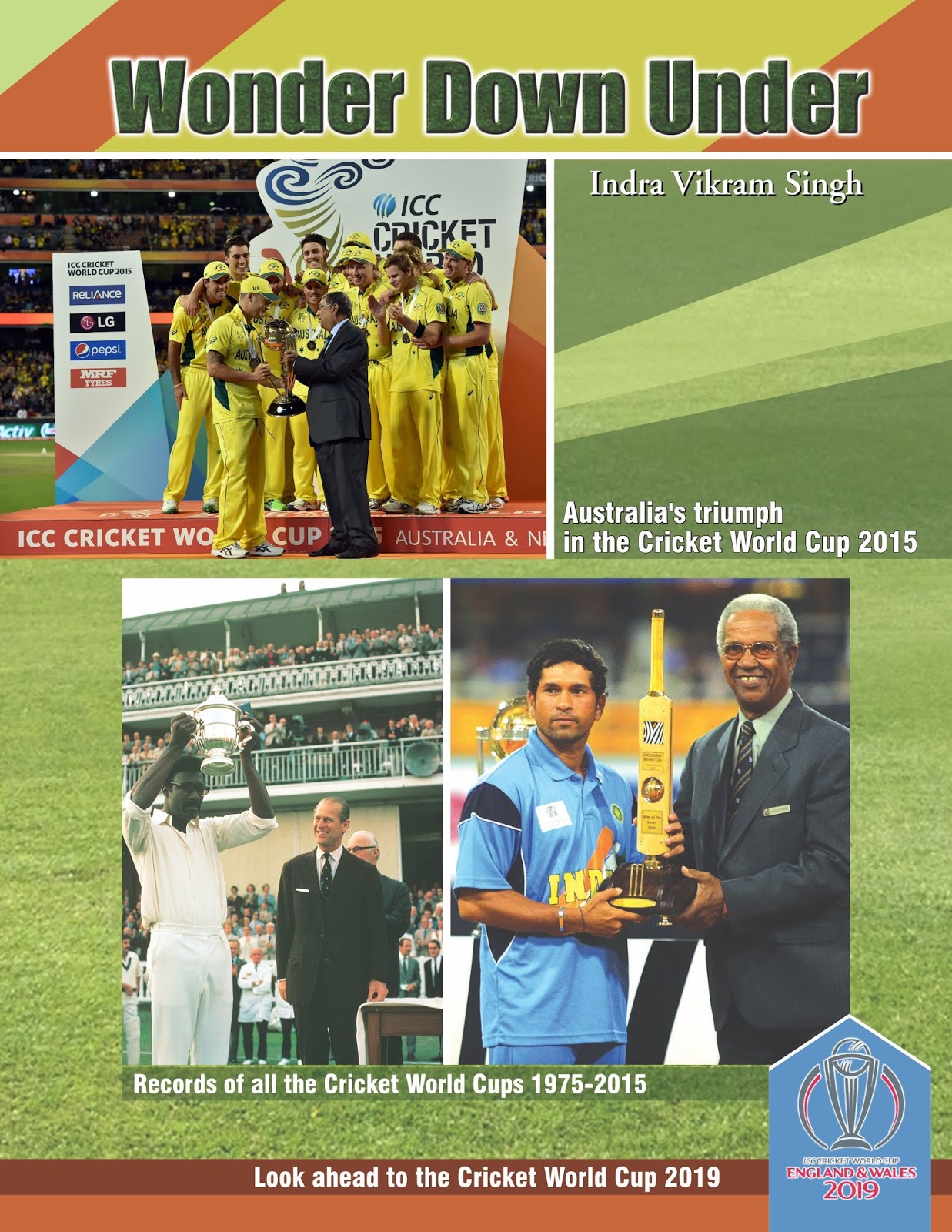
Wonder Down Under, special souvenir on the cricket World Cup 2015

Monday, April 29, 2019

Road to the Cricket World Cup 2019. Awesome Tendulkar towers in mother of all battles. Excerpt from Indra Vikram Singh’s book ‘The Big Book of World Cup Cricket’

INDIA v PAKISTAN
SuperSport Park, Centurion, 1 March 2003


So often has Sachin Tendulkar pounded the bowlers into submission, and dominated top-class attacks to win matches off his own explosive bat. But has there been something like this? Consider the scene. It is a high-voltage match in the World Cup, no less, against arch-rivals Pakistan, who desperately need a win in order to qualify for the next stage. And the target is 274. This is not for the faint-hearted, or for those with ordinary ability. But then, it is really just the sort of challenge that the greats of sport revel in. Tendulkar once again rose to the occasion, stamping his pedigree on cricket’s big show of 2003.  

He said he came out to bat with a blank mind. He also stated that the moment he stroked Wasim Akram through the covers right off the sweet spot, he knew it was going to be his day. It took just three deliveries for the genius to realise what a beauty of a wicket it was and that his own Midas touch was intact enough to enable him essay yet another glittering innings. His partner Virender Sehwag too dared to square-cut the last ball of that opening over off the front foot for another four.

The pacy Shoaib Akhtar came on at the other end and promptly hurled a wide down the leg-side. The fourth ball was fast and short outside the off-stump, and Tendulkar got under it. His furious slash and the speed of the ball sent it sailing into the stands at backward point. The incensed, though seemingly chastened, speedster pitched the next one up but the direction was just a bit awry on the other side, and the little blaster whipped it to the square-leg boundary. The last delivery looked a good one but Tendulkar, now master of the situation, drove it past mid-on for another four. He had established ascendancy in a matter of two overs. Akhtar was taken off after one over that cost 18 runs. The stands were abuzz. This was indeed going to be electric.

The fifty came up in five overs. Waqar Younis dismissed Sehwag and Sourav Ganguly at 53 off successive deliveries. Tendulkar was in a different zone, zooming to his own fifty in 37 balls. He treated every bowler with disdain, flicking Waqar, executing a sweetly timed straight drive off Abdul Razzaq, and crafting a skillful on-drive to Shahid Afridi’s leg-spin, to recount a few of his dozen exquisite boundaries. His only real blemish was when he drove a bit early and Razzaq grassed the ball at mid-off.  

Mohammad Kaif helped add 102. Tendulkar got cramps but refused a runner till he was almost immobile. “Only I know how hard I have hit the ball and where it will go. A runner cannot anticipate this,” he explained. A man with immense faith in his own prowess would not risk someone ruin his precious innings. Now hobbling, he fended at a vicious Akhtar bouncer and was caught on the off-side for 98. He had faced just 75 deliveries and hit 12 fours and a six. India were already 177 in the 28th over, with the bowling decimated. Rahul Dravid and Yuvraj Singh ushered in an easy win. Writing in The Times of India, Wasim Akram saluted the maestro: “He has a great eye, but on this pitch, he seemed to have all the time in the world to select the right shot and play it to perfection…..he showed that he is capable of unforgettable strokeplay, which makes him the larger-than-life figure he is.” It was another page in the saga of Sachin Tendulkar.

Pakistan: 273 for 7 wickets (50 overs)
India: 276 for 4 wickets (45.4 overs)

(Author Indra Vikram Singh can be contacted on email singh_iv@hotmail.com).

Follow his blogs:

Indra Vikram Singh’s books are available at attractive prices on Amazon:

The Big Book of World Cup Cricket 1975-2011
Published in India by Sporting Links
ISBN 978-81-901668-4-3


Crowning Glory
Published by Sporting Links
ISBN 978-81-901668-6-7


Don’s Century
Published in India by Sporting Links
ISBN 978-81-901668-5-0


A Maharaja’s Turf
Published in India by Sporting Links
ISBN 978-81-901668-3-6


Indra Vikram Singh’s forthcoming books:

Indian Spring, on India’s triumph in the cricket World Cup 2011

Wonder Down Under, special souvenir on the cricket World Cup 2015

Sunday, April 20, 2014

ICC World Cup 2011, the crowning glory to India’s golden run and to Sachin Tendulkar’s glorious career : Excerpt from Indra Vikram Singh’s forthcoming book ‘Indian Spring’


The World Cup returned to the sub-continent for the third time in 2011. On this occasion it was staged in India, Sri Lanka and Bangladesh, a jamboree of colour, jubilation and thunderous cheers, a wondrous odyssey through diverse cultures embracing more than a quarter of the world’s population. The legendary Sachin Tendulkar, highest run-getter in the World Cup and player-of-the tournament in the 2003 edition, was appointed ICC’s brand ambassador for this event. The logo signified a travelling cricket ball, seam up, carrying along with it players and spectators in this exhilarating expedition.

An elegantly-poised young elephant, christened Stumpy, was anointed the mascot of the 2011 edition of this showpiece event. The organizing committee put it thus : “The idea of our mascot is to crystallise the feelings and action of the sport and the fans in a graphic form that reflects the visceral tone and emotion that cricket creates in its followers, especially in an event like the cricket World Cup. It also emphasises the enthusiasm of youth both in general and for cricket itself, especially on the sub-continent with its massive and dedicated following. He’s stylised to give an instantly recognisable graphic strength so that with exposure his bold lines and strong colouring will instantly create a friendly face for the cricket World Cup.” The endearing Stumpy was reminiscent of the lovable Appu of the New Delhi Asian Games 1982.

The official song of the tournament had three versions, in Bengali, Hindi and Sinhala. The Hindi version “De Ghuma Ke” (Swing It Hard) was composed by the trio of Shankar Mahadevan, Ehsaan Noorani and Loy Mendonsa, or Shankar-Ehsaan-Loy. They used an array of Indian rhythms, coalesced with rock and hip hop. The Sinhala version “Sinha Udaane” was composed by lyricist Shehan Galahitiyawa, and performed by Rhythm & Blues and hip-hop musician Ranidu Lankage.

Two new stadiums were built in Sri Lanka. The Pallekele International Cricket Stadium, constructed at a cost of $4 million at Kandy, holds 35,000 spectators, while the Suriyawewa Stadium at Hambantota on the south-eastern coast, dotted with tourist resorts, has a seating capacity of 33,000, a project costing about $8 million. The capacity of Colombo’s Premadasa Stadium was increased from 12,000 to 30,000.

There were now 14 teams in the fray, two less than in 2007. The ten full members got direct entry, including Zimbabwe, even though they were at that time suspended from Test matches. In the qualifying tournament held in South Africa for associate members in 2009, Ireland beat Canada by nine wickets in the final at Centurion. These two countries were joined by Holland and Kenya on the big stage now.

The super-league was done away with, and the teams advanced from the group matches to the quarter-finals. It was akin to the format of the 1996 World Cup, also played in the sub-continent, but with two more teams this time. There were thus 49 matches instead of the 51 played in 2007, and the event was about a week shorter, the groupings being as follows:
Group A : Australia, Pakistan, New Zealand, Sri Lanka, Zimbabwe, Canada and Kenya.
Group B : India, South Africa, England, West Indies, Bangladesh, Ireland and Holland.

The 18 umpires chosen for the tournament were Billy Bowden, Aleem Dar, Steve Davis, Asoka de Silva, Billy Doctrove, Marais Erasmus, Ian Gould, Daryl Harper, Tony Hill, Asad Rauf, Simon Taufel, Rod Tucker (all from the ICC Elite Panel of Umpires), Kumar Dharmasena, Richard Kettleborough, Nigel Llong, Bruce Oxenford, Amish Saheba, and Shahvir Tarapore (all from the ICC International Panel of Umpires). The reserve umpire was Enamul Hoque-Moni. There were five match referees: Chris Broad, Jeff Crowe, Ranjan Madugalle, Roshan Mahanama and Andy Pycroft.

The television rights were secured by ESPN Star Sports for $2 billion, with the event being telecast live in 220 countries. There was high-definition (HD) telecast and live 3G streaming, and each match was covered by at least 27 cameras, inclusive of the revolutionary movable slip and low-45 degree field cameras. As many as 37 games were simulcast in Hindi. The ICC decided to deploy the Umpire Decision Review System (UDRS) for the first time in any of its events.

Apart from ESPN Star Sports, the commercial partners of ICC were Reliance Communications, LG Electronics, PepsiCo, Hero Honda Motors Limited, Emirates, Reebok International Limited, Yahoo! Inc., Castrol and MoneyGram International.  

The total prize money was doubled to $10 million, of which the champions carried away $3 million, the runners-up $1.5 million, the losing semi-finalists $750,000 each, the fifth to eighth placed teams $370,000 each, and the winners of the 42 preliminary matches $60,000 each. 

The opening ceremony and first match between co-hosts Bangladesh and India were held at the Sher-e-Bangla National Stadium in Mirpur, on the outskirts of the capital Dhaka. Bangladesh played all their six group matches at home in Dhaka and Chittagong, while India played the rest of their matches on their own soil. Eight venues were chosen in India - Ahmedabad, Bangalore, Chennai, Kolkata, Mohali, Mumbai, Nagpur and New Delhi. Sri Lanka, like India, were seen in action on home territory, except for their last league match which was staged in Mumbai.

Owing to security concerns, the 14 matches scheduled to be held in Pakistan were relocated, and their team was based in Sri Lanka. Not only all of Pakistan’s league matches but their quarter-final and semi-final too - in the event of their reaching those stages - were to be held in Sri Lanka at the Premadasa Stadium in Colombo. The other semi-final was scheduled at the Punjab Cricket Association Stadium in Mohali. As it happened, India and Sri Lanka entered the semi-finals, and did not face each other at that stage. They hosted both their semi-finals on home venues, and Pakistan travelled to Mohali for a nerve-wracking clash with India. The venue for the final was the remodelled Wankhede Stadium. India hosted 29 matches, while Sri Lanka and Bangladesh staged 12 and 8 games respectively. 
  
It appeared almost inevitable that India would win the 2011 World Cup. A billion Indians seemed to believe that the team would certainly win, and the team itself desperately wanted to win it for its billion fanatical followers and for one peerless and inspirational representative of God himself, Sachin Tendulkar. The team had been steadily ascending the ladder of success since its heart-wrenching ouster from the 2007 World Cup. One by one, things began falling into place. Tendulkar toiled not only to regain the magical touch of yore but also to scale peak after peak. An efficient back-up staff led by the taciturn and hard-nosed Gary Kirsten engineered the side into a fighting machine. A young, razor-sharp, unflappable and versatile skipper Mahendra Dhoni arrived to steer the ship deftly through calm as well as stormy seas.  

Blessed with arguably the greatest batting line-up in history, the team crafted one success after another, rising to no. 1 status in Test matches for the first time in its chequered history of 78 years, hovering around that position in One-day Internationals as well, holding its own at home and also overseas, and all this after having won the inaugural ICC World Twenty20 that same year of 2007. The victorious side defied conventional wisdom by clinching matches and series on the strength of its powerful batting, either posting unattainable totals or chasing down impossible targets. There was always enough depth as well as bench strength to tide over even acute crises, and to cover up for the sketchy and often profligate bowling. The captain and team management made skillful use of the embarrassingly limited bowling resources, which ultimately proved adequate in home conditions. The much-derided fielding proved equal to the task, and the end result was an inspired outfit that carried the day despite a bit of a stutter in the early stages. Even these hiccups had a silver lining, for they helped fine-tune the playing eleven and to temper the arrogance of the middle-order batsmen.

There were other fancied sides too, the Sri Lankans, favoured in familiar conditions, with strong batting and balanced bowling; the South Africans, whose day some experts believed had finally come, boasting of the best pace attack in the world, a complete bowling line-up on paper, replete with allrounders, and a fine array of batsmen to go with their customary top-class fielding; and the Australians, never ones to be counted out as they showed in 2007 despite sliding down the order and obvious depletion in resources, still possessing top-quality fast bowlers but little else. The dark horses were Pakistan, unpredictable as ever, and they did threaten all the way until their ouster by the relentless Indians in an emotionally-charged semi-final.   

On behalf of the minnows, the heartening performance came from the plucky Irish along with a glorious hand by Holland’s Ryan ten Doeschate. This itself makes out a case for the inclusion of some associate member nations in future World Cup tournaments. The idea to have just ten teams is perhaps a sound one but one feels that the bottom two teams among those with One-day international status should compete in the ICC qualifying tournament with the associate members to earn the right to play in the World Cup. Thankfully the inane ICC Champions Trophy is being scrapped. The World Twenty20 should be staged only every four years in order to avoid an overkill and to sustain public and media interest. The International Cricket Council should be able to generate adequate finances from the events it would then be left with.

Despite the odd flutter, the eight top teams took their appointed places in the quarter-finals. As expected, that is where the real action began. After Pakistan disdainfully swept aside the once-mighty West Indies, India stopped the incredible Cup-winning run of an Aussie outfit in decline. Then came possibly the biggest shock of the tournament. The unheralded and grossly underrated Kiwis skittled out the Proteas to add yet another chapter to the bemusing saga of a handsome-looking side that invariably flatters to deceive in this showpiece event. To complete the picture, Sri Lanka were as contemptuous of England as Pakistan were of the West Indies earlier.

There were, not surprisingly, three sub-continental teams in the semi-finals. New Zealand did battle hard, as is their wont, but Sri Lanka were too good in the end. The Kiwis have now played six of the ten semi-finals without once breaching this penultimate barrier. The other semi-final was really a war and a carnival rolled into one, simply the most heart-stopping sporting event held anywhere. India prevailed over Pakistan in a most curious encounter, and the fireworks at the end would have one believe that the Cup itself had been won that night.

It was an engrossing final but a relatively sedate affair. Sri Lanka were worthy opponents, equalling Australia’s highest losing score of 1975 in a World Cup final. India, irresistible as they were by now, cruised to the title amid wild jubilation.

Dhoni’s emphatic hit over the long-on boundary with plenty to spare only reaffirmed the belief of so many.

India became the first team to win the World Cup on home soil, the crowning glory to Sachin Tendulkar’s astonishing career and to the team’s triumphant run of the preceding years. 

The final:
Wankhede Stadium, Mumbai, 2 April 2011

India won by 6 wickets

Sri Lanka: 274 for 6 wickets in 50 overs (Tillakaratne Dilshan 33, Kumar Sangakkara 48, Mahela Jayawardene 103 not out, Nuwan Kulasekara 32)

India: 277 for 4 wickets in 48.2 overs (Gautam Gambhir 97, Virat Kohli 35, Mahendra Singh Dhoni 91 not out)

Man of the Match : Mahendra Singh Dhoni


Player of the Tournament : Yuvraj Singh


(Author Indra Vikram Singh can be contacted on email singh_iv@hotmail.com).