Showing posts with label Adam Gilchrist. Show all posts

Tuesday, September 21, 2021

Matthew Hayden, one of the hardest hitting opening batsmen in history. Excerpt from Indra Vikram Singh’s book ‘Don’s Century’


For long his colleague Matthew Hayden sizzled in the first-class game, but fizzled at the highest level. His successes for Queensland did not translate into performances of any note for Australia. His first stint was mediocre and he was dropped. The big man continued to persevere, scoring heavily in domestic cricket, finally making his breakthrough at the age of 29 in the 2000-01 series in India. It has been forgotten that in that big turnaround in the Kolkata Test, engineered by the Herculean partnership between V.V.S. Laxman and Rahul Dravid, Hayden was a star performer for Australia with scores of 97 and 67. Since then the southpaw did not look back. Each year from 2001 to 2005 he hit up 1000 Test runs. Forging highly successful left-handed opening partnerships, with Adam Gilchrist in the One-dayers and Justin Langer in Tests, Hayden played a key role in Australia’s golden run.

The big bully advanced menacingly down the pitch, almost intimidating the bowlers like a giant caveman brandishing a chunky club. He did actually club the ball with his booming drives, rasping cuts and thundering pulls. The most menacing hitter since Ian Botham, Hayden slammed pacemen and spinners alike. His one weakness was his tendency to play a shot too many in his quest to dominate the bowling, thereby often giving his wicket away.

In their heyday this century, the Australians came to be hailed for their quick scoring. This was mainly courtesy the rousing starts Hayden gave with his partners. In the Tests they would hammer the new ball around and Australia invariably clocked four runs an over. In the shorter version, Hayden and Gilchrist would knock up six to seven runs an over in the first fifteen overs with the field in. That was the foundation for the incredible success Australia achieved during his fruitful days at the top of the order.

Hayden’s moment of euphoria, of course, was when he broke Lara’s Test record, blasting 380 against Zimbabwe at Perth on October 10, 2003. The bowling may have been ordinary, but it was a terrific display of hitting. Hayden struck 38 fours and 11 sixes - 218 in boundaries alone - off just 437 balls in 10 hours and 22 minutes. He took 208 deliveries to reach his hundred, and then just 229 more for the rest of his 280 runs. The Perth wicket was not as fast and bouncy as of yore, and with the ball coming nicely on to the bat, Hayden made merry. India’s former captain S. Venkataraghavan, who was umpiring that match told The Times of India, “He’s just so uninhibited. Nothing seemed to bother him.”

Just over six months later on April 12, 2004 Lara snatched the record back. Hayden bludgeoned his way through to 8625 runs at an average of 50.73 with 30 hundreds in his 103 Tests. In the One-dayers Hayden slammed 6133 runs at an average of 43.80, and a strike-rate of 78.96. An essential part of Ponting’s all-conquering World Cup team, Hayden hit the then fastest century in the competition off 66 balls against South Africa at St. Kitts in 2007. He also had the highest aggregate in that tournament with 659 runs at an average of 73.22 with three hundreds in 11 matches. One of the hardest hitting opening batsmen in history, Hayden’s contribution to Australian cricket has been matched by few.

(Author Indra Vikram Singh can be contacted on email singh_iv@hotmail.com).

Don’s Century

Published in India by Sporting Links

ISBN 978-81-901668-5-0

Fully illustrated

Paperback French Fold 11 x 8.5 x 0.4 inches

Weight 480 grams

188 pages


Available on Amazon at an attractive price: https://www.amazon.in/dp/8190166859  

Indra Vikram Singh's other books available on Amazon: https://www.amazon.in/s?k=Indra+Vikram+Singh&i=stripbooks&rh=p_6%3AA3HSV0N9AV7NOK&dc&qid=1602408830&rnid=1318474031&ref=sr_nr_p_6_1

Saturday, April 20, 2019

Road to the cricket World Cup 2019. Heart-stopping tie. Excerpt from Indra Vikram Singh’s book ‘The Big Book of World Cup Cricket 1975-2011’

AUSTRALIA v SOUTH AFRICA (SEMI-FINAL) 
EDGBASTON, BIRMINGHAM, 17 JUNE 1999


Just four days earlier the two teams had fought a high-scoring cliffhanger. Australia had advanced to the semi-final with just two balls to spare. It was clear that not much separated these sides. Excitement was running high as they clashed again at Edgbaston. Yet none could have imagined that the match would end the way it did.

Pacemen Shaun Pollock and Allan Donald were in devastating form. Pollock made a delivery jump, and Mark Waugh gloved it to Mark Boucher. Adam Gilchrist and Ricky Ponting put on 51 but South Africa struck back. Three wickets fell for 14 runs, and at 68 for four in the 17th over, Australia were looking down the barrel.

That man Steve Waugh fought another valiant battle. He put on 90 for the fifth wicket with Michael Bevan. Waugh was caught by Boucher, trying to glide the ball to third-man. He scored 56 off 76 balls with a six and 6 fours. Thereafter only Shane Warne offered resistance. Bevan was last out in the final over for 65. Pollock took five for 36 off 9.2 overs, while Donald bagged four for 32 off 10 overs. They shot out Australia for 213.

Gary Kirsten and Herschelle Gibbs put on 48 before an inspired Warne struck. He beat Gibbs in the air and bowled him. Kirsten tried to heave him and was also bowled. Warne beat Hansie Cronje second ball with a vicious turner. David Shepherd declared him caught at slip by Mark Waugh. The ball had apparently missed the bat. Misfortune struck again as Daryll Cullinan was run out. South Africa were 61 for four off 21.2 overs.

Jacques Kallis and Jonty Rhodes put on 84 for the fifth wicket. Kallis scored a resilient half-century before falling to Warne. Pollock hit 20 off 14 deliveries. But wickets kept falling while the irrepressible Lance Klusener blazed away at the other end. Boucher and Steve Elworthy departed in quick succession. The score then was 198 for nine after 48.4 overs, with 16 runs required off 8 balls. Klusener swung Glenn McGrath high towards long-on. Paul Reiffel on the boundary jumped to catch the ball, but palmed it over the ropes. Klusener then scrambled a single to retain the strike for the final over.  

There were now 9 runs needed. Klusener smashed Damien Fleming for boundaries off the first two balls. Just one run was required off 4 deliveries with Klusener still on strike. Steve Waugh brought in all his fielders. Donald at the other end seemed jittery. He was nearly run out off the third ball. Klusener played the next ball towards Mark Waugh in the covers and ran. Donald was confused. He stayed put, then ran, dropping his bat in the process. Mark Waugh back-handed the ball towards the stumps at the bowler's end where both the batsmen were stranded. Fleming then rolled the ball to Ian Healy, and Donald was beaten by yards.

It was a tie, the first in the World Cup. Australia advanced to the final, having beaten South Africa by a whisker in the previous match. A relieved Shane Warne exclaimed: "We just got out of jail at the end. I don't know how we did it. It was just a great game of cricket." Sometimes the difference between triumph and tragedy can be very slender indeed.

Australia        : 213 all out (49.2 overs)
South Africa : 213 all out (49.4 overs)

(Author Indra Vikram Singh can be contacted on email singh_iv@hotmail.com).

Follow his blogs:

Indra Vikram Singh’s books are available at attractive prices on Amazon:

The Big Book of World Cup Cricket 1975-2011
Published in India by Sporting Links
ISBN 978-81-901668-4-3


Crowning Glory
Published by Sporting Links
ISBN 978-81-901668-6-7


Don’s Century
Published in India by Sporting Links
ISBN 978-81-901668-5-0


A Maharaja’s Turf
Published in India by Sporting Links
ISBN 978-81-901668-3-6


Indra Vikram Singh’s forthcoming books:

Indian Spring, on India’s triumph in the cricket World Cup 2011


Wonder Down Under, special souvenir on the cricket World Cup 2015

Sunday, December 7, 2014

My Cricket World Cup Dream Team


1.  Sachin Tendulkar
Runs 2278,  Average 56.95,  Strike-rate 88.98,  HS 152,  100s 6,  50s 15
Catches 12 
 
2.  Mark Waugh
Runs 1004,  Average 52.84,  Strike-rate 83.04,  HS 130,  100s 4,  50s 4
Catches 11

3.  Vivian Richards
Runs 1013,  Average 63.31,  Strike-rate 85.05,  HS 181,  100s 3,  50s 5
Wickets 10,  Average 34.50,  RO 4.15,  Best 3/41
Catches 9

4.  Martin Crowe
Runs 880,  Average 55.00,  Strike-rate 83.49,  HS 100*,  100s 1,  50s 8
Catches 8

5.  Steve Waugh  (captain)
Runs 978,  Average 48.90,  Strike-rate 81.02,  HS 120*,  100s 1,  50s 6
Wickets 27,  Average 30.14,  RO 4.70,  Best 3/36
Catches 14

6.  Adam Gilchrist  (wicketkeeper)
Runs 1085,  Average 36.16,  Strike-rate 98.01,  HS 149,  100s 1,  50s 8
Catches 45,  Stumpings 7

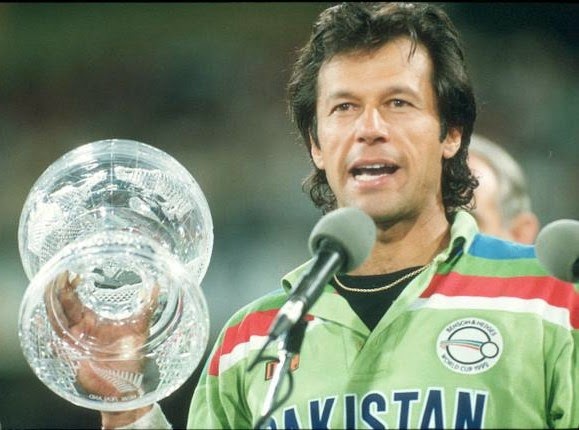
7.  Imran Khan (vice captain)
Runs 666,  Average 35.05,  Strike-rate 65.61,  HS 102*,  100s 1
Wickets 34,  Average 19.26,  RO 3.86,  Best 4/37
Catches 2

8.  Kapil Dev
Runs 669,  Average 37.16,  Strike-rate 115.14,  HS 175*,  100s 1,  50s 1
Wickets 28,  Average 31.85,  RO 3.76,  Best 5/43
Catches 12

9.  Wasim Akram
Runs 426,  Average 19.36,  Strike-rate 100.70,  HS 43
Wickets 55,  Average 23.83,  RO 4.04,  Best 5/28
Catches 8

10.  Shane Warne
Wickets 32,  Average 19.50,  RO 3.83,  Best 4/29
Catches 2

11.  Glenn McGrath
Wickets 71,  Average 18.19,  RO 3.96,  Best 7/15
Catches 5

12th Man  Lance Klusener
Runs 372,  Average 124.00,  Strike-rate 121.17,  HS 57,  50s 3
Wickets 22,  Average 22.13,  RO 4.82,  Best 5/21
Catches 2

Sunday, October 19, 2014

The Cricket World Cup - Dream Team…..6. Adam Gilchrist : Excerpt from ‘The Big Book of World Cup Cricket 1975-2011’ by Indra Vikram Singh

Adam Gilchrist
Greatest ever wicketkeeper-batsman?

Born  14.11.1971

BATTING (World Cups 1999-2007)
Matches.....31      
Innings.....31     
Not Out.....1   
Highest Score.....149      
Runs.....1085     
Average.....36.16      
Strike-rate.....98.01    
100s.....1   
50s.....8

WICKETKEEPING (World Cups 1999-2007)   
Catches.....45
Stumping.....7


Adam Gilchrist’s belligerence with the willow catapulted him to the opening slot in One-day Internationals. Coupled with his prowess with the gauntlets, the southpaw became a key element in the success of Australian teams for a decade. For an aggressive batsman, he was amazingly consistent batting down the order in Test matches. Considering that he kept wickets brilliantly to superlative pacemen and top-class leg-spinners, Gilchrist must arguably be the best wicketkeeper-batsman the game has ever seen. It is players like him that contribute to the making of great teams.

The 1999 World Cup was not particularly distinguished for him personally, but by his own lofty standards. He started badly, as did most openers in this event, and brought up his first fifty only in the fourth fixture. He slammed the hapless Bangladesh bowlers for 63 off a mere 39 balls, blitzing a dozen boundaries. Having already lost to New Zealand and Pakistan, it was absolutely essential for Australia to boost their run-rate. Gilchrist put up an opening stand of 98 off just 71 deliveries with Mark Waugh. That set the tone for later batsmen, Tom Moody hitting what was then the fastest World Cup half-century off 28 balls.

Gilchrist was unusually sedate as India were trounced in the first super-six match. He scored 31 off 52 balls with just one boundary as Mark Waugh outpaced him in a partnership of 97. Gilchrist emulated Greg Dyer’s 1987 feat of snapping up four catches, the only Australian wicketkeepers to do so in the World Cup at that point. It was only in the lop-sided final that Gilchrist hit up his second half-century. Set a meagre target of 133 by Pakistan, he raised 75 with Mark Waugh in 10.1 overs. Gilchrist brought up his fifty off 33 balls, fastest in a World Cup final. He was dismissed for 54 off 36 deliveries, having hit 8 fours and a six. Gilchrist’s role in the victorious campaign may not have been stellar, but it was useful under the circumstances.

Australia went from one peak to another after this triumph. Gilchrist also grew in stature, and by the 2003 World Cup, there was none to challenge either. He raised an opening stand of 100 with Matthew Hayden against India, scoring 48 off 61 balls with 6 boundaries. Facing a formidable Zimbabwean score of 246, Gilchrist and Hayden put on 89. Gilchrist went on to score 61 off 64 deliveries, having hit 8 fours.

He then caught a record six Namibian batsmen, the maximum dismissals in a World Cup match. It also equalled his own record for most dismissals in all One-day Internationals, which he shared with Alec Stewart and Ridley Jacobs. In the process he went past Moin Khan’s all-time tally of 257 dismissals in 182 matches. Gilchrist’s new high in One-day Internationals now stood at 259 dismissals, comprising 222 catches and 37 stumpings in 151 matches. In the next match he snapped up three catches as the English gave the champions a scare. He was careering along with the bat before he fell for 22 off 18 balls, having cracked five boundaries.

Gilchrist’s best innings came in the super-six encounter with Sri Lanka. After raising 75 with Hayden, he added 106 with skipper Ricky Ponting. They seized the initiative from the opposition, regaling the Centurion crowd with thunderous shots all over the park. Having smashed his way to fifty off 37 balls, Gilchrist seemed over-anxious to log up his first hundred in the World Cup. Sadly, he ran himself out for 99. He had taken only 88 deliveries to get there, having blasted 14 boundaries and 2 sixes. Gilchrist was at his aggressive best as he waded into the attack of dark horses Kenya. Once again with Hayden and Ponting for company, he slammed 67 in a 43-ball knock that comprised nine hits to the fence and three over it.

Gilchrist was going well in the semi-final when he swept hard at Aravinda de Silva’s second delivery. The ball lobbed up and wicketkeeper Kumar Sangakkara pouched it. Even as umpire Rudi Koertzen was turning down the vociferous appeal, Gilchrist walked away towards the pavilion. He had scored 22 off 20 balls, having hit 2 fours and a six. He was lauded for his sporting gesture. Off-spinner de Silva hailed him as “a gentleman”. Later, foreign exchange company Travelex – that was already sponsoring Gilchrist – appointed him non-executive director, rewarding him for his integrity.   

The final turned into Ponting’s match, but it was Gilchrist and Hayden who gave the initial impetus. They carted the Indian bowling all around before Gilchrist left in the 14th over. The score was already 105 by then. His 57 came off just 48 deliveries and contained 8 fours and a six. He had scored half-centuries in both his World Cup finals, which were hugely skewed in Australia’s favour.  

As expected the Scots hardly provided any opposition in their opening encounter in 2007. Just as expected, Gilchrist and Hayden raised 91 in 17 overs first up. Gilchrist fired 7 boundaries in his 55-ball 46. The consequence was a knockout by more than 200 runs. It was not much different with the Dutch. The opening stand this time was 73 in 11.5 overs. Gilchrist got to his fifty off 53 deliveries, and was dismissed for 57, having crashed 11 fours.

Hayden was on fire in their first hot contest of the tournament, blazing to the fastest hundred ever in the World Cup. Gilchrist was not too cold either, and the end result was a 106-run partnership in 14.5 overs. Gilchrist fell for a run-a-ball 42 with 6 hits to the ropes and a six over long-leg off Charl Langeveldt. Australia piled up their highest total in the showpiece event which shut the Proteas out of the match.

In the opening game of the Super-Eights, Australia took on hosts West Indies. Gilchrist, though, departed early even as Hayden hit up 158, which set up a win by over 100 runs. Bangladesh were brushed aside. Gilchrist and Hayden raised the same number of runs as in the match against South Africa - 106, but in an over less - 13.5. This brought up a ten-wicket win. Gilchrist was unbeaten with 59 off 44 deliveries, having hit 8 boundaries and a six. England set up a target of 248. This time the Aussie openers posted 57 in 11 overs before Gilchrist was dismissed for 57. It was another easy triumph by seven wickets.

Ireland were bowled out for 91. Gilchrist’s opening partner on this occasion was Michael Hussey, as the middle-order were short of match practice. There was another half-century stand, 62 in 8.5 overs. Gilchrist departed for 34, having faced 25 balls and crashed 4 boundaries. It was an easy nine-wicket triumph.    No team was able to provide serious opposition to the Australians. The next best side Sri Lanka was also bowled out for 226. Hayden was back in tandem with Gilchrist, and now the two hoisted 76 in 11.5 overs. They fell in quick succession, the great wicketkeeper for 30, and the batsmen who followed brought up a seven-wicket victory. As Hayden and the others went about flaying the New Zealand attack, Gilchrist was dismissed cheaply, but the outcome was a massive win by more than 200 runs.   

The unbeaten Aussies faced South Africa in the second semi-final. The Proteas were shot out for 149, Gilchrist snapping up four catches off the pacemen. He lost his wicket early again, but that was the only real hiccup in the seven-wicket triumph. So far Gilchrist had performed well, scoring two half-centuries and a few cameos at his usual rapid pace, but had not dazzled.

Then, cometh the hour, cometh the man. Gilchrist made the final his own. Rain ensured that the match would not start before 15 minutes past noon, and curtailed to 38 overs-a-side. The start was deceptive with 2 runs coming off two overs. Then the pyrotechnics began. Gilchrist hit Chaminda Vaas for a four and a six. Still there was no hint of the carnage to follow. The odd boundary was coming, but in the 11th over Gilchrist slammed Dilhara Fernando for 2 fours and a six. He reached his fifty off 43 balls and then launched into Tillakaratne Dilshan, tonking him twice straight and over the ropes. He welcomed Fernando back with a six and a four. On 64 he reached 1000 runs in the World Cup. The belligerent left-hander did not spare the great Muralitharan either, sweeping him deep into the stands. Hayden welcomed Lasith Malinga back with a six over long-off, and two ball later Gilchrist, on 96, banged it to the long-off boundary. The hundred had come off 72 deliveries, the second fifty in 29. He had hit 8 fours and 6 sixes thus far.

To celebrate, Gilchrist crashed two boundaries each off consecutive overs from Vaas and Malinga. Just then Mahela Jayawardene pulled off a brilliant catch in the covers to send back Hayden. The burly opener had scored 38 off 55 deliveries in a partnership of 172. Gilchrist was on 119 off 83 balls. After a quiet period Gilchrist smashed Sanath Jayasuriya for 2 sixes and a four off successive overs. When Fernando returned, Gilchrist finally top-edged one to mid-wicket. He had blitzed 149 off 104 deliveries, regaling the crowd with 13 fours and 8 sixes. It was the highest score in a World Cup final, surpassing Ricky Ponting’s 140 in 2003. It was also the top score by a wicketkeeper, overhauling Rahul Dravid’s 145 in 1999. Australia finished on 281 for four off their allocated 38 overs. Surely, Gilchrist had already won the final off his own bat. He was not finished yet, though. In the third over he snapped up Upul Tharanga off Nathan Bracken to complete 50 dismissals in the premier event. There were two more dismissals to his name before the match ended in a last minute drama marked by umpiring gaffes. No other wicketkeeper has more than 32 dismissals. The Duckworth-Lewis method gave the game to Australia by 53 runs. The final had only one hero.
        
Gilchrist already has all the wicketkeeping records in the World Cup: most dismissals, most catches, most stumpings jointly with Moin Khan, most catches and dismissals in a match, most dismissals in a World Cup in 2003, also the most dismissals in 2007, highest score by a wicketkeeper, the lone wicketkeeper to score a hundred and effect three dismissals in a match, highest run-aggregate among wicketkeepers, and a brilliant strike-rate of more than 98 runs per 100 balls. It is a long list. Australia won all the World Cups Gilchrist played, and he made a stellar contribution in this singular achievement.

His closest competitor in terms of statistics Mark Boucher (521) has overtaken Gilchrist (416) in terms of dismissals in Test matches but has already played 43 games more. Boucher is 50 dismissals behind Gilchrist (472) in One-day Internationals but has already played five more matches. In terms of batting, Gilchrist scored 5570 runs in 96 Tests at an average of 47.60 and strike-rate of 81.95, while Boucher has 5312 runs in 139 Tests at an average of 30.70 and strike-rate of 50.13. Gilchrist has 17 hundreds to Boucher’s five. In 287 One-day Internationals, Gilchrist scored 9619 runs at an average of 35.89 and strike-rate of 96.94, while Boucher has scored 4664 runs in 292 One-day Internationals at an average of 28.79 and strike-rate of 84.72. Gilchrist has 16 hundreds to Boucher’s solitary ton. Is Adam Gilchrist, then, the Bradman or Sobers among wicket-keepers?

(Author Indra Vikram Singh can be contacted on email singh_iv@hotmail.com).

The Big Book of World Cup Cricket 1975-2011

ISBN 978-81-901668-4-3

Distributed in India by Variety Book Depot, Connaught Place, New Delhi, Phones + 91 11 23417175, 23412567.

Available in leading bookshops, and online on several websites.

Saturday, April 12, 2014

A tragic ICC World Cup 2007 that was not fair to the merry Caribbean people : Excerpt from ‘The Big Book of World Cup Cricket 1975-2011’ by Indra Vikram Singh


The World Cup came a full circle in 2007 when the West Indies had the honour of staging it. It should have been a watershed for West Indies cricket, which languished in the nineties after the magnificent Lloyd-Richards era of the seventies and eighties, and indeed the earlier glorious days of Constantine, Headley, the three Ws - Worrell, Weekes and Walcott, and the peerless Sobers. Not only did the supply line of world-class players dry up either side of the turn of the century, West Indies cricket in general went into decline. There seemed to be complacency, financial constraints were a bane, pitches turned into lifeless sandpits and the team depended on the performances of three or four stars. Not surprisingly, West Indies failed to reach a World Cup final after 1983, coming close to it only in 1996. The dreadful slump must have hurt.

But there were clear signs of a turnaround. With a streamlined administration, Brian Lara regaining his magical touch, a batting line-up at par with the best in the world, promising young bowlers beginning to emerge and wickets showing signs of life, West Indies cricket appeared to be on the high road towards re-scaling the pinnacles of yore. It would have been a fair reward for the most enthusiastic and joyous crowd in world cricket. Through the days of ignominy, it had been the delightful crowds at the West Indies grounds that kept their cricket going. They deserved a feast and were dearly wishing that their team would provide the dessert. Lara would certainly have been yearning for a triumphant theme to his swansong, a high note in the evening of a glittering career.

In the words of the ICC, the logo of the 2007 World Cup “expresses the joy and exuberance of cricketers and cricket fans worldwide, in a Caribbean setting. The vibrant red figure central to the logo captures the exuberant energy of dance and celebration. The colour red represents the passion that the fans both in the West Indies and the world have for the game of cricket. The positioning of the bat and ball are figurative elements of the palm tree forming the trunk and fruit. The vibrant green of the crown of the palm tree, and the azure blue which stands for the surrounding sky and seas are the backdrop in which the prestigious tournament will take place.”

The mascot of the 2007 World Cup was a teenage character called ‘Mello’, who embodied the lifestyle of the region, ‘cheeky and curious and socially aware like so many young people today.’

Hero Honda and Hutch joined LG Electronics and Pepsi as global partners of the ICC. The telecommunications behemoth, Cable & Wireless, long associated with West Indies cricket, was the principal telecom provider to the event, and an official sponsor alongside Indian Oil and Scotiabank.

The prize money remained static at $5 million, but the teams took home larger amounts. The champions were awarded $2.24 million, while the runners-up received $1 million. The losing semi-finalists got $45,000 each, while the teams that finished fifth to eighth were awarded $200,000, $150,000, $100,000 and $50,000 respectively. In the group matches, the winning teams took away $10,000 and the losing teams a consolation of $5,000. The player-of-the-tournament prize was a diamond-studded cricket ball crafted at Kolkata, worth Rupees 30,00,000 ($60,000), won appropriately by Glenn McGrath.

 The ICC’s Venue Assessment Team, using the most stringent standards, chose eight venues: Antigua & Barbuda, Barbados, Grenada, Guyana, Jamaica I, St. Kitts & Nevis, St. Lucia, and Trinidad & Tobago. Capacity in all the grounds, except St. Kitts, was enhanced to seat at least 20,000 spectators. Jamaica, headquarters of the ICC World Cup 2007 Inc., had the privilege of staging the opening ceremony and opening match, as well as the first semi-final. All preliminary round matches in Group D were played here at the Sabina Park in the capital city, Kingston. The second semi-final was held in St. Lucia at the state-of-the-art Beausejour Stadium in the resort town of Gros Islet. The preliminary round matches in Group C were staged at this venue.

Kensington Oval, dubbed fondly as The Mecca by the locals, at Bridgetown, the capital of Barbados, was chosen to host the final, and also six super-eight matches. Home to the Pickwick Cricket Club since 1882, the ground has hosted international fixtures since 1895, including the first Test match played in the West Indies in 1930 against England. A new stadium came up here to hold 31,000 spectators, more than doubling its earlier capacity of 15,000.

Group A teams battled in out in the refurbished Warner Park at Basseterre, the capital of St. Kitts & Nevis, where the capacity is just 10,000. The preliminary round matches of Group B were played at the Queen’s Park Oval, Port of Spain in Trinidad & Tobago. Even though hitherto it had the largest seating capacity in the Caribbean, a new stadium was built here too, capable of holding 25,000 people.

The other three venues staged only super-eight games. The brand new Queen’s Park Stadium at St. George’s, the capital of Grenada, was one of these arenas. Sadly, the Antigua Recreation Ground, headquarters of the West Indies Cricket Board, and where Brian Lara twice broke the record for the highest Test score, did not see World Cup action as a result. The Antigua & Barbuda government ordered a new stadium named after the legendary Sir Vivian Richards, which was built at North Sound, outside its capital St. John’s. Interestingly, China paid $23 million to construct this facility.

A new stadium was also built in Guyana at Providence, near the capital Georgetown to replace the Bourda Oval. The Government of India provided assistance, the cost of $25 million being met through a $6 million grant and an Exim Bank loan on concessional terms.    

Bermuda, Jamaica II, St. Vincent & Grenadines, and the United States of America were the four venues that lost out. There was much talk about staging four matches in the United States, one of which would have been in Disney World, Florida. Though the United States finished sixth and last in the ICC Trophy 2005, they would have gained automatic entry as co-hosts of the 2007 World Cup. That would have given tremendous fillip to the game in that country. America has a longer history of cricket than is generally believed. The game was introduced there in the early 18th century by the British, and John Adams, one of the founding fathers of the nation, was also one of its first cricketers. The first-ever international cricket match was held between the United States and Canada in 1844 at the St. George’s Cricket Club Ground in Bloomingdale Park, New York. The US team beat the West Indies on January 5, 1888, and more recently won the American Championships in 2002, during which they beat Canada by three wickets. There are 10,000 players representing 500 clubs in 29 leagues across New York, California - which has four turf wickets - Florida, Chicago, Texas and New Jersey. Ultimately the strict security measures that would have been enforced for entry into the United States, following the 9/11 attacks, deterred the ICC from staging matches there. Cricket will have to wait awhile before it gains a foothold in the richest market in the world.

The eleven teams with One-day International status were seeded according to their rankings in the ICC table as on 1 April 2005. Five other qualifiers came in, based on their performances in the ICC Trophy held in Ireland in July 2005. The winners of that tournament, Scotland, and fifth-placed Holland joined Australia and South Africa in Group A. Bermuda, fourth in the ICC Trophy, were put alongside Sri Lanka, India and Bangladesh in Group B. The third qualifiers Canada were placed with New Zealand, England and Kenya in Group C, while runners-up Ireland found themselves in Group D along with Pakistan, West Indies and Zimbabwe. The ICC spent up to $500,000 on each of the five qualifiers to prepare for the World Cup and development of cricket in these associate member countries. The groups and seedings were as under:
Group A at St. Kitts : Australia (1), South Africa (5), Scotland (12), Holland (16).
Group B at Trinidad : Sri Lanka (2), India (8), Bangladesh (11), Bermuda (15).
Group C at St. Lucia : New Zealand (3), England (7), Kenya (10), Canada (14).
Group D at Jamaica : Pakistan (4), West Indies (6), Zimbabwe (9), Ireland (13).

There were exciting possibilities. Despite setbacks like the players’ endorsements controversy, the tournament was believed to be the turbo that West Indies cricket needed to re-charge itself. The event was televised in 200 countries to an estimated viewership of two billion. The World Cup had come a long way since that day in 1975 when all the top cricketers of the world assembled at Buckingham Palace to meet the Queen. One could almost see the calypso kings swaying in anticipation.

What actually happened was not only stunning and entirely unexpected but turned this into the most tragic World Cup of all. First the brand new stadiums with every modern facility at hand, but many located miles out of the way were too inaccessible for the local populace. Their very character was so distinct from the homely Caribbean party venues that the old stadiums were. To make matters worse the high ticket prices were a huge deterrent to the average West Indian fan, along with stifling security that prohibited them from bringing in not only their own food and placards but also musical instruments that are an integral part of joyous Caribbean cricket. It was avaricious and officious administration at its worst, and it came as no surprise that the officials were roundly booed at the closing ceremony. There were sparse crowds at all the grounds. They reached a nadir at the Warner Park, Basseterre, St. Kitts where less than 1,500 people saw Herschelle Gibbs hit 6 sixes in an over. Only in five of the 24 group matches did the crowd exceed 10,000, the highest being in the opening clash between the hosts and Pakistan at Sabina Park in Kingston, and the India-Sri Lanka encounter at Queens Park Oval, Port of Spain, when the figure exceeded 16,000. The average attendance in the group matches was less than 7,000.

There was an improvement from the super-eight stage onwards, and even though restrictions were eased, there was never a capacity crowd. The largest assembly was at Brian Lara’s farewell game, the last super-eight face-off with England at the famous Kensington Oval at Bridgetown, when 22,452 fans arrived. The next highest was in the final, the official attendance figure being 20,108, again at Kensington Oval, which has a capacity of 31,000. The average attendance figure through the super-eight to the final was just over 10,000. Still, the gate receipts were double that of the previous World Cup at $32 million. The moot point was whether the same, or better, result could have been achieved with lower ticket prices but much larger crowds.      

The format of the tournament was changed, bringing in two more teams, making a total of 16 participants. There were, therefore, four groups of four teams each, with the top two in each group advancing to a super-eight league. This brought its own set of problems. There were far too many matches against and between the weaker sides. Of the 24 group matches, there were obviously only four games, one in each group, contested between the top eight teams. One upset was likely to topple the applecart, which it did in two groups and sent India and Pakistan crashing out of the tournament after playing only three matches each. This not only took away huge numbers of television viewers but also necessitated half the 24 super-eight matches involving unfancied outfits like Bangladesh and first-timers Ireland.

The shock defeat of Pakistan at the hands of Ireland also had a horrible fallout. The next morning their coach Bob Woolmer was found dead in his hotel bathroom. Then followed one of the most bizarre and sorrowful episodes in the history of sport. All kinds of conjectures and insinuations flew about. Crack sleuths were brought in, inquests were held, there were murder theories, stories about the betting mafia and deranged fans did the rounds, the needle of suspicion was even pointed at the players. The whole tournament was vitiated, and the sordid saga dragged on for months after. Ultimately it was concluded that the genial man had died of natural causes. In all probability, stress got the better of him; the intense scrutiny and censure must have been too much to endure.    

There was a lot of splendid cricket played during the tournament but Woolmer’s death cast a dark shadow over everything else. Australia marched on relentlessly. Such was their dominance that they never lost more than six wickets in a match, and a couple of their tailenders did not get a chance to bat at all. On the other hand, they bowled out their opponents every time except in two matches, in one of which they prised out six wickets in a 22-over innings, and in the other captured eight wickets in the 36-over Sri Lankan knock in the final. It was awesome cricket. Australia were not clear favourites this time, but they won all their matches for the second World Cup in a row, wresting their third successive title, and appearing in their fourth consecutive final. By doing so, they surpassed Clive Lloyd’s great West Indies side and set near-impossible benchmarks for other teams to emulate.

Just as everyone was heaving a sigh of relief when the rain-interrupted, truncated final was drawing to a close, the light was offered to the Sri Lankan batsmen after 33 overs, and everyone trudged off. The Australians had begun to celebrate and preparations for the presentation had started. But hullo, what’s this? The umpires Aleem Dar and Steve Bucknor decreed that the match was not over and that everyone would need to come back on the morrow to complete the remaining three overs, even though the minimum 20 overs had been bowled. It was amazing that neither the match referee Jeff Crowe nor the reserve umpires Rudi Koertzen and Billy Bowden prevailed on the on-field umpires to end a match that was already over. Ultimately it took a gentlemen’s agreement between the two captains Ricky Ponting and Mahela Jayawardene to end the impasse. The Sri Lankan skipper sent out his batsmen in near darkness and the Australian chief put on his slow bowlers to conclude the farce. Never before had the final of a sporting event of this magnitude ended in such embarrassing circumstances. That the five match officials were suspended for the next ICC event, the Twenty20 World Championship later that year, was hardly of concern to billions of disgusted fans around the world.     

It might be uncharitable, but quite often the word used for this tournament was ‘fiasco’, even though there were lots of stirring deeds with bat and ball. Indeed, off-field events overtook the exciting action in the brand new stadiums of the exotic Caribbean islands. Not since the 1972 Olympics at Munich had a sadder sporting international event been staged. It was time for cricket to make a new beginning.

The final:
Kensington Oval, Bridgetown, Barbados, 28 April 2007
Australia won by 53 runs (D/L method)
Australia: 281 for 4 wickets in 38 overs (Adam Gilchrist 149, Matthew Hayden 38, Ricky Ponting 37)                                                  
Sri Lanka: 215 for 8 wickets in 36 overs (Sanath Jayasuriya 63, Kumar Sangakkara 54)
Man of the Match : Adam Gilchrist
Player of the Tournament : Glenn McGrath

(Author Indra Vikram Singh can be contacted on email singh_iv@hotmail.com).

The Big Book of World Cup Cricket 1975-2011

ISBN 978-81-901668-4-3

Distributed in India by Variety Book Depot, Connaught Place, New Delhi, Phones + 91 11 23417175, 23412567

Available in leading bookshops, and online on several websites.