Showing posts with label Shaun Pollock. Show all posts

Thursday, April 18, 2024

Ben Stokes has accorded top priority to Test cricket; bids fair to be ranked among the finest batting allrounders

Ben Stokes is set to emulate Gary Sobers, the king of allrounders,  in terms of Test runs and wickets.

It is commendable that Ben Stokes has given top priority to Test cricket. He skipped the Indian Premier League (IPL) 2024 and has made himself unavailable for the World T20 in order to be fresh for Test cricket. More particularly, he wants to be fit to bowl regularly and fulfil his role as allrounder. As one of the leading cricket personalities of the time, he has, in no uncertain terms, declared that Test cricket is the ultimate form of the game and deserves all the respect.

Firmly at the helm of the England Test team, and with another belligerent personality, coach Brendon McCullum, by his side, Stokes appears set to pen the next exhilarating chapter in his saga.

Gary Sobers is the king of allrounders. Jacques Kallis with his fabulous record is not far behind. Imran Khan and Keith Miller would come next in the hierarchy. In simple terms, an allrounder can be defined as one whose batting average is higher than his bowling average. A good allrounder’s quotient, that is, batting average divided by bowling average should be above 1, or in the positive.

Ideally, an allrounder’s batting average should be above 30, and bowling average below 30. Taking a minimum of 2,000 runs and 100 wickets, there have been only 18 allrounders with a quotient of more than 1 in the 147-year history of Test cricket.  Monty Noble missed the distinction by just three runs, having scored 1,997 runs at an average of 30.25, and taken 121 wickets at 25.00 apiece in his 42 Tests, for a quotient of 1.21.

Wilfred Rhodes, whose Test career spanned a huge period of 31 years between 1899 and 1930, was the pioneer. He scored 2,325 runs at an average of 30.19, and bagged 127 wickets at 26.96 each in 58 Tests, ending with a quotient of 1.11.

Sobers is at the top of the league with a quotient of 1.697; Kallis is right on his heels with 1.695. Imran ranks third at 1.65, with Miller close behind at 1.60. Ravindra Jadeja, who is still playing, has a quotient of 1.49.

When he hung up his boots in 1974, Sobers held the record for the highest score (365 not out) and aggregate (8,032 runs), and centuries second in number (26) to Bradman, in his 93 Test matches, and was the first to hit 6 sixes in an over in First-class cricket. One of the greatest batsmen, with a repertoire of bowling none has been able to match (235 wickets), and a brilliant fielder, Sobers remains peerless.

Kallis was one for the long distance, amassing 13,289 runs with 45 hundreds and picking up 292 wickets in 166 Test matches.

Sobers (57.78) and Kallis (55.37) are the only allrounders to average in the fifties with the bat.

Among top allrounders, the only three to average below 23 with the ball are Richard Hadlee 22.29 (431 wickets in 86 Tests), Imran 22.81 (362 wickets in 88 Tests) and Miller 22.97 (170 wickets in 55 Tests).

Ben Stokes is one of just five top allrounders to score above 5,000 Test runs

Just five allrounders have scored above 5,000 runs, Kallis, Sobers, Kapil Dev (5,248 runs, 31.05 average, 131 Tests) Ben Stokes (6,316 runs, 35.48 average, 102 Tests), and Ian Botham (5,200 runs, 33.54 average, 102 Tests).

Similarly, only six allrounders have captured 300 wickets and more, Ravichandran Ashwin (516 wickets, 23.75 average, 100 Tests), Kapil Dev (434 wickets, 29.64 average, 131 Tests), Hadlee (431 wickets, 22.29 average, 86 Tests), Shaun Pollock (421 wickets, 23.11 average, 108 Tests), Botham (383 wickets, 28.40 average, 102 Tests), and Imran (362 wickets, 22.81 average, 88 Tests). Ravindra Jadeja is ready to creep into this list (294 wickets, 24.13 average, 72 Tests). Incidentally, these are the only seven allrounders to score 3,000 runs as well.

From the above figures, it is clear who the top allrounders have been in Test history. The aggressive, hard-hitting Stokes has made his mark as a batting allrounder. His bowling has lagged behind. Injuries have taken their toll. But he is on the verge of 200 wickets. After 102 Tests, he has 198 wickets for an average of 31.99, and a quotient of 1.109. When he reaches the milestone, he will be only the third to score 6,000 runs and capture 200 wickets after Sobers and Kallis. With the bat, Stokes is a match-winner, capable of turning around a game at any time, with a fierce desire to win.

Present-day cricket is fortunate to have several fine allrounders, like in the 1970s, 1980s and early 1990s, though they do not get the same credit.

In addition to Stokes, there are four other allrounders putting in sterling performances this generation. In chronological order, they are Shakib Al Hasan (67 Tests, 4,505 runs at 38.83 average, 237 wickets at 31.16 average, 1.24 quotient), Ashwin (100 Tests, 3,309 runs at 26.26 average, 516 wickets at 23.75 average, 1.105 quotient), Jadeja (72 Tests, 3,036 runs at 36.14 average, 294 wickets at 24.13 average, 1.49 quotient), and Jason Holder (64 Tests, 2797 runs at 29.44 average, 157 wickets at 29.21 average, 1.00 quotient).

Will Stokes become the first to score 8,000 runs and bag 300 wickets in his Test career? Time will tell, but his attitude and determination certainly indicate that he will.

Saturday, April 20, 2019

Road to the cricket World Cup 2019. Heart-stopping tie. Excerpt from Indra Vikram Singh’s book ‘The Big Book of World Cup Cricket 1975-2011’

AUSTRALIA v SOUTH AFRICA (SEMI-FINAL) 
EDGBASTON, BIRMINGHAM, 17 JUNE 1999


Just four days earlier the two teams had fought a high-scoring cliffhanger. Australia had advanced to the semi-final with just two balls to spare. It was clear that not much separated these sides. Excitement was running high as they clashed again at Edgbaston. Yet none could have imagined that the match would end the way it did.

Pacemen Shaun Pollock and Allan Donald were in devastating form. Pollock made a delivery jump, and Mark Waugh gloved it to Mark Boucher. Adam Gilchrist and Ricky Ponting put on 51 but South Africa struck back. Three wickets fell for 14 runs, and at 68 for four in the 17th over, Australia were looking down the barrel.

That man Steve Waugh fought another valiant battle. He put on 90 for the fifth wicket with Michael Bevan. Waugh was caught by Boucher, trying to glide the ball to third-man. He scored 56 off 76 balls with a six and 6 fours. Thereafter only Shane Warne offered resistance. Bevan was last out in the final over for 65. Pollock took five for 36 off 9.2 overs, while Donald bagged four for 32 off 10 overs. They shot out Australia for 213.

Gary Kirsten and Herschelle Gibbs put on 48 before an inspired Warne struck. He beat Gibbs in the air and bowled him. Kirsten tried to heave him and was also bowled. Warne beat Hansie Cronje second ball with a vicious turner. David Shepherd declared him caught at slip by Mark Waugh. The ball had apparently missed the bat. Misfortune struck again as Daryll Cullinan was run out. South Africa were 61 for four off 21.2 overs.

Jacques Kallis and Jonty Rhodes put on 84 for the fifth wicket. Kallis scored a resilient half-century before falling to Warne. Pollock hit 20 off 14 deliveries. But wickets kept falling while the irrepressible Lance Klusener blazed away at the other end. Boucher and Steve Elworthy departed in quick succession. The score then was 198 for nine after 48.4 overs, with 16 runs required off 8 balls. Klusener swung Glenn McGrath high towards long-on. Paul Reiffel on the boundary jumped to catch the ball, but palmed it over the ropes. Klusener then scrambled a single to retain the strike for the final over.  

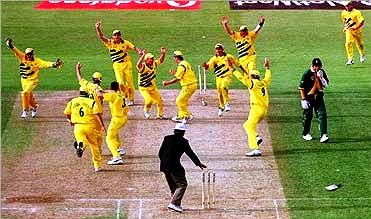
There were now 9 runs needed. Klusener smashed Damien Fleming for boundaries off the first two balls. Just one run was required off 4 deliveries with Klusener still on strike. Steve Waugh brought in all his fielders. Donald at the other end seemed jittery. He was nearly run out off the third ball. Klusener played the next ball towards Mark Waugh in the covers and ran. Donald was confused. He stayed put, then ran, dropping his bat in the process. Mark Waugh back-handed the ball towards the stumps at the bowler's end where both the batsmen were stranded. Fleming then rolled the ball to Ian Healy, and Donald was beaten by yards.

It was a tie, the first in the World Cup. Australia advanced to the final, having beaten South Africa by a whisker in the previous match. A relieved Shane Warne exclaimed: "We just got out of jail at the end. I don't know how we did it. It was just a great game of cricket." Sometimes the difference between triumph and tragedy can be very slender indeed.

Australia        : 213 all out (49.2 overs)
South Africa : 213 all out (49.4 overs)

(Author Indra Vikram Singh can be contacted on email singh_iv@hotmail.com).

Follow his blogs:

Indra Vikram Singh’s books are available at attractive prices on Amazon:

The Big Book of World Cup Cricket 1975-2011
Published in India by Sporting Links
ISBN 978-81-901668-4-3


Crowning Glory
Published by Sporting Links
ISBN 978-81-901668-6-7


Don’s Century
Published in India by Sporting Links
ISBN 978-81-901668-5-0


A Maharaja’s Turf
Published in India by Sporting Links
ISBN 978-81-901668-3-6


Indra Vikram Singh’s forthcoming books:

Indian Spring, on India’s triumph in the cricket World Cup 2011


Wonder Down Under, special souvenir on the cricket World Cup 2015

Tuesday, April 9, 2019

Road to the cricket World Cup 2019. Lara's theme halts South African juggernaut. Excerpt from Indra Vikram Singh’s book ‘The Big Book of World Cup Cricket 1975-2011’

South v West Indies (Quarter-final)
National Stadium, Karachi  •  11 March 1996


Brian Lara did not always relish the slow wickets of the sub-continent. With a penchant for playing even spinners on the rise, he was rarely happy with the ball not coming on to the bat. And here was a pitch which offered turn and also bounce. The opponents, South Africa, were in prime form, having won ten consecutive matches, including five in a row in the round-robin stage of the present competition. But when Lara was in good nick, little else mattered.

He came in at 42 for one off just six overs, and took charge rightaway. Using his wrists in inimitable fashion, Lara cut and flicked the pacemen. When the spinners came on he used his feet, and also employed the sweep to good effect. He raced to his fifty off just 45 deliveries, and then clouted Pat Symcox for 22 runs in an over, including five boundaries, four of them off successive balls. These were glimpses of the Lara of 1994, who broke the records for the highest individual scores in Tests as well as first-class cricket. Since then his career was chequered for a few years until he shifted into overdrive. On this day he was at his effervescent best.

The South Africans are usually an efficient, professional side. But they found themselves helpless when faced with the awesome talent of Lara in such brilliant touch. The seam of Shaun Pollock, Craig Matthews, Brian McMillan and Hansie Cronje came to him as easy as the contrasting spin of Pat Symcox and Paul Adams. In this mood no bowler troubled him as he toyed with all that was hurled at him, in his cavalier style. Being slight of build, not for him were shots of power. Rarely did he loft the ball. He wielded his bat with the deftness of touch of a born artist. Some of the strokes were patently his own - playing late, waiting for the ball to do what it had to off the pitch, and then guiding it with extremely skillful wrists. Unlike Mohammad Azharuddin, who used his wrists to flick the ball towards the on-side, Lara's wristwork enabled him to place the ball with a lightness of touch on the off-side as well. Hardly ever did you hear the thump of the ball against Lara's bat. He seemed to merely caress it most of the time.

In the company of Shivnaraine Chanderpaul, Lara added 138 runs for the second wicket in just under 25 overs. By then the West Indies had reached 180 in 30.5 overs, and poised for a total of 300. Lara cruised on, reaching his first World Cup century off 83 deliveries in his 13th match, having hit five half-centuries earlier. This was the second-quickest in the event, taking one ball more than Clive Lloyd's hundred in the 1975 final. Lara proceeded to notch up 111 runs off just 94 balls with 16 hits to the fence. With this he lifted his average in the premier event to over 50. After his departure the West Indies innings lost momentum somewhat, but Lara had already ensured that his side's total would be enough to get them into the semi-finals. "The difference was Lara", rued Cronje.

Not for nothing was Lara considered a temperamental genius. When in form there was no sight quite like him in international cricket. It is also a fact that in the four years prior to this tournament - and after - the West Indies relied almost exclusively on Lara, Richie Richardson and Chanderpaul to get the runs. And so was it in their last three matches, in which they performed so well, in the 1996 tournament. Perhaps Lara felt uninspired in a lacklustre team. Whatever it was, innings like the one at Karachi were few and often far between during that phase from this immensely gifted player.

West Indies  264 for eight wickets (50 overs)
South Africa  245 all out (49.3 overs)

(Author Indra Vikram Singh can be contacted on email singh_iv@hotmail.com).

Follow his blogs:

Indra Vikram Singh’s books are available at attractive prices on Amazon:

The Big Book of World Cup Cricket 1975-2011
Published in India by Sporting Links
ISBN 978-81-901668-4-3


Crowning Glory
Published by Sporting Links
ISBN 978-81-901668-6-7


Don’s Century
Published in India by Sporting Links
ISBN 978-81-901668-5-0


A Maharaja’s Turf
Published in India by Sporting Links
ISBN 978-81-901668-3-6


Indra Vikram Singh’s forthcoming books:

Indian Spring, on India’s triumph in the cricket World Cup 2011

Wonder Down Under, special souvenir on the cricket World Cup 2015

Saturday, June 7, 2014

The Cricket World Cup - Classic Matches…..7 : Excerpt from ‘The Big Book of World Cup Cricket 1975-2011’ by Indra Vikram Singh

HEART-STOPPING TIE

Australia v South Africa (Semi-Final)  •  
Edgbaston, Birmingham, 17 June 1999


Just four days earlier the two teams had fought a high-scoring cliffhanger. Australia had advanced to the semi-final with just two balls to spare. It was clear that not much separated these sides. Excitement was running high as they clashed again at Edgbaston. Yet none could have imagined that the match would end the way it did. 

Pacemen Shaun Pollock and Allan Donald were in devastating form. Pollock made a delivery jump, and Mark Waugh gloved it to Mark Boucher. Adam Gilchrist and Ricky Ponting put on 51 but South Africa struck back. Three wickets fell for 14 runs, and at 68 for four in the 17th over, Australia were looking down the barrel.

That man Steve Waugh fought another valiant battle. He put on 90 for the fifth wicket with Michael Bevan. Waugh was caught by Boucher, trying to glide the ball to third-man. He scored 56 off 76 balls with a six and 6 fours. Thereafter only Shane Warne offered resistance. Bevan was last out in the final over for 65. Pollock took five for 36 off 9.2 overs, while Donald bagged four for 32 off 10 overs. They shot out Australia for 213.

Gary Kirsten and Herschelle Gibbs put on 48 before an inspired Warne struck. He beat Gibbs in the air and bowled him. Kirsten tried to heave him and was also bowled. Warne beat Hansie Cronje second ball with a vicious turner. David Shepherd declared him caught at slip by Mark Waugh. The ball had apparently missed the bat. Misfortune struck again as Daryll Cullinan was run out. South Africa were 61 for four off 21.2 overs.

Jacques Kallis and Jonty Rhodes put on 84 for the fifth wicket. Kallis scored a resilient half-century before falling to Warne. Pollock hit 20 off 14 deliveries. But wickets kept falling while the irrepressible Lance Klusener blazed away at the other end. Boucher and Steve Elworthy departed in quick succession. The score then was 198 for nine after 48.4 overs, with 16 runs required off 8 balls. Klusener swung Glenn McGrath high towards long-on. Paul Reiffel on the boundary jumped to catch the ball, but palmed it over the ropes. Klusener then scrambled a single to retain the strike for the final over.

There were now 9 runs needed. Klusener smashed Damien Fleming for boundaries off the first two balls. Just one run was required off 4 deliveries with Klusener still on strike. Steve Waugh brought in all his fielders. Donald at the other end seemed jittery. He was nearly run out off the third ball. Klusener played the next ball towards Mark Waugh in the covers and ran. Donald was confused. He stayed put, then ran, dropping his bat in the process. Mark Waugh back-handed the ball towards the stumps at the bowler's end where both the batsmen were standed. Fleming then rolled the ball to Ian Healy, and Donald was beaten by yards.

It was a tie, the first in the World Cup. Australia advanced to the final, having beaten South Africa by a whisker in the previous match. A relieved Shane Warne exclaimed: "We just got out of jail at the end. I don't know how we did it. It was just a great game of cricket." Sometimes the difference between triumph and tragedy can be very slender indeed.

Australia        : 213 all out (49.2 overs)
South Africa : 213 all out (49.4 overs)

(Author Indra Vikram Singh can be contacted on email singh_iv@hotmail.com).

The Big Book of World Cup Cricket 1975-2011

ISBN 978-81-901668-4-3

Distributed in India by Variety Book Depot, Connaught Place, New Delhi, Phones + 91 11 23417175, 23412567

Available in leading bookshops, and online on several websites.