Showing posts with label Cricket World Cup 1999. Show all posts

Tuesday, April 13, 2021

Steve Waugh, legendary warrior. Excerpt from Indra Vikram Singh’s book ‘Don’s Century’


Steve Waugh was different; cool of mind and stout of spirit, he was a fighter to the core. He left arguably the biggest impact on the game in Australia since Bradman. His predecessor Allan Border was also a gritty batsman, and became the highest run-getter in Test cricket. But Border would grind the opposition, rather than dominate them, and the one feature that characterised his batting was his propensity to sweep. When the chips were down Border would be an immovable object for the opposition, but there was nothing endearing about him.

That was not the case with Steve Waugh. He was forever proving his critics wrong through sheer strength of character. His twin Mark was far more talented with the bat as well as a fielder, and more elegant by miles. But it was Steve who first broke into the Australian team and stayed in longer. He played a key role in Australia’s first World Cup triumph in 1987 as a bowler sans nerves, and a lower middle-order batsman with an abundance of commonsense. His stock as a batsman continued to rise, and he became a reliable rungetter by the late eighties.

It was under Border’s captaincy, and with the guiding hand of Bobby Simpson, that Australia won the 1987 World Cup, but try as he might he could not turn Australia into the best in the world in either form of the game. That changed when the more genial and composed Mark Taylor took over. Steve Waugh, helped by twin Mark, stood up to the West Indies pacemen in a titanic battle at Kingston in 1994-95, which was crucial for wresting the Test series 2-1, amazingly for the first time against these rivals in nine attempts since the heady days of 1975-76. In that Test Steve Waugh scored 200 and Mark Waugh 126. 

Then Australia were runners-up in the 1996 World Cup, with Mark Waugh in delightful form, but Steve not too far behind with bat and ball. Steve Waugh first took over the One-day captaincy, and then the top job in Tests as well. The start belied what lay ahead as Brian Lara’s genius denied Australia a Test series win in the Caribbean in 1998-99, and then Steve Waugh’s team faltered in the early stages of the 1999 World Cup. But Australia were unstoppable once Waugh’s fighting hundred, aided by a gaffe in the field by Herschelle Gibbs, in their last super-six match, and subsequent tie in the semi-final, also against South Africa, breathed life into the team.          

They went on to lift the 1999 World Cup, and then carve an unprecedented 16 consecutive Test victories. Steve Waugh built one of the greatest teams in history, and his own batting continued to rise to greater heights. He scored an exhilarating century at Sydney in the 2002-03 Ashes series as a scathing riposte to his critics who wanted him out of the side. When he took his final bow a year later, he was given a touching farewell.

By then he was the most capped player ever at 168 Tests, Australia’s second-highest rungetter with 10,927 runs at an average of 51.06, and their top century maker with 32, surpassing Bradman’s tally. Steve Waugh never gave in, or gave up, the quintessential warrior always searching for new frontiers. He was strong on the back foot through the off-side, and played the slog sweep better than most. More admired than loved, he had no shot that would delight the connoisseur, but he was effective. He never learnt to deal with the rising delivery, but coped well enough. If ever there was a player with little natural ability, but achieved super success by dint of hard work, resilience and determination, it would have to be Steve Waugh.

(Author Indra Vikram Singh can be contacted on email singh_iv@hotmail.com).

Don’s Century

Published in India by Sporting Links

ISBN 978-81-901668-5-0

Fully illustrated

Paperback French Fold 11 x 8.5 x 0.4 inches

Weight 480 grams

188 pages

Available on Amazon at an attractive price:  

https://www.amazon.in/dp/8190166859  

Indra Vikram Singh's other books available on Amazon:

https://www.amazon.in/s?k=Indra+Vikram+Singh&i=stripbooks&rh=p_6%3AA3HSV0N9AV7NOK&dc&qid=1602408830&rnid=1318474031&ref=sr_nr_p_6_1

Saturday, April 20, 2019

Road to the cricket World Cup 2019. Heart-stopping tie. Excerpt from Indra Vikram Singh’s book ‘The Big Book of World Cup Cricket 1975-2011’

AUSTRALIA v SOUTH AFRICA (SEMI-FINAL) 
EDGBASTON, BIRMINGHAM, 17 JUNE 1999


Just four days earlier the two teams had fought a high-scoring cliffhanger. Australia had advanced to the semi-final with just two balls to spare. It was clear that not much separated these sides. Excitement was running high as they clashed again at Edgbaston. Yet none could have imagined that the match would end the way it did.

Pacemen Shaun Pollock and Allan Donald were in devastating form. Pollock made a delivery jump, and Mark Waugh gloved it to Mark Boucher. Adam Gilchrist and Ricky Ponting put on 51 but South Africa struck back. Three wickets fell for 14 runs, and at 68 for four in the 17th over, Australia were looking down the barrel.

That man Steve Waugh fought another valiant battle. He put on 90 for the fifth wicket with Michael Bevan. Waugh was caught by Boucher, trying to glide the ball to third-man. He scored 56 off 76 balls with a six and 6 fours. Thereafter only Shane Warne offered resistance. Bevan was last out in the final over for 65. Pollock took five for 36 off 9.2 overs, while Donald bagged four for 32 off 10 overs. They shot out Australia for 213.

Gary Kirsten and Herschelle Gibbs put on 48 before an inspired Warne struck. He beat Gibbs in the air and bowled him. Kirsten tried to heave him and was also bowled. Warne beat Hansie Cronje second ball with a vicious turner. David Shepherd declared him caught at slip by Mark Waugh. The ball had apparently missed the bat. Misfortune struck again as Daryll Cullinan was run out. South Africa were 61 for four off 21.2 overs.

Jacques Kallis and Jonty Rhodes put on 84 for the fifth wicket. Kallis scored a resilient half-century before falling to Warne. Pollock hit 20 off 14 deliveries. But wickets kept falling while the irrepressible Lance Klusener blazed away at the other end. Boucher and Steve Elworthy departed in quick succession. The score then was 198 for nine after 48.4 overs, with 16 runs required off 8 balls. Klusener swung Glenn McGrath high towards long-on. Paul Reiffel on the boundary jumped to catch the ball, but palmed it over the ropes. Klusener then scrambled a single to retain the strike for the final over.  

There were now 9 runs needed. Klusener smashed Damien Fleming for boundaries off the first two balls. Just one run was required off 4 deliveries with Klusener still on strike. Steve Waugh brought in all his fielders. Donald at the other end seemed jittery. He was nearly run out off the third ball. Klusener played the next ball towards Mark Waugh in the covers and ran. Donald was confused. He stayed put, then ran, dropping his bat in the process. Mark Waugh back-handed the ball towards the stumps at the bowler's end where both the batsmen were stranded. Fleming then rolled the ball to Ian Healy, and Donald was beaten by yards.

It was a tie, the first in the World Cup. Australia advanced to the final, having beaten South Africa by a whisker in the previous match. A relieved Shane Warne exclaimed: "We just got out of jail at the end. I don't know how we did it. It was just a great game of cricket." Sometimes the difference between triumph and tragedy can be very slender indeed.

Australia        : 213 all out (49.2 overs)
South Africa : 213 all out (49.4 overs)

(Author Indra Vikram Singh can be contacted on email singh_iv@hotmail.com).

Follow his blogs:

Indra Vikram Singh’s books are available at attractive prices on Amazon:

The Big Book of World Cup Cricket 1975-2011
Published in India by Sporting Links
ISBN 978-81-901668-4-3


Crowning Glory
Published by Sporting Links
ISBN 978-81-901668-6-7


Don’s Century
Published in India by Sporting Links
ISBN 978-81-901668-5-0


A Maharaja’s Turf
Published in India by Sporting Links
ISBN 978-81-901668-3-6


Indra Vikram Singh’s forthcoming books:

Indian Spring, on India’s triumph in the cricket World Cup 2011


Wonder Down Under, special souvenir on the cricket World Cup 2015

Saturday, April 14, 2018

Some iconic cricket pictures

First tied Test, Australia vs West Indies, Brisbane, 1960-61

Gary Sobers hitting 6 sixes in an over

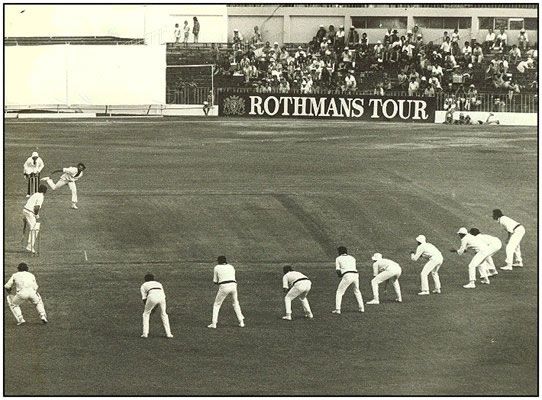
Dennis Lillee bowling to 9 slips and gullies

Glenn McGrath bowling to 9 slips and gullies

World Cup 1999 tie - Australia versus South Africa

Even spinners can fence in batsmen

Sunday, March 30, 2014

Australia begin their golden run as the World Cup returns to English turf in 1999 : Excerpt from ‘The Big Book of World Cup Cricket 1975-2011’ by Indra Vikram Singh


The World Cup returned to England in 1999 after a lapse of 16 years. In keeping with the times, Holland and Ireland too got to host a match each, besides Scotland and Wales. So much had changed in the interim. An Indian businessman, Jagmohan Dalmiya, presided over the ICC after a stint by a great West Indies batsman of yore, Clyde Walcott.

Even the Marylebone Cricket Club (MCC), one of the last bastions of tradition, had to bow before the winds of modernity by constructing a new media centre at the Nursery End of the Lord's ground. Named Spaceship, it was built at a cost of £5.8 million ($ 9.3 million), and can accomodate 250 journalists and broadcasters. It was unveiled on 27 April 1999, seventeen days before the start of the World Cup.

There was now a permanent ICC World Cup Trophy crafted in silver and gilt in London by Garrard, the Crown jewellers, featuring a golden globe held aloft by three silver columns. Valued at more than £27,000, it is 60 centimetres in height and weighs 11 kilograms. The golden globe is presented in the form of a stylised cricket ball. The silver columns, which are designed as stumps and bails, represent the three pillars of cricket - batting, bowling and fielding. Australia had the honour of winning it.

This time the title sponsorship was not awarded. Instead there were four global partners - Emirates Airlines, NatWest Bank, Pepsi and Vodafone. The tournament was christened ICC World Cup.

A total of £11 million was raised from sponsorship. Income from television grossed £23 million from a global audience of 2.3 billion in 129 countries. There was a record profit of more than £30 million from this World Cup. The English Cricket Board (ECB) kept all the gate receipts and merchandising revenue, while the money received from award of television rights and sponsorship was divided between the participants. The ECB thus raked in £13.7 million, while the other Test playing nations received £1.425 million each, except Bangladesh whose share was £225,000.

The prize money on offer was close to £600,000 ($1 million), with the winners receiving £180,000 and the runners-up taking home £90,000. The losing semi-finalists received £60,000 each. The rest of the prize money, amounting to around £210,000 was shared by the other eight participants.

A Daewoo Musso car, prize for the player-of-the-tournament, was won by the dashing South African allrounder Lance Klusener.

Bangladesh, who won the ICC Trophy 1997, and runners-up Kenya had already gained One-day International status. For the former it was the first appearance in the World Cup, as it was for Scotland who finished third in the tournament for the associate member countries. Group A comprised England, India, Kenya, South Africa, Sri Lanka and Zimbabwe, while in Group B were Australia, Bangladesh, New Zealand, Pakistan, Scotland and the West Indies.

For the first time there was a super-six stage. This was an improvement on the previous format wherein it was almost a foregone conclusion as to which eight teams would advance to the quarter-finals. This is not meant as disrespect towards Zimbabwe, but even in 1996 they were considered the weakest of the nine Test-playing nations. In the super-six, the three teams that qualified from Group A: South Africa, India and Zimbabwe, played each of the three qualifiers from Group B: Pakistan, Australia and New Zealand.

There were flaws in this system too. The points that teams carried forward from the group matches to the super-six were only those that they earned against the two teams that qualified from their group. Hence, Zimbabwe who finished third in Group A, carried 4 points, top team South Africa took with them 2 points, while second-placed India got none. Zimbabwe, who did not win a single super-six match, nearly made it to the semi-final. Eventual champions Australia, who won all three super-six matches, advanced to the semi-finals only by virtue of their victory in the last match against South Africa. There could easily have been a travesty of justice. 

The Duckworth-Lewis system of re-setting targets, which the average cricket enthusiast does not understand anyway, is another that might create a huge problem some day. In this, target scores can sometimes get enhanced, and a team that scores more can lose, in rain-interrupted matches. One-day cricket in general, and the World Cup in particular, could do with a simpler, more rational system.

About a year later, allegations of match-fixing took some sheen off this highly successful tournament. It cast a shadow over the game for a long time.

Pakistan beat New Zealand to enter the final. 

In the other semi-final there was a thrilling tie between Australia and South Africa, the first in the World Cup. 

Australia made it to the final as they had beaten South Africa in their earlier match. The Australians went on to emulate the West Indies by winning the World Cup for the second time.

The final:
Lord’s, London, 20 June 1999
Australia won by 8 wickets
Pakistan: 132  all out in 39 overs (Shane Warne 4 for 33)
Australia: 133 for 2 wickets in 20.1 overs (Mark Waugh 37 not out, Adam Gilchrist 54)
Man of the Match: Shane Warne
Player of the Tournament: Lance Klusener

(Author Indra Vikram Singh can be contacted on email singh_iv@hotmail.com).

The Big Book of World Cup Cricket 1975-2011

ISBN 978-81-901668-4-3

Distributed in India by Variety Book Depot, Connaught Place, New Delhi, Phones + 91 11 23417175, 23412567

Available in leading bookshops, and online on several websites.