|
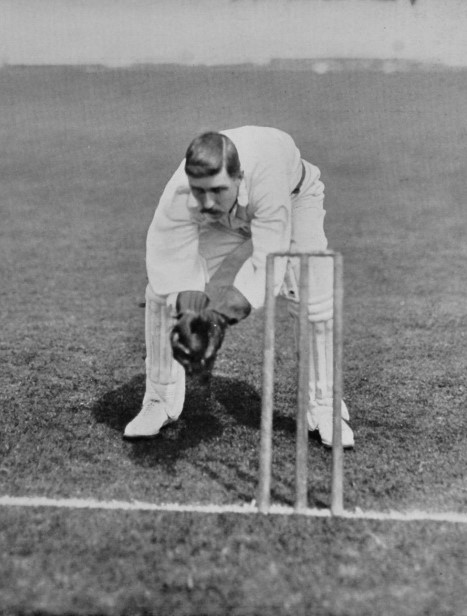
| Bert Oldfield |
 |
| Leslie Ames |
The only wicketkeeper with 100 dismissals to his credit between the two World Wars was the great Australian William ‘Bert’ Oldfield. He pouched 78 catches and effected 52 stumpings, totalling 130 dismissals, in his 54 Tests between 1920 and 1937. He was a competent right-handed batsman too, scoring 1427 runs at an average of 22.65 with a highest score of 65 not out, and 4 half-centuries.
England’s Leslie Ames narrowly missed the 100 dismissals mark. He took 72 catches behind the stumps and caused 23 stumpings, for an aggregate of 95 dismissals in 47 Tests between 1929 and 1939. He had two more catches to his name as a fielder. Ames was a top-class right-handed batsman, and many believed that he was in the Test side more for his batting skills than his prowess behind the stumps. He hit up 2434 runs at an average of 40.56, with 149 as his top score and 8 hundreds and 7 half-centuries. No other wicketkeeper had a century to his name in this period.
George Duckworth was arguably the best English wicketkeeper in this era, but was eclipsed by the far superior batting skills of Ames in the latter part of his Test career. Duckworth held 45 catches and carried out 15 stumpings, aggregating 60 dismissals in 24 Tests from 1924 to 1936. He scored 234 runs with a best of 39 not out, averaging 14.62 with his right-hand batting.
The South African Horace ‘Jock’ Cameron was the fourth wicketkeeper to bag 50 dismissals and more between the Wars. In 26 Tests between 1927 and 1935, Cameron totalled 51 dismissals comprising 39 catches and 12 stumpings. He was a fine right-handed batsman, accumulating 1239 runs at an average of 30.21, with a top-score of 90, and 10 fifties.
Herbert ‘Bert’ Strudwick’s career straddled the First World War, making his Test debut for England in 1910. In 17 Tests between 1920 and 1926, Strudwick held 38 catches and triggered 4 stumpings, for an aggregate of 42 dismissals. He played 11 Test matches before the War, taking 23 catches and effecting 8 stumpings. Bert Strudwick played a total of 28 Test matches till 1926, finishing with 61 catches and 12 stumpings, a total of 73 dismissals. A right-hander, he did not have much pretentions as a batsman, scoring 139 runs after the War, with his all-time best of 24 and an average of 8.17. He aggregated 230 runs in his 28 Tests, averaging 7.93.
Hanson ‘Sammy’ Carter played 8 Test matches for Australia after the First World War, in 1921, clutching 16 catches and having a hand in 11 stumpings, snaring 27 dismissals. A right-handed batsman he scored 218 runs at an average of 27.25, with a highest score of 47. Sammy Carter made his Test debut in 1907. He played 20 Test matches before the First World War, taking 28 catches and effecting 10 stumpings. He scored 655 runs in that phase at an average of 21.83, with a highest score of 72 and 4 fifties. He finished his 28-Test career with 44 catches and 21 stumpings, in all 65 dismissals. He aggregated 873 runs at an average of 22.97, the top score and half-centuries coming before the Great War.
West Indies gloveman Ivan Barrow appeared in 11 Test matches from 1930 to 1939, grabbing 16 catches and making 5 stumpings, for a total of 21 dismissals. He took 1 more catch
in the field. Right-handed with the willow, he scored 276 runs, averaging 16.23. He hit up a best score of 105, his only century, and he had no fifty to his name.
Thomas ‘Tommy’ Ward played 13 Test matches for South Africa after the First World War, from 1921 to 1924 , holding 11 catches and effecting 6 stumpings, for a total of 17 dismissals. A right-hander he hit up 316 runs at an average of 17.55, with a highest score of 64 and 2 fifties. Earlier, between 1912 and 1914, Tommy Ward held 8 catches and effected 7 stumpings in 10 Tests. He scored 143 runs, averaging 9.53. Overall, he ended his 23-Test career with 19 catches and 13 stumpings, for a total of 32 dismissals. He aggregated 459 runs at an average of 13.90, his top score of 64 and 2 fifties achieved after the War.
Kenneth James of New Zealand appeared in 11 Test matches between 1930 and 1933, pouching 11 catches and causing 5 stumpings, totalling 16 dismissals. Right-handed with the bat, he scored 52 runs, averaging 4.72 with a highest of 14.
England’s Arthur Wood played 4 Test matches in 1938-1939, holding 10 catches and effecting 1 stumping. A right-hander, he scored 80 runs, averaging 20. His top score of 53, was his only half-century.
Ultimately, Oldfield and Ames were in a league all their own among stumpers between the two World Wars.