|
| (from left), W.G. Grace, Frederick Spofforth, Sydney Barnes and Jack Hobbs.....four of the finest Test cricketers before the First World War. |
It is a fascinating exercise picking a World XI from
the inception of Test cricket in 1877 till the First World War began in 1914.
Wickets in the 1870s and 1880s were very uneven and rough. They improved in the
1890s with the introduction of the heavy roller, and further still in the first
14 years of the 20th century, but were still not as well prepared as
in later decades. By today’s standards, wickets were heavily loaded in favour
of bowlers, and they were uncovered. But those were the conditions the players
knew then, and coped with them.
Here is a World XI of those times. I am sure readers would make a few changes based on their perception, but some of the players would be common in all lists. 1. Jack Hobbs - England Batting
Pre-WWI 1908 to 1914 - Tests 28, Runs 2465, Average 57.32, Highest Score 187, Hundreds
5, Fifties 16 Batting
Full Career 1908 to 1930 - Tests 61, Runs 5410, Average 56.94, Highest Score
211, Hundreds 15, Fifties 28 What stands out is that Jack Hobbs has been the greatest Test batsman in the pre-First World War period. He was just as great after the War till the end of his career in 1930. In fact the War divided Hobbs’ Test career into almost two equal halves, with no decline whatsoever in performance in the latter part. In 28 Tests from 1908 to 1914, the English right-handed master opening batsman scored 2465 runs at an average of 57.32 with 5 hundreds and 16 fifties, and a highest score of 187. Then in 28 Tests from 1919 to 1930, Hobbs scored 2945 runs at an average of 56.63 with 10 hundreds and 12 fifties, and a highest score of 211. The first batsman to average 50 in Tests, he carried his supreme form forward till his retirement from Tests almost at the age of 48. His final figures in 61 Tests were 5410 runs at an average of 56.94 with 15 hundreds and 28 fifties. He was consistency personified, adept on turf as well as matting wickets, on bouncy, turning and wet tracks, against pace and spin alike. It is well-known that Hobbs scored 100 First-class hundreds after 40 years of age. He played First-class cricket till he was nearly 52 years old, and finished with a record 199 centuries, a true master. 2. Victor Trumper - Australia Batting
Pre-WWI 1899 to 1912 - Tests 48, Runs 3163, Average 39.04, Highest Score 214
not out, Hundreds 8, Fifties 13 The highest run-getters before the First World War were the top-class Australian opening pair of the left-handed Clem Hill, and the exquisite stroke-maker and highly proficient on wet wickets Victor Trumper. In 49 Tests from 1896 to 1912, Hill scored 3412 runs, the highest hitherto, at an average of 39.21. Trumper was just behind. In 48 Tests from 1899 to 1912, Trumper scored 3163 runs at an average of 39.04 with 8 hundreds and 13 fifties, and a highest score of 214 not out. 3. W.G. Grace (Captain) - England Batting
Pre-WWI 1880 to 1899 - Tests 22, Runs 1098, Average 32.29, Highest Score 170,
Hundreds 2, Fifties 5 The first batsman to score 1000 Test runs was the right-handed Englishman Arthur Shrewsbury. Playing only in the 19th century, in 23 Tests from 1881 to 1893, Shrewsbury scored 1227 runs at an average of 35.47. There were three other batsmen who scored 1000 Test runs while playing only in the 19th century, WG Grace, George Giffen and AC Bannerman. As we know, wickets in the 1870s and 1880s were very rough and uneven. They improved in the 1890s but were still far inferior to those later. The batting performances of these players is, therefore, very commendable. In 22 Tests from 1880 to 1899, the inimitable right-handed English opening batsman WG Grace scored 1098 runs at an average of 32.29 with 2 hundreds and 5 fifties, and a highest score of 170. 4. Stanley Jackson - England Batting
Pre-WWI 1893 to 1905 - Tests 20, Runs 1415, Average 48.79, Highest Score 144
not out, Hundreds 5, Fifties 6 Bowling
Pre-WWI 1893 to 1905 - Wickets 24, Average 33.29, Best Bowling 5/52, 5WI 1 The next in terms of Test averages after Hobbs, among batsmen who scored more than 251 runs before the First World War, was The Honourable F.S. Jackson or Stanley Jackson, the English right-handed batsman. In 20 Tests from 1893 to 1905, Jackson scored 1415 runs at an average of 48.79, with 5 hundreds and 6 fifties, and a highest score of 144 not out. He was a fine fast-medium bowler too, capturing 24 Tests wickets at an average of 33.29. 5. K.S. Ranjitsinhji - England Batting
Pre-WWI 1896 to 1902 - Tests 15, Runs 989, Average 44.95, Highest Score 175,
Hundreds 2, Fifties 6 The Indian right-handed wizard K.S. Ranjitsinhji just missed scoring 1000 Test runs. In 15 Tests for England from 1896 to 1902, he hit up 989 runs at an average of 44.95 with 2 hundreds and 6 fifties, and a highest score of 175. 6. Aubrey Faulkner - South Africa Batting
Pre-WWI 1906 to 1914 - Tests 24, Runs 1717, Average 41.87, Highest Score 204,
Hundreds 4, Fifties 8 Bowling
Pre-WWI 1906 to 1914 - Wickets 82, Average 25.52, Best Bowling 7/84, 5WI 4 Batting
Full Career 1906 to 1924 - Tests 25, Runs 1754, Average 40.79, Highest Score
204, Hundreds 4, Fifties 8 Bowling
Full Career 1906 to 1924 - Wickets 82, Average 26.58, Best Bowling 7/84, 5WI 4 The king of allrounders of the pre-First World War period, the South African Aubrey Faulkner, appeared in 1906. He bowled leg-breaks and googlies. Till the War, he had scored 1,717 runs at an average of 41.87, and taken 82 wickets at an average of 25.52, in 24 Tests. His quotient then was 1.64, at par with the doyens Gary Sobers and Jacques Kallis, though the sample size is obviously much smaller. After the War, he played one Test in 1924, scoring 37 runs and not taking a wicket. His quotient fell to 1.53, still comparable to greats like Imran Khan and Keith Miller. 7. Monty Noble - Australia Batting
Pre-WWI 1898 to 1909 - Tests 42, Runs 1997, Average 30.25, Highest Score 133, Hundred
1, Fifties 16 Bowling
Pre-WWI 1898 to 1909 - Wickets 121, Average 25.00, Best Bowling 7/17, 5WI 9,
10WM 2 Monty Noble entered the scene in 1898, a couple of years after his compatriot Giffen had finished. Noble bowled right-arm medium-pace and off-break. He came close to becoming the first to completing the double of 2,000 runs and 100 wickets, finishing just 3 runs short. He hit up 1,997 runs at an average of 30.25, and bagged 121 wickets at an average of 25.00 in 42 Tests, his career lasting till 1909. His quotient is 1.21. 8. Arthur Lilley (Wicketkeeper) - England Batting
Pre-WWI 1896 to 1909 - Tests 35, Runs 903, Average 20.52, Highest Score 84,
Fifties 4 Wicketkeeping
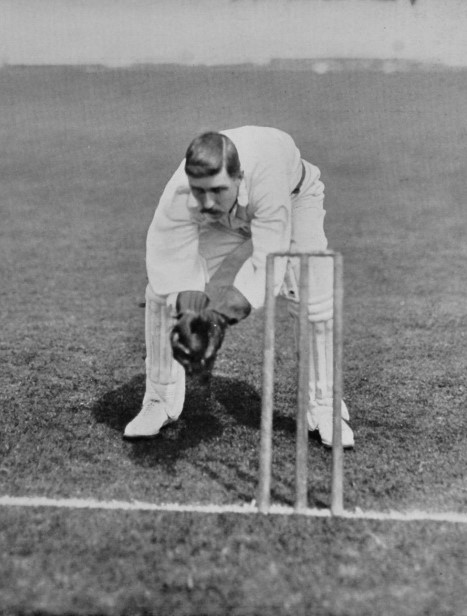
Pre-WWI 1896 to 1909 - Catches 70, Stumpings 22 Arthur Frederick Augustus ‘Dick’ Lilley made his Test debut for England in 1896. He played 35 Test matches till 1909, holding 70 catches and bringing off 22 stumpings. A right-handed batsman he scored 903 runs at an average of 20.52, with 4 half-centuries and a top score of 84. Dick Lilley came very close to becoming the first wicketkeeper-batsman to achieve the Test double of 1000 runs and 100 dismissals, finishing with 903 runs and 92 dismissals. Arthur Lilley was arguably the finest wicketkeeper-batsman up to the First World War. 9. George Lohmann - England Bowling
Pre-WWI 1886 to 1896 - Tests 18, Wickets 112, Average 10.75, Best Bowling 9/28,
5WI 9, 10WM 5 The English right-arm medium-pacer George Lohmann, who played 18 Tests from 1886 to 1896, took 112 wickets at an incredible average of 10.75. It is the best average among bowlers who took more than 7 Test wickets before the First World War. He bagged 9 hauls of five wickets or more in an innings, and 5 hauls of 10 wickets or more in a Test. His best analyses were 9 for 28 in an innings, and 15 for 45 in a Test. 10. Sydney Barnes
- England Bowling
Pre-WWI 1901 to 1914 - Tests 27, Wickets 189, Average 16.43, Best Bowling 9/103,
5WI 24, 10WM 7 There is little doubt that Sydney Barnes was the best bowler in the pre-First World War period. The English right-arm fast-medium to medium pacer played only in the 20th century when wickets were far better for batsmen than in the 1870s, 1880s, and even 1890s. Appearing between 1901 and 1914, Barnes captured 189 wickets in just 27 Tests at an average of 16.43. That is a brilliant 7 wickets per Test. He bagged 24 hauls of five wickets or more in an innings, and 7 hauls of 10 wickets or more in a Test. His best analyses were 9 for 103 in an innings, and 17 for 159 in a Test. The other four bowlers who bagged 50 or more wickets with better averages than Barnes played only in the 19th century when wickets were coarse and hazardous for batsmen. 11. Frederick Spofforth
- Australia Bowling
Pre-WWI 1877 to 1887 - Tests 18, Wickets 94, Average 18.41, Best Bowling 7/44,
5WI 7, 10WM 4 The right-arm fast-medium Frederick ‘Demon’ Spofforth played 18 Tests for Australia from 1877 to 1887. He took 94 wickets at an average of 18.41. He bagged 7 hauls of five wickets or more in an innings, and 4 hauls of 10 wickets or more in a Test. His best analyses were 7 for 44 in an innings, and 14 for 90 in a Test. 12th Man Wilfred Rhodes - England Batting
Pre-WWI 1899 to 1914 - Tests 47, Runs 1965, Average 32.21, Highest Score 179,
Hundreds 2, Fifties 10 Bowling
Pre-WWI 1899 to 1914 - Wickets 105, Average 24.90, Best Bowling 8/68, 5WI 6,
10WM 1 Batting
Full Career 1899 to 1930 - Tests 58, Runs 2325, Average 30.19, Highest Score 179,
Hundreds 2, Fifties 10 Bowling Full Career 1899 to 1930 - Wickets 127, Average 26.96, Best Bowling 8/68, 5WI 6, 10WM 1 The Test career of the remarkable Englishman Wilfred Rhodes lasted for 31 years till 1930. He was a right-handed batsman, and slow left-arm orthodox spinner. His career spanned the generations of W.G. Grace and Don Bradman, and became the first to achieve the feat of 2,000 runs and 100 wickets. He scored 2,325 runs at an average of 30.19, and took 127 wickets at an average of 26.96 in 58 Tests. His quotient is 1.11. Till the First World War, he had scored 1,965 runs at an average of 32.21, and took 105 wickets at an average of 24.90 in 47 Tests. His quotient at that time was 1.29. |