Showing posts with label Neville Cardus. Show all posts

Sunday, September 11, 2022

Remembering K.S. Ranjitsinhji on his 150th birth anniversary. Excerpt from Indra Vikram Singh’s book ‘Don’s Century’


On the birth anniversary of K.S. Ranjitsinhji, 10th September 2022, we remember one of the greats of batting who went on to become Maharaja Jam Saheb of Nawanagar. Reproduced below is an excerpt from Indra Vikram Singh’s book ‘Don’s Century’:

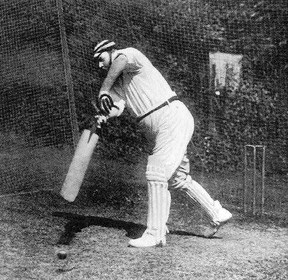
Batting, having already been defined by Grace, saw its next two stars descend from distant lands. If Prince Ranjitsinhji, later the Jam Saheb of Nawanagar, delighted with his artistry at the crease, the Aussie Victor Trumper provided the thrills with his panache. The very thought of Ranji conjures images of the leg-glance. He was the inventor of the shot, one that was patently his own and an early glimpse of the suppleness of wrists that characterised the batting of later Indian stalwarts Gundappa Viswanath, Mohammad Azharuddin and V.V.S. Laxman.

Ranji worked hard to hone his talent, hiring professional bowlers from Surrey while he was at Cambridge. Simon Wilde wrote in his biography Ranji A Genius Rich and Strange: “He practised with as much purpose whether he had just been out for 100 or for 0. He was a severe critic of his own game, and if he was indeed a genius it was for his infinite capacity for taking pains, not for becoming a superlative cricketer overnight. He enjoyed theorizing about the game and putting those theories into practice.”

The outcome was a batting style that was as unique as it was novel, and it perplexed the English. Cardus elucidated in Good Days (1934): “In the ‘nineties the game was absolutely English; it was even Victorian. W.G. Grace for years had stamped on cricket the English mark and the mark of the period. It was the age of simple first principles, of the stout respectability of the straight bat and the good-length balls. And then suddenly this visitation of dusky, supple legerdemain happened; a man was seen playing cricket as nobody in England could possibly have played it. The honest length ball was not met by the honest straight bat, but there was a flick of the wrist, and lo! The straight ball was charmed away to the leg-boundary. And nobody quite saw or understood how it all happened.”

All those who saw Ranji bat vouched for the fact that he had an exceptionally quick eye and could hook the fastest bowling with ease. Though he had appeared in English first-class cricket since 1893, Ranjitsinhji’s first full season was in 1895 when he made his debut for Sussex against the MCC at Lord’s. He caused an immediate impact, carving out scores of 77 and 150. From then on he captured the imagination of the public and became a very popular, even mystical, figure.

The next year at the age of 23, Ranji topped the first-class averages at 57.92, surpassing Grace’s record season aggregate by scoring 2780 runs, and equalling the great senior’s 10 hundreds. In a unique feat, Ranji hit up a century in each innings of a match on the same day. Resuming at zero not out, he notched up 100 and 125 not out for Sussex against Yorkshire at Hove. The English were reluctant to pick him in their Test side, but his huge popularity ensured that he was selected for the second match. Appropriately, Ranji became the second England batsman after Grace to score a hundred on Test debut, an unbeaten 154 against Australia at Manchester, having hit 62 in the first innings. In the process he nearly pulled off an improbable win. In the 1897 season, Ranji scored 1940 runs at an average of 45.12. He hit up his first double-century, 260 in just 250 minutes with 36 fours and a six against MCC at Lord’s, the highest by a Sussex batsman.

K.S. Ranjitsinhji (left) with W.G. Grace

Ranji never took the tedious sea journeys well. Prone to attacks of asthma, he was taken ill during the month-long voyage to Australia in 1897-98, even though he joined the team only in the south of the European Continent. He was still unwell when the first Test began in Sydney. Even so, he battled through, carving out a monumental 175, which was a record for England until R.E. Foster bettered it with 287 at the same venue six years later. Ranji’s knock enabled England to win their only Test in a series they lost 1-4. It was a productive tour for him personally, averaging over 50 in the Tests and over 60 in the first-class matches. In all he collected 1157 runs. At the end of the tour, Ranji returned to his homeland after a decade.

Having missed the English season of 1898 as a result of a long sojourn at home, Ranji’s best came at the turn of the century, even though he was not quite as slim and his feet seemed not as nimble. In 1899 he became the first to score 3000 runs in a season. He bailed out England in the first Test at Nottingham, scoring 42 and 93 not out, and holding Australia to a draw. By the end of the series he had scored 970 runs in 12 Tests at a brilliant average of 53.88. He amassed 3159 first-class runs at 63.18 per innings.

After a trip to the United States during the winter, Ranji’s 1900 season was just as brilliant. So irresistible was his form that he knocked up successive double centuries, both for Sussex - 222 against Somerset at Hove, and an unbeaten 215 versus Cambridge University at Fenners. Quite the master on rain-affected wickets, he breezed to 202 in three hours off the Middlesex bowling after a thunderstorm at Hove, the next highest by a Sussex colleague being 17. His five double centuries were a record for a season, bettered only by Bradman with six in 1930. Everton Weekes of the West Indies equalled Ranji’s five double tons exactly half a century later. The now-unstoppable Ranji logged up 3000 runs for the second successive season, this time scoring 3065 runs and topping the averages at a mind-boggling 87.57, hitting up 11 hundreds.

1901 was yet another splendid season. Again Ranji scored two double centuries in a row, once more representing his county, an unbeaten 285 against Somerset at Taunton and 204 at the expense of Lancashire at the home ground of Hove. The first was an amazing feat, not only for the fact that it was his top score and the highest-ever by a Sussex batsman, but because he was out fishing the entire previous night! For the 1901 season his tally was 2468 runs at 70.51 per innings. In three consecutive seasons, Ranjitsinhji had totalled 8692 runs at an average of 72.43 with 27 hundreds. The wizard from the orient continued to enchant and befuddle at the same time.          

He did not sail to Australia in 1901-02 and, perhaps due to the troubles in his personal life, lost form dramatically in the Tests in 1902, managing just 19 runs in four innings and never played at that level again. He still finished with a Test average of 44.96, a splendid achievement at the time. In first-class matches, though, Ranji continued to blaze away till 1904 when he again topped the 2000 mark as well as the averages - 2077 runs at 74.17.

Succession issues in Nawanagar kept Ranjitsinhji back in India, and he missed the next three seasons. He returned to England in 1908 as His Highness The Jam Sahib of Nawanagar, having being installed as ruler of the 3791 square miles, 13-gun salute princely State in circumstances so full of intrigue and danger as to render a racy novel hopelessly mundane. He played that season as well as in 1912, remarkably notching up 1000 runs each time. Ranji was seen on the cricket field one last time in 1920. Astonishingly, he played three first-class matches and, as was only to be expected, failed miserably. The fact was that his right eye had been removed five years earlier when on August 31 he had met with an accident while shooting grouse on the Yorkshire moors. This was soon after he returned from France, ending a brief and miserable stint in the army during the First World War.

Chamber of Princes 1930. Maharaja Jam Saheb Ranjitsinhji of Nawanagar is seated fourth from left. To his right is Maharaja Vijaysinhji of Rajpipla, and to his left is Maharaja Bhupindra Singh of Patiala. 

       It is quite uncanny that another Indian of princely origin and dashing batsman who was also to lead Sussex, Nawab of Pataudi junior, Mansur Ali Khan, also virtually lost vision in his right eye after a car accident on July 1, 1961 on the way back to Hove after dining out at neighbouring Brighton. The difference was that Ranji had his mishap after his cricket career was over, while Tiger Pataudi met this fate when his journey in the game had hardly begun.

It was while Ranji was recuperating, eye still bandaged, that he travelled to Beckenham, Kent, on October 26, 1915 to attend the funeral of his former England captain W.G. Grace. The curtain had come down not just on one era, but for all practical purposes, two.

Hartland summed up the impact of Ranji on the game: “The batting star of the Golden Age in England was Ranjitsinhji, with a first-class average of 56 - virtually as high as any English-qualified player has ever achieved and quite phenomenal for the time, particularly since he scored at around 50 runs an hour. Taking a qualification of ten thousand runs for all English batsmen who faced their first ball in the nineteenth century, Ranji’s first-class average is approached only by Sussex teammate Fry with 50. Test bowling did not slow Ranjitsinhji much, and the combination of his high average and scoring rate in relation to others really does mark him as out of the ordinary.”

Ranji’s first-class average of 56.37 was the highest for a full career by an England-based player until as late as 1986 when Geoff Boycott retired with a fractionally higher average of 56.84. And if one considers that Ranji’s career was all but over in 1904; his appearances thereafter were sporadic in 1908 and 1912, and farcical in 1920, his deeds are even more astounding. Upto 1904, Ranji had scored 22,402 runs at an average of 58.49 with 65 hundreds in 267 matches, really in less than a decade. That is the true reflection of his genius.

To the outside world Ranji was an exceptionally gifted prince who toiled diligently in the nets to emerge as the finest batsman of his era. Yet not many realised the inner turmoil that he undoubtedly underwent during his best years at the wicket, what with the drama of his adoption that never was, the machinations over his succession as ruler and his financial woes at the time. And he was laid low by illness for long periods. One has to marvel at the fact that he excelled at the game under these trying circumstances. Or more likely, he used them as a spur to motivate himself and to prove to those who mattered that he was fit to be king.

Yet his charm transcended all the elegant runs that he made. As Jessop wrote: “From the moment he stepped out of the pavilion he drew all eyes and held them. No one who saw him bat will ever forget it. He was the first man I ever knew who wore silk shirts, and there was something almost romantic about the very flow of his sleeves and the curve of his shoulders. He drew the crowds wherever he went, and at the height of his cricket days the shops in Brighton would empty if he passed along the street. Everyone wanted to see him.”

There was little doubt that Ranjitsinhji had transformed batting forever. As late as 1944, Pelham Warner wrote in The Book of Cricket: “With his wonderful eye and wrists, he could play back to almost any ball, however good a length, and however fast. Like Bradman, he seldom played a genuine forward stroke, for, again like Bradman he found that balls to which he could not play back he could, with his quickness of foot, get to and drive.” This ‘play back or drive’ method, however, could only be used by one with a sharp eye and quicksilver footwork, like a Ranji or a Bradman. English batsmen attempted to copy it with disastrous results. It takes someone extraordinary to play in an extraordinary way. Ranji scored more profusely than anyone had done before, just as Bradman was to do three decades later.

(Author Indra Vikram Singh can be contacted on email singh_iv@hotmail.com).

Don’s Century 

Published in India by Sporting Links 

ISBN 978-81-901668-5-0 

Fully illustrated 

Paperback French Fold 

11 x 8.5 x 0.4 inches 

Weight 480 grams 

188 pages 

Available on Amazon at an attractive price: https://www.amazon.in/dp/8190166859

Indra Vikram Singh's other books available on Amazon: 

https://www.amazon.in/s?k=Indra+Vikram+Singh&i=stripbooks&rh=p_6%3AA3HSV0N9AV7NOK&dc&qid=1602408830&rnid=1318474031&ref=sr_nr_p_6_1 

Thursday, June 18, 2020

Gary Sobers…..pure genius, inarguably the greatest allrounder ever. Excerpt from Indra Vikram Singh’s book ‘Don’s Century’


Just as the memorable careers of the three Ws were drawing to a close, there appeared on the stage a cricketer blessed by nature like no other. Inarguably the most versatile and complete player, with class stamped all over, the left-handed genius Garfield Sobers was the only one apart from Bradman who would walk into everybody’s all-time dream team. To state the obvious, Sobers was a powerful strokeplayer, predecessor to Brian Lara in myriad ways, not the least in hitting up the record score and highest aggregate in Test cricket; bowler of greater variety than anyone in history - genuine speed, medium-pace swing, left-arm orthodox as well as chinaman; and a superb fielder, particularly close to the wicket in the slips or at backward short-leg.  Like Bradman, the game is not likely to see another with his amazing skills.

The doyen himself, Sir Neville Cardus, described Sobers’ batting thus: “He makes a stroke with moments to spare. The sure sign of mastery, of genius of any order, is absence of strain, natural freedom of rhythm.” How aptly can this be applied to sportspersons of any discipline. Brian Johnston, legend in the commentary box, observed Sobers for years. He wrote in his book It’s Been a Piece of Cake: “…..like all the greats - he had a sound defensive technique, but in attack with a high backlift and perfect timing the power of his strokes had to be seen to be believed. His sizzling drives and crashing hooks were hammered to the boundary, leaving the fielders helpless to stop them.”

Sobers never wore a thigh pad, and except for early in his career had no use for a cap, batting or fielding. His rasping cuts were facilitated by a light bat weighing around 2 lb 4 oz. There was no less power in his shots than seen today by those wielding the chunky modern day bludgeons. That is one of the reasons why there are not many players today who can play genuine horizontal bat shots like the cut, pull and hook with authority. Sobers rarely went down the wicket to the spinners, either using his long reach to drive or playing right back.

For someone who was pitchforked into the Test arena as a 17-year-old left-arm spinner in 1953-54 after just two first-class appearances, it is quite amazing that Sobers went on to become one of the greatest batsmen in history. Four years after his debut, he recorded his first Test hundred against Pakistan at Kingston, an unbeaten 365, the top score at the highest level, surpassing Len Hutton’s mark of two decades earlier. He added 446 for the second wicket in the company of Conrad Hunte, just five runs short of the then all-time high for any wicket put up by Ponsford and Bradman in 1934. Sobers celebrated his achievement by hammering a century in each innings - 125 and 108 not out - in the Georgetown Test. He finished the series with 824 runs at an average of 137.33. The legend of Sobers had been launched.

In 1959-60 against England, Sobers hit up 709 runs at an average of 101.28, crashing 226 at Bridgetown, 147 at Kingston and 146 at Georgetown. He put on 399 for the fourth wicket with Worrell in the Georgetown Test. Though a natural successor to Worrell, Sobers was not as diligent a captain as Bradman. From 1966 to 1967-68, Sobers had a golden run with the bat, averaging over 100 in two successive series, and 90 in the third. During the 1966 tour of England, he scored 722 runs at an average of 103.14 in five Tests, took 20 wickets at 27.25 apiece and held 10 catches. England were again given a 3-1 hammering, and Sobers once more hit up three centuries - 161 at Old Trafford, 163 not out at Lord’s and 174 at Headingley. He then went to India in 1966-67, scoring half-centuries in all his five innings with a highest of 95, aggregating 342 runs and averaging 114. By now the West Indies were the best side in the world. In 1967-68 against England at home, Sobers knocked up 545 runs in five Tests at 90.83 per innings but his over-confident declaration in the fourth Test at Kingston - 215 to win in 165 minutes - handed the series to England, who won that game with three minutes to spare, and the crown slipped.

The irrepressible Sobers became the first batsman in first-class cricket to hit 6 sixes in an over for Nottinghamshire against Glamorgan, smashing a bewildered Malcolm Nash at St Helen’s Ground, Swansea in 1968. It was in the evening of his career that Sobers played what Sir Donald Bradman described as the best innings he had seen in Australia, comparing it to Stan McCabe’s superb 232 at Trent Bridge in 1938. He slammed 254 for the Rest of the World against Australia at Melbourne in 1971-72 against a young and lightning fast Dennis Lillee. It was an amazing display of pyrotechnics, and when it reached its crescendo, rousing applause came from the spectators and fielders alike. 

When a damaged knee ended his 20-year Test career, Sobers had become the highest rungetter in his 93 appearances with 8032 runs at an average of 57.78, having blazed 26 hundreds, second behind Bradman’s 29. He had captured 235 wickets at 34.03 each, and snapped up 109 catches. It would be fair to say that had he batted higher than the no. 6 that he often did as captain, and if the West Indies did not have bowlers of the calibre of Wesley Hall, Charlie Griffith and Lance Gibbs, Sobers would have had many more runs and wickets to his credit. Gary Sobers was a cricketer beyond compare. It was just a matter of time before knighthood was bestowed on him.

(Author Indra Vikram Singh can be contacted on email singh_iv@hotmail.com).

Don’s Century

Published in India by Sporting Links

ISBN 978-81-901668-5-0

Fully illustrated

Paperback French Fold 11 x 8.5 x 0.4 inches

188 pages

Friday, January 19, 2018

K.S. Ranjitsinhji as seen through the eyes of some writers. Excerpts from Indra Vikram Singh’s book ‘Don’s Century’


The very thought of Ranji conjures images of the leg-glance. He was the inventor of the shot, one that was patently his own and an early glimpse of the suppleness of wrists that characterised the batting of later Indian stalwarts Gundappa Viswanath, Mohammad Azharuddin and V.V.S. Laxman.

Ranji worked hard to hone his talent, hiring professional bowlers from Surrey while he was at Cambridge. Simon Wilde wrote in his biography Ranji A Genius Rich and Strange: “He practised with as much purpose whether he had just been out for 100 or for 0. He was a severe critic of his own game, and if he was indeed a genius it was for his infinite capacity for taking pains, not for becoming a superlative cricketer overnight. He enjoyed theorizing about the game and putting those theories into practice.”

The outcome was a batting style that was as unique as it was novel, and it perplexed the English. (Neville) Cardus elucidated in Good Days (1934): “In the ‘nineties the game was absolutely English; it was even Victorian. W.G. Grace for years had stamped on cricket the English mark and the mark of the period. It was the age of simple first principles, of the stout respectability of the straight bat and the good-length balls. And then suddenly this visitation of dusky, supple legerdemain happened; a man was seen playing cricket as nobody in England could possibly have played it. The honest length ball was not met by the honest straight bat, but there was a flick of the wrist, and lo! The straight ball was charmed away to the leg-boundary. And nobody quite saw or understood how it all happened.”

(Peter) Hartland summed up the impact of Ranji on the game: “The batting star of the Golden Age in England was Ranjitsinhji, with a first-class average of 56 - virtually as high as any English-qualified player has ever achieved and quite phenomenal for the time, particularly since he scored at around 50 runs an hour. Taking a qualification of ten thousand runs for all English batsmen who faced their first ball in the nineteenth century, Ranji’s first-class average is approached only by Sussex teammate (C.B.) Fry with 50. Test bowling did not slow Ranjitsinhji much, and the combination of his high average and scoring rate in relation to others really does mark him as out of the ordinary.”

Ranji’s first-class average of 56.37 was the highest for a full career by an England-based player until as late as 1986 when Geoff Boycott retired with a fractionally higher average of 56.84. And if one considers that Ranji’s career was all but over in 1904; his appearances thereafter were sporadic in 1908 and 1912, and farcical in 1920, his deeds are even more astounding. Upto 1904, Ranji had scored 22,402 runs at an average of 58.49 with 65 hundreds in 267 matches, really in less than a decade. That is the true reflection of his genius.

To the outside world Ranji was an exceptionally gifted prince who toiled diligently in the nets to emerge as the finest batsman of his era. Yet not many realised the inner turmoil that he undoubtedly underwent during his best years at the wicket, what with the drama of his adoption that never was, the machinations over his succession as ruler and his financial woes at the time. And he was laid low by illness for long periods. One has to marvel at the fact that he excelled at the game under these trying circumstances. Or more likely, he used them as a spur to motivate himself and to prove to those who mattered that he was fit to be king.

Yet his charm transcended all the elegant runs that he made. As (Gilbert) Jessop wrote: “From the moment he stepped out of the pavilion he drew all eyes and held them. No one who saw him bat will ever forget it. He was the first man I ever knew who wore silk shirts, and there was something almost romantic about the very flow of his sleeves and the curve of his shoulders. He drew the crowds wherever he went, and at the height of his cricket days the shops in Brighton would empty if he passed along the street. Everyone wanted to see him.”

There was little doubt that Ranjitsinhji had transformed batting forever. As late as 1944, Pelham Warner wrote in The Book of Cricket: “With his wonderful eye and wrists, he could play back to almost any ball, however good a length, and however fast. Like Bradman, he seldom played a genuine forward stroke, for, again like Bradman he found that balls to which he could not play back he could, with his quickness of foot, get to and drive.” This ‘play back or drive’ method, however, could only be used by one with a sharp eye and quicksilver footwork, like a Ranji or a Bradman. English batsmen attempted to copy it with disastrous results. It takes someone extraordinary to play in an extraordinary way. Ranji scored more profusely than anyone had done before, just as Bradman was to do three decades later.

Don’s Century
Published by Sporting Links
ISBN 978-81-901668-5-0, Fully Illustrated
French Fold 21.5 cm x 28 cm, 188 Pages
Price Rupees 995

Indra Vikram Singh’s latest books published by Sporting Links:
A Maharaja’s Turf  ISBN 978-81-901668-3-6
The Big Book of World Cup Cricket  ISBN 978-81-901668-4-3
Don’s Century  ISBN 978-81-901668-5-0
Crowning Glory  ISBN 978-81-901668-6-7

Distributed in India by:  Variety Book Depot, AVG Bhawan, M-3 Middle Circle, Connaught Circus, New Delhi-110001, India. Tel. + 91 11 23417175, 23412567, Email varietybookdepot@gmail.com.

Available on amazon.in: https://www.amazon.in/s/ref=sr_hi_eb?rh=k%3AIndra+Vikram+Singh%2Cn%3A976389031&ie=UTF8&qid=1516365638&keyword=Indra+Vikram+Singh

Thursday, November 9, 2017

The legendary writer Neville Cardus’ comments on some great cricketers

Sir Neville Cardus (1888-1975) was a famous English cricket writer, music critic and long-timecorrespondent of The Manchester Guardian. His comments on some great cricketers make interesting reading.


On W.G. Grace and K.S. Ranjitsinhji, in his book Good Days (1934): “In the ‘nineties the game was absolutely English; it was even Victorian. W.G. Grace for years had stamped on cricket the English mark and the mark of the period. It was the age of simple first principles, of the stout respectability of the straight bat and the good-length balls. 
And then suddenly this visitation of dusky, supple legerdemain happened; a man was seen playing cricket as nobody in England could possibly have played it. The honest length ball was not met by the honest straight bat, but there was a flick of the wrist, and lo! The straight ball was charmed away to the leg-boundary. And nobody quite saw or understood how it all happened.”


On Victor Trumper, Charles Macartney  and Don Bradman: “Macartney, perfect of technique, none the less used his bat with an unmistakable pugnacity. He was less courtly in his stroke-play than Trumper, whose masterful innings had a certain effortless charm. Sir Donald Bradman annihilated all bowlers as though he was just performing the day’s work with a deadly efficiency. Macartney slaughtered bowling quite rapaciously. If he was obliged to bat through a maiden over he looked annoyed with himself at the end of it; and he would gnaw his glove. His forearms were formidably strong, his chin was aggressive and his eyes perpetually alive. They looked you in the face; they looked the best bowlers in the world in the face. Macartney employed a defensive stroke as a last resort. Nothing could daunt him. Before the start of a Lord’s Test match he came down to breakfast in a London hotel, looking through the window at the June sunshine and said:- ‘Lovely day, Cripes, I feel sorry for any poor cove who’s got to bowl at me today’.”


On Don Bradman’s 334 in the Leeds Test of 1930, in his book Play Resumed with Cardus: “At Leeds Bradman announced his rights to mastership in a few swift moments. He made 72 runs in his first hour at the wicket, giving to us every bit of cricket excepting the leg-glance. Every fine point of batsmanship was to be admired; strokes powerful and swift and accurate and handsome; variety of craft controlled with singleness of mind and purpose. Bradman was as determined to take no risks, as was to hit boundaries from every ball the least loose. And his technique is so extensive and practised that he can get runs at the rate of 50 an hour, without once needing to venture romantically into the realms of the speculative or the empirical.”

On Don Bradman: “People say ‘Oh, but he hasn’t the charm of McCabe, or the mercury of MacCartney, or the dignity of Hammond’; the objection is a little unintelligent, as though a lion was criticized for lacking the delicacy of the gazelle, the worrying tenacity of the terrier and the disdainful elegance of a swan or a camel.”

On Don Bradman: “Bradman’s achievements stagger the imagination. No writer of boys’ fiction would dare to invent a hero who performed with Bradman’s continual consistency. His batsmanship delights one’s knowledge of the game, his every stroke is a dazzling and precious stone in the game’s crown.”


On Gary Sobers: “He makes a stroke with moments to spare. The sure sign of mastery, of genius of any order, is absence of strain, natural freedom of rhythm.”


(These comments are reproduced in Indra Vikram Singh’s book ‘Don’s Century’, written in the centenary year of Sir Donald Bradman, celebrating his life and cricket career, and also presenting a panorama of batting from the 1860s to present times).  


Don’s Century
Published by Sporting Links
ISBN 978-81-901668-5-0, Fully Illustrated
French Fold 21.5 cm x 28 cm, 188 Pages
Price Rupees 995

Indra Vikram Singh’s latest books published by Sporting Links:
A Maharaja’s Turf  ISBN 978-81-901668-3-6
The Big Book of World Cup Cricket  ISBN 978-81-901668-4-3
Don’s Century  ISBN 978-81-901668-5-0
Crowning Glory  ISBN 978-81-901668-6-7

Distributed in India by:  Variety Book Depot, AVG Bhawan, M-3 Middle Circle, Connaught Circus, New Delhi-110001, India. Tel. + 91 11 23417175, 23412567, Email varietybookdepot@gmail.com.

Available online at amazon.in:
https://www.amazon.in/s/ref=sr_hi_eb?rh=k%3AIndra+Vikram+Singh%2Cn%3A976389031&ie=UTF8&qid=1508325652&keyword=Indra+Vikram+Singh

Thursday, April 14, 2016

“The straight ball was charmed away to the leg-boundary.” So said Cardus about Ranji. Excerpt from Indra Vikram Singh’s book ‘Don’s Century’


In the twilight of W.G. Grace’s long career dawned what came to be known as The Golden Age of Cricket. This was the twenty-year period before the First World War - 1894 to 1914. As Hartland explained in his The Balance of Power in Test Cricket 1877-1998: “This is largely because pitches had improved, but not too much, and the balance between bat and ball was just about right. In England cricket was at its highest level of popularity relative to other sports, notably football. Another reason is that England and Australia were more evenly matched than at any time. (Test) Matches in England were still limited to three days, while those in Australia were played to a finish.” Vic Marks added in The Wisden Illustrated History of Cricket, “Most of the innovations had already taken place, now was the time to lie back and enjoy the national game at your leisure. The Empire was secure; all that was to be feared was the possibility of a wet summer.”

Batting, having already been defined by Grace, saw its next two stars descend from distant lands. If Prince Ranjitsinhji, later the Jam Saheb of Nawanagar, delighted with his artistry at the crease, the Aussie Victor Trumper provided the thrills with his panache. The very thought of Ranji conjures images of the leg-glance. He was the inventor of the shot, one that was patently his own and an early glimpse of the suppleness of wrists that characterised the batting of later Indian stalwarts Gundappa Viswanath, Mohammad Azharuddin and V.V.S. Laxman.

Ranji worked hard to hone his talent, hiring professional bowlers from Surrey while he was at Cambridge. Simon Wilde wrote in his biography Ranji A Genius Rich and Strange: “He practised with as much purpose whether he had just been out for 100 or for 0. He was a severe critic of his own game, and if he was indeed a genius it was for his infinite capacity for taking pains, not for becoming a superlative cricketer overnight. He enjoyed theorizing about the game and putting those theories into practice.”

The outcome was a batting style that was as unique as it was novel, and it perplexed the English. Cardus elucidated in Good Days (1934): “In the ‘nineties the game was absolutely English; it was even Victorian. W.G. Grace for years had stamped on cricket the English mark and the mark of the period. It was the age of simple first principles, of the stout respectability of the straight bat and the good-length balls. And then suddenly this visitation of dusky, supple legerdemain happened; a man was seen playing cricket as nobody in England could possibly have played it. The honest length ball was not met by the honest straight bat, but there was a flick of the wrist, and lo! The straight ball was charmed away to the leg-boundary. And nobody quite saw or understood how it all happened.”

(Author Indra Vikram Singh can be contacted on email singh_iv@hotmail.com.
Follow Indra Vikram Singh on Twitter @IVRajpipla.)

Don’s Century
Published by Sporting Links
ISBN 978-81-901668-5-0, Fully Illustrated
French Fold 21.5 cm x 28 cm, 188 Pages
Price Rupees 995

Indra Vikram Singh’s latest books published by Sporting Links:   
A Maharaja’s Turf  ISBN 978-81-901668-3-6   
The Big Book of World Cup Cricket  ISBN 978-81-901668-4-3   
Don’s Century  ISBN 978-81-901668-5-0   
Crowning Glory  ISBN 978-81-901668-6-7

Distributed in India by:  Variety Book Depot, AVG Bhawan, M-3, Middle Circle, Connaught Circus, New Delhi-110 001, India. Tel. + 91 11 23417175, 23412567.

Saturday, January 12, 2013

Excerpts from Indra Vikram Singh's book 'Don's Century' ..... 2 - Chapter 7 : PEERLESS RUNGETTER AND OTHER MASTERS OF THE WILLOW (2. K.S. Ranjitsinhji)


Batting, having already been defined by Grace, saw its next two stars descend from distant lands. If Prince Ranjitsinhji, later the Jam Saheb of Nawanagar, delighted with his artistry at the crease, the Aussie Victor Trumper provided the thrills with his panache. The very thought of Ranji conjures images of the leg-glance. He was the inventor of the shot, one that was patently his own and an early glimpse of the suppleness of wrists that characterised the batting of later Indian stalwarts Gundappa Viswanath, Mohammad Azharuddin and V.V.S. Laxman.

Ranji worked hard to hone his talent, hiring professional bowlers from Surrey while he was at Cambridge. Simon Wilde wrote in his biography Ranji A Genius Rich and Strange: “He practised with as much purpose whether he had just been out for 100 or for 0. He was a severe critic of his own game, and if he was indeed a genius it was for his infinite capacity for taking pains, not for becoming a superlative cricketer overnight. He enjoyed theorizing about the game and putting those theories into practice.”

The outcome was a batting style that was as unique as it was novel, and it perplexed the English. Cardus elucidated in Good Days (1934): “In the ‘nineties the game was absolutely English; it was even Victorian. W.G. Grace for years had stamped on cricket the English mark and the mark of the period. It was the age of simple first principles, of the stout respectability of the straight bat and the good-length balls. And then suddenly this visitation of dusky, supple legerdemain happened; a man was seen playing cricket as nobody in England could possibly have played it. The honest length ball was not met by the honest straight bat, but there was a flick of the wrist, and lo! The straight ball was charmed away to the leg-boundary. And nobody quite saw or understood how it all happened.”

All those who saw Ranji bat vouched for the fact that he had an exceptionally quick eye and could hook the fastest bowling with ease. Though he had appeared in English first-class cricket since 1893, Ranjitsinhji’s first full season was in 1895 when he made his debut for Sussex against the MCC at Lord’s. He caused an immediate impact, carving out scores of 77 and 150. From then on he captured the imagination of the public and became a very popular, even mystical, figure.

The next year at the age of 23, Ranji topped the first-class averages at 57.92, surpassing Grace’s record season aggregate by scoring 2780 runs, and equalling the great senior’s 10 hundreds. In a unique feat, Ranji hit up a century in each innings of a match on the same day. Resuming at zero not out, he notched up 100 and 125 not out for Sussex against Yorkshire at Hove. The English were reluctant to pick him in their Test side, but his huge popularity ensured that he was selected for the second match. Appropriately, Ranji became the second England batsman after Grace to score a hundred on Test debut, an unbeaten 154 against Australia at Manchester, having hit 62 in the first innings. In the process he nearly pulled off an improbable win. In the 1897 season, Ranji scored 1940 runs at an average of 45.12. He hit up his first double-century, 260 in just 250 minutes with 36 fours and a six against MCC at Lord’s, the highest by a Sussex batsman.

Ranji never took the tedious sea journeys well. Prone to attacks of asthma, he was taken ill during the month-long voyage to Australia in 1897-98, even though he joined the team only in the south of the European Continent. He was still unwell when the first Test began in Sydney. Even so, he battled through, carving out a monumental 175, which was a record for England until R.E. Foster bettered it with 287 at the same venue six years later. Ranji’s knock enabled England to win their only Test in a series they lost 1-4. It was a productive tour for him personally, averaging over 50 in the Tests and over 60 in the first-class matches. In all he collected 1157 runs. At the end of the tour, Ranji returned to his homeland after a decade.

Having missed the English season of 1898 as a result of a long sojourn at home, Ranji’s best came at the turn of the century, even though he was not quite as slim and his feet seemed not as nimble. In 1899 he became the first to score 3000 runs in a season. He bailed out England in the first Test at Nottingham, scoring 42 and 93 not out, and holding Australia to a draw. By the end of the series he had scored 970 runs in 12 Tests at a brilliant average of 53.88. He amassed 3159 first-class runs at 63.18 per innings.

After a trip to the United States during the winter, Ranji’s 1900 season was just as brilliant. So irresistible was his form that he knocked up successive double centuries, both for Sussex - 222 against Somerset at Hove, and an unbeaten 215 versus Cambridge University at Fenners. Quite the master on rain-affected wickets, he breezed to 202 in three hours off the Middlesex bowling after a thunderstorm at Hove, the next highest by a Sussex colleague being 17. His five double centuries were a record for a season, bettered only by Bradman with six in 1930. Everton Weekes of the West Indies equalled Ranji’s five double tons exactly half a century later. The now-unstoppable Ranji logged up 3000 runs for the second successive season, this time scoring 3065 runs and topping the averages at a mind-boggling 87.57, hitting up 11 hundreds.

1901 was yet another splendid season. Again Ranji scored two double centuries in a row, once more representing his county, an unbeaten 285 against Somerset at Taunton and 204 at the expense of Lancashire at the home ground of Hove. The first was an amazing feat, not only for the fact that it was his top score and the highest-ever by a Sussex batsman, but because he was out fishing the entire previous night! For the 1901 season his tally was 2468 runs at 70.51 per innings. In three consecutive seasons, Ranjitsinhji had totalled 8692 runs at an average of 72.43 with 27 hundreds. The wizard from the orient continued to enchant and befuddle at the same time.          

He did not sail to Australia in 1901-02 and, perhaps due to the troubles in his personal life, lost form dramatically in the Tests in 1902, managing just 19 runs in four innings and never played at that level again. He still finished with a Test average of 44.96, a splendid achievement at the time. In first-class matches, though, Ranji continued to blaze away till 1904 when he again topped the 2000 mark as well as the averages - 2077 runs at 74.17.

Succession issues in Nawanagar kept Ranjitsinhji back in India, and he missed the next three seasons. He returned to England in 1908 as His Highness The Jam Sahib of Nawanagar, having being installed as ruler of the 3791 square miles, 13-gun salute princely State in circumstances so full of intrigue and danger as to render a racy novel hopelessly mundane. He played that season as well as in 1912, remarkably notching up 1000 runs each time. Ranji was seen on the cricket field one last time in 1920. Astonishingly, he played three first-class matches and, as was only to be expected, failed miserably. The fact was that his right eye had been removed five years earlier when on August 31 he had met with an accident while shooting grouse on the Yorkshire moors. This was soon after he returned from France, ending a brief and miserable stint in the army during the First World War.      

It is quite uncanny that another Indian of princely origin and dashing batsman who was also to lead Sussex, Nawab of Pataudi junior, Mansur Ali Khan, also virtually lost vision in his right eye after a car accident on July 1, 1961 on the way back to Hove after dining out at neighbouring Brighton. The difference was that Ranji had his mishap after his cricket career was over, while Tiger Pataudi met this fate when his journey in the game had hardly begun.

It was while Ranji was recuperating, eye still bandaged, that he travelled to Beckenham, Kent, on October 26, 1915 to attend the funeral of his former England captain W.G. Grace. The curtain had come down not just on one era, but for all practical purposes, two.

Hartland summed up the impact of Ranji on the game: “The batting star of the Golden Age in England was Ranjitsinhji, with a first-class average of 56 - virtually as high as any English-qualified player has ever achieved and quite phenomenal for the time, particularly since he scored at around 50 runs an hour. Taking a qualification of ten thousand runs for all English batsmen who faced their first ball in the nineteenth century, Ranji’s first-class average is approached only by Sussex teammate Fry with 50. Test bowling did not slow Ranjitsinhji much, and the combination of his high average and scoring rate in relation to others really does mark him as out of the ordinary.”

Ranji’s first-class average of 56.37 was the highest for a full career by an England-based player until as late as 1986 when Geoff Boycott retired with a fractionally higher average of 56.84. And if one considers that Ranji’s career was all but over in 1904; his appearances thereafter were sporadic in 1908 and 1912, and farcical in 1920, his deeds are even more astounding. Upto 1904, Ranji had scored 22,402 runs at an average of 58.49 with 65 hundreds in 267 matches, really in less than a decade. That is the true reflection of his genius.

To the outside world Ranji was an exceptionally gifted prince who toiled diligently in the nets to emerge as the finest batsman of his era. Yet not many realised the inner turmoil that he undoubtedly underwent during his best years at the wicket, what with the drama of his adoption that never was, the machinations over his succession as ruler and his financial woes at the time. And he was laid low by illness for long periods. One has to marvel at the fact that he excelled at the game under these trying circumstances. Or more likely, he used them as a spur to motivate himself and to prove to those who mattered that he was fit to be king.

Yet his charm transcended all the elegant runs that he made. As Jessop wrote: “From the moment he stepped out of the pavilion he drew all eyes and held them. No one who saw him bat will ever forget it. He was the first man I ever knew who wore silk shirts, and there was something almost romantic about the very flow of his sleeves and the curve of his shoulders. He drew the crowds wherever he went, and at the height of his cricket days the shops in Brighton would empty if he passed along the street. Everyone wanted to see him.”

There was little doubt that Ranjitsinhji had transformed batting forever. As late as 1944, Pelham Warner wrote in The Book of Cricket: “With his wonderful eye and wrists, he could play back to almost any ball, however good a length, and however fast. Like Bradman, he seldom played a genuine forward stroke, for, again like Bradman he found that balls to which he could not play back he could, with his quickness of foot, get to and drive.” This ‘play back or drive’ method, however, could only be used by one with a sharp eye and quicksilver footwork, like a Ranji or a Bradman. English batsmen attempted to copy it with disastrous results. It takes someone extraordinary to play in an extraordinary way. Ranji scored more profusely than anyone had done before, just as Bradman was to do three decades later.

(Author Indra Vikram Singh can be contacted on email singh_iv@hotmail.com).

Saturday, January 5, 2013

Excerpts from Indra Vikram Singh's book 'Don's Century' .....1 - Chapter 7 : PEERLESS RUNGETTER AND OTHER MASTERS OF THE WILLOW (1. W.G. Grace)


“Bradman’s achievements stagger the imagination. No writer of boys’ fiction would dare to invent a hero who performed with Bradman’s continual consistency. His batsmanship delights one’s knowledge of the game, his every stroke is a dazzling and precious stone in the game’s crown,” was Sir Neville Cardus’ famous observation. So, was Bradman the best batsman of all time?

He was certainly the greatest rungetter if the criterion is runs per innings and the frequency with which he got the big scores - centuries and, more significantly, double centuries. But was he the best in terms of quality, in all conditions, against all types of bowling? Critics have put forward various theories and lauded the merits of several great batsmen for nearly a century-and-a-half.

Inarguably, the first great batsman was W.G. Grace. He is credited with developing batting technique as we know it today. Another wizard who joined Grace during the later stages of his career, K.S. Ranjitsinhji wrote in The Jubilee Book of Cricket (1897): “He revolutionized batting. He turned it from an accomplishment into a science….. Before W.G. batsmen were of two kinds; a batsman played a forward game or he played a back game….. It was bad cricket to hit a straight ball; as for pulling a long hop, it was regarded as immoral. What W.G. did was to unite in his mighty self all the good points of all the good players and to make utility the criterion of style. He founded the modern theory of batting by making forward and back play of equal importance, relying neither on one nor the other, but both….. I hold him to be, not only the finest player born or unborn, but the maker of modern batting. He turned the old one-stringed instrument into a many chorded lyre.”

The emergence of Grace saw significant developments in the game. In 1864, over-arm bowling was approved. Grace was then able to develop batting technique that countered this revolutionary over-the-shoulder style of delivering the ball. Cricket received the impetus it required. County cricket began the same year, as was Wisden first published.

The popular image of Dr. William Gilbert Grace is that of the Grand Old Man, portly, ageing, with a flowing grey beard. But his best came very early in his career. It is reckoned that he was at eighteen years the best batsman in England, and consequently the world. That was in 1866 when, as Vic Marks wrote in The Wisden Illustrated History of Cricket: “W.G. was creating new standards that no one else could reach.” Playing for an England XI against Surrey, Grace scored 224 not out in a crushing victory of an innings and 300 runs. Marks recounted: “On the last afternoon his captain gave him permission to pop off to Crystal Palace to run in a 440-yard hurdle race - he won. Three weeks later he scored 173 not out for the Gentlemen of the South against Players of the South at The Oval, having already taken seven wickets whilst bowling unchanged throughout the Players’ innings.”

Grace’s halcyon days were in the pre-Test cricket era. Peter Hartland reflected in his book The Balance of Power in Test Cricket 1877-1998: “Picture him in 1873 as a 25-year-old, already known for prodigious feats in track and field athletics. At this stage he scored more runs in his short cricketing career - over 10,000 - than anyone else in history to date, at more than double the average. His career average was now 61, the next best being (reputedly the best professional batsman of the 1860s and 1870s) Richard Daft’s 29. Grace was literally twice as good as anyone who had ever played. With a step-change in broad-batted technique, if not in style, he was the first to show that cricket could be a batsman’s game; that bowlers could be forced on the defensive for long periods. The remarkable thing to remember about Grace is not so much his cricketing longevity, remarkable though that was, but the fact that he established a lead over his contemporaries which has never been equalled.”

It must be remembered that Grace had to play on pitches in the 1860s that were terrible for batting. Hartland continued, “….. pitches, still rough and ready with scant regard for evenness or slope, had barely improved. The only tool in regular use was the scythe, complementing the work of rabbits, sheep and, on one reported occasion at Lord’s a brace of partridges.”

Batting was a hazardous exercise as W.G. Grace’s own observation on wickets bears out: “Many of the principal grounds were so rough as to be positively dangerous to play upon and batsmen were commonly damaged by the fast bowling. When the wickets were in this condition the batsmen had to look out for shooters and leave the bumping balls to look after themselves. In the sixties it was no unusual thing to have three shooters in an over.” And there were only four deliveries in an over in those days!

Later the tracks did improve somewhat, and it is no coincidence that in 1871, around the time the heavy roller came to be used, Grace became the first batsman to score 2000 runs in a season - 2739 runs at an average of 78.25 with 10 hundreds, including two double centuries. That was an age when there was a clear demarcation between the amateurs and the professionals, or the Gentlemen and the Players, as they were called. The Gentlemen were the aristocrats of the game and invariably batsmen, while much of the hard labour, bowling, fell to the lot of the Players. Most of the time it was the Players who triumphed but as Marks recorded “Only during the Grace era did the Gentlemen dominate the fixture. W.G. seemed to save his best performance for the occasion, which serves to emphasise the fact that it was the most important game in the cricket calendar.”

That awesome hitter Gilbert ‘Croucher’ Jessop wrote in the July 1923 edition of The Cricketer International: “In the early days the success of the Gentlemen depended almost entirely on the ‘Old Man’. Fifteen centuries in all did he collect against the ‘Professors’ and on two of the occasions he exceeded the double century. His brightest and best patch occurred before I was born, when in consecutive innings from 1871-73 he took toll of the Players bowling to the extent of 217, 77 and 112, 117, 163, 158 and 70. And in those days, mind you, the wickets, to say the least, were not quite up to the standard of modern days. Yet against ‘rib-roasters’, ‘nose-enders’ - yes, even ‘shooters’ - did the Old Man keep his end up and calmly pursue the path which leads to centuries. Rare indeed was the occasion when ‘W.G.’ gave his wicket away, and yet few balls in the course of a long innings passed his bat.”  

W.G. also bowled accurate medium-paced to slow leg-cutters and became the first to perform the double of 1000 runs and 100 wickets in a season in 1873.

Grace came up with a stupendous performance in The Gentlemen versus The Players match at Lord’s in 1876. Opening the batting, he scored 169 out of the team’s total of 449. He then bowled 97 four-ball overs, taking three for 81 and six for 41 as The Players collapsed for 219 and 132 in their two innings. That year he became the first batsman to score a triple century in first-class cricket and, as if to celebrate, hit another, two innings later. His sequence of scores were 344, 177 and 318 not out, and in the month of August piled up 1279 runs. 

The 1870s were a golden period for Gloucestershire in the County Championships, W.G. and his brothers, Edward Mills and George Frederick, with a team composed entirely of amateurs won the title jointly with Nottinghamshire in 1873, and then on their own in 1874, 1876 and 1877, and never thereafter.

Hartland continued, “When the Test match era began in 1877, the process of allowing the batsman as fair a chance as the bowler, though reasonably advanced, still had a long way to go.” In the early 1880s, the heavy roller was complemented by the grass mower, which were used over tended soil. This made life a bit easier for batsmen. Given the awesome stature that he had already acquired, it seemed almost inevitable that W.G. would score a hundred on his Test debut. He did, at the Oval in 1880, the second such distinction after Charles Bannerman’s feat in the inaugural Test at Melbourne in 1876-77. Grace’s 152 helped England win by five wickets. Australian terror Fred Spofforth was injured during that Test, but Grace was at his best against fast bowling.

His duels with Spofforth were exhilarating, one such occasion being in what came to be known as ‘Spofforth’s match’ at the Oval in August 1882 when Australia lost at home for the first time. It was this Test that led to the creation of the Ashes. On a treacherous wicket rendered well nigh unplayable due to rain, England were set 85 to win. At 51 for two, with Grace still at the wicket, victory seemed in sight. But he holed out to mid-off for 32, and England collapsed to 77 all out. Spofforth took seven wickets in each innings, and the rest is history.

In 1886 Grace performed the astounding feat of scoring a hundred and capturing all ten wickets in an innings in the same match. He hit up 104 in MCC’s only innings, and bagged two for 60 and ten for 49, against Oxford University.

As late as 1895, at nearly 47 years, Grace was a rejuvenated man. He resurrected his career by becoming the first to score over 1000 runs in May, a cherished achievement at the beginning of the English season when it is generally cold and damp, and the ball darts around; and to notch up 100 first-class hundreds, achieving the coveted landmark in the game against Somerset at Bristol. As if to celebrate, he went on to hit up 288 out of a total of 474. Grace was the lone man to achieve these two distinctions in the 19th century. He topped the run tally for the season with 2346 runs. The next year he made his third triple century, two decades after he had compiled his first two.    

Amazingly, Grace was captain of Gloucestershire from 1871 to 1898. He led England in 13 Tests, playing 22 in all and scoring 1098 runs at an average of 32.29 with two centuries both at the Oval against Australia, 170 being the highest in 1886. Though he played his last first-class match in 1908, when he was sixty, the same year that Bradman was born, W.G.’s career was effectively over by the close of the nineteenth century. His final appearance at Lord’s for The Gentlemen was in 1899. He was still captain but did not bowl, and batted only at no. 7, instead of his customary position at the top of the order. He scored 78 before being run out, his age and bulk unable to meet the demands of sprinting up and down the pitch with youthful partners.

As Marks noted: “The Gentlemen won by an innings, which was hardly surprising since the side contained many of the men who were to become legendary figures of the Edwardian era (Archie) MacLaren, (C.B.) Fry, (K.S.) Ranjitsinhji, and F.S. Jackson. On the Players side was a 21-year-old Yorkshireman Wilfred Rhodes, who was to have the rare privilege - and pain - of bowling to both W.G. and his Australian counterpart of the next generation, Donald Bradman.”    Grace aggregated 6008 runs for the Gentlemen against the Players - more than twice the next man - and also took 276 wickets.

In addition to his three first-class triple centuries, Grace knocked up 10 double centuries in his tally of 126 three-figure knocks. He made up 1000 runs in a season 28 times, the only other player to achieve it so many times being Frank Woolley. Grace scored a hundred in each innings of a match thrice. His career aggregate of 54,896 runs at an average of 39.55 was then a record. It is remarkable that in such a long career played on uncovered wickets of dubious quality, Grace did not bag a single pair. Lord Harris paid his tribute later: “Grace was just as watchful when his score was 200 as when he was on 0 - and just as reluctant to leave the wicket on dismissal.” He also took 2876 first-class wickets at an average of 17.92 and, as was only to be expected from a man of his temperament, a brilliant fielder off his own bowling. Amazingly, even a century later, W.G. Grace is still fifth in the all-time rungetters list, and sixth among the wicket-takers, in the first-class arena.  

Vic Marks, in The Wisden Illustrated History of Cricket, summed up the career of cricket’s first superstar: “W.G. Grace was to dwarf all others in the period 1865 to 1900. He became as celebrated as Queen Victoria herself. Unwittingly Grace carried the game of cricket into the modern era almost single-handed.” There is indeed little doubt that he transformed the game and the public’s awareness of it. Perhaps appropriately, the last word on Grace should come from his memorial biography published under the auspices of the MCC. Sir Home Gordon eulogised, “That he will never have an equal in the future is to us equally an axiom because never again will the conditions under which it is played be so difficult as they were when he built up his reputation by demonstrating his superiority alike over them and over his contemporaries, a position he holds for decades.”

In the twilight of W.G. Grace’s long career dawned what came to be known as The Golden Age of Cricket. This was the twenty-year period before the First World War - 1894 to 1914. As Hartland explained in his The Balance of Power in Test Cricket 1877-1998: “This is largely because pitches had improved, but not too much, and the balance between bat and ball was just about right. In England cricket was at its highest level of popularity relative to other sports, notably football. Another reason is that England and Australia were more evenly matched than at any time. (Test) Matches in England were still limited to three days, while those in Australia were played to a finish.” Vic Marks added in The Wisden Illustrated History of Cricket, “Most of the innovations had already taken place, now was the time to lie back and enjoy the national game at your leisure. The Empire was secure; all that was to be feared was the possibility of a wet summer.”

(Author Indra Vikram Singh can be contacted on email singh_iv@hotmail.com).