Showing posts with label Mohammad Azharuddin. Show all posts

Friday, January 19, 2018

K.S. Ranjitsinhji as seen through the eyes of some writers. Excerpts from Indra Vikram Singh’s book ‘Don’s Century’


The very thought of Ranji conjures images of the leg-glance. He was the inventor of the shot, one that was patently his own and an early glimpse of the suppleness of wrists that characterised the batting of later Indian stalwarts Gundappa Viswanath, Mohammad Azharuddin and V.V.S. Laxman.

Ranji worked hard to hone his talent, hiring professional bowlers from Surrey while he was at Cambridge. Simon Wilde wrote in his biography Ranji A Genius Rich and Strange: “He practised with as much purpose whether he had just been out for 100 or for 0. He was a severe critic of his own game, and if he was indeed a genius it was for his infinite capacity for taking pains, not for becoming a superlative cricketer overnight. He enjoyed theorizing about the game and putting those theories into practice.”

The outcome was a batting style that was as unique as it was novel, and it perplexed the English. (Neville) Cardus elucidated in Good Days (1934): “In the ‘nineties the game was absolutely English; it was even Victorian. W.G. Grace for years had stamped on cricket the English mark and the mark of the period. It was the age of simple first principles, of the stout respectability of the straight bat and the good-length balls. And then suddenly this visitation of dusky, supple legerdemain happened; a man was seen playing cricket as nobody in England could possibly have played it. The honest length ball was not met by the honest straight bat, but there was a flick of the wrist, and lo! The straight ball was charmed away to the leg-boundary. And nobody quite saw or understood how it all happened.”

(Peter) Hartland summed up the impact of Ranji on the game: “The batting star of the Golden Age in England was Ranjitsinhji, with a first-class average of 56 - virtually as high as any English-qualified player has ever achieved and quite phenomenal for the time, particularly since he scored at around 50 runs an hour. Taking a qualification of ten thousand runs for all English batsmen who faced their first ball in the nineteenth century, Ranji’s first-class average is approached only by Sussex teammate (C.B.) Fry with 50. Test bowling did not slow Ranjitsinhji much, and the combination of his high average and scoring rate in relation to others really does mark him as out of the ordinary.”

Ranji’s first-class average of 56.37 was the highest for a full career by an England-based player until as late as 1986 when Geoff Boycott retired with a fractionally higher average of 56.84. And if one considers that Ranji’s career was all but over in 1904; his appearances thereafter were sporadic in 1908 and 1912, and farcical in 1920, his deeds are even more astounding. Upto 1904, Ranji had scored 22,402 runs at an average of 58.49 with 65 hundreds in 267 matches, really in less than a decade. That is the true reflection of his genius.

To the outside world Ranji was an exceptionally gifted prince who toiled diligently in the nets to emerge as the finest batsman of his era. Yet not many realised the inner turmoil that he undoubtedly underwent during his best years at the wicket, what with the drama of his adoption that never was, the machinations over his succession as ruler and his financial woes at the time. And he was laid low by illness for long periods. One has to marvel at the fact that he excelled at the game under these trying circumstances. Or more likely, he used them as a spur to motivate himself and to prove to those who mattered that he was fit to be king.

Yet his charm transcended all the elegant runs that he made. As (Gilbert) Jessop wrote: “From the moment he stepped out of the pavilion he drew all eyes and held them. No one who saw him bat will ever forget it. He was the first man I ever knew who wore silk shirts, and there was something almost romantic about the very flow of his sleeves and the curve of his shoulders. He drew the crowds wherever he went, and at the height of his cricket days the shops in Brighton would empty if he passed along the street. Everyone wanted to see him.”

There was little doubt that Ranjitsinhji had transformed batting forever. As late as 1944, Pelham Warner wrote in The Book of Cricket: “With his wonderful eye and wrists, he could play back to almost any ball, however good a length, and however fast. Like Bradman, he seldom played a genuine forward stroke, for, again like Bradman he found that balls to which he could not play back he could, with his quickness of foot, get to and drive.” This ‘play back or drive’ method, however, could only be used by one with a sharp eye and quicksilver footwork, like a Ranji or a Bradman. English batsmen attempted to copy it with disastrous results. It takes someone extraordinary to play in an extraordinary way. Ranji scored more profusely than anyone had done before, just as Bradman was to do three decades later.

Don’s Century
Published by Sporting Links
ISBN 978-81-901668-5-0, Fully Illustrated
French Fold 21.5 cm x 28 cm, 188 Pages
Price Rupees 995

Indra Vikram Singh’s latest books published by Sporting Links:
A Maharaja’s Turf  ISBN 978-81-901668-3-6
The Big Book of World Cup Cricket  ISBN 978-81-901668-4-3
Don’s Century  ISBN 978-81-901668-5-0
Crowning Glory  ISBN 978-81-901668-6-7

Distributed in India by:  Variety Book Depot, AVG Bhawan, M-3 Middle Circle, Connaught Circus, New Delhi-110001, India. Tel. + 91 11 23417175, 23412567, Email varietybookdepot@gmail.com.

Available on amazon.in: https://www.amazon.in/s/ref=sr_hi_eb?rh=k%3AIndra+Vikram+Singh%2Cn%3A976389031&ie=UTF8&qid=1516365638&keyword=Indra+Vikram+Singh

Thursday, April 14, 2016

“The straight ball was charmed away to the leg-boundary.” So said Cardus about Ranji. Excerpt from Indra Vikram Singh’s book ‘Don’s Century’


In the twilight of W.G. Grace’s long career dawned what came to be known as The Golden Age of Cricket. This was the twenty-year period before the First World War - 1894 to 1914. As Hartland explained in his The Balance of Power in Test Cricket 1877-1998: “This is largely because pitches had improved, but not too much, and the balance between bat and ball was just about right. In England cricket was at its highest level of popularity relative to other sports, notably football. Another reason is that England and Australia were more evenly matched than at any time. (Test) Matches in England were still limited to three days, while those in Australia were played to a finish.” Vic Marks added in The Wisden Illustrated History of Cricket, “Most of the innovations had already taken place, now was the time to lie back and enjoy the national game at your leisure. The Empire was secure; all that was to be feared was the possibility of a wet summer.”

Batting, having already been defined by Grace, saw its next two stars descend from distant lands. If Prince Ranjitsinhji, later the Jam Saheb of Nawanagar, delighted with his artistry at the crease, the Aussie Victor Trumper provided the thrills with his panache. The very thought of Ranji conjures images of the leg-glance. He was the inventor of the shot, one that was patently his own and an early glimpse of the suppleness of wrists that characterised the batting of later Indian stalwarts Gundappa Viswanath, Mohammad Azharuddin and V.V.S. Laxman.

Ranji worked hard to hone his talent, hiring professional bowlers from Surrey while he was at Cambridge. Simon Wilde wrote in his biography Ranji A Genius Rich and Strange: “He practised with as much purpose whether he had just been out for 100 or for 0. He was a severe critic of his own game, and if he was indeed a genius it was for his infinite capacity for taking pains, not for becoming a superlative cricketer overnight. He enjoyed theorizing about the game and putting those theories into practice.”

The outcome was a batting style that was as unique as it was novel, and it perplexed the English. Cardus elucidated in Good Days (1934): “In the ‘nineties the game was absolutely English; it was even Victorian. W.G. Grace for years had stamped on cricket the English mark and the mark of the period. It was the age of simple first principles, of the stout respectability of the straight bat and the good-length balls. And then suddenly this visitation of dusky, supple legerdemain happened; a man was seen playing cricket as nobody in England could possibly have played it. The honest length ball was not met by the honest straight bat, but there was a flick of the wrist, and lo! The straight ball was charmed away to the leg-boundary. And nobody quite saw or understood how it all happened.”

(Author Indra Vikram Singh can be contacted on email singh_iv@hotmail.com.
Follow Indra Vikram Singh on Twitter @IVRajpipla.)

Don’s Century
Published by Sporting Links
ISBN 978-81-901668-5-0, Fully Illustrated
French Fold 21.5 cm x 28 cm, 188 Pages
Price Rupees 995

Indra Vikram Singh’s latest books published by Sporting Links:   
A Maharaja’s Turf  ISBN 978-81-901668-3-6   
The Big Book of World Cup Cricket  ISBN 978-81-901668-4-3   
Don’s Century  ISBN 978-81-901668-5-0   
Crowning Glory  ISBN 978-81-901668-6-7

Distributed in India by:  Variety Book Depot, AVG Bhawan, M-3, Middle Circle, Connaught Circus, New Delhi-110 001, India. Tel. + 91 11 23417175, 23412567.

Sunday, May 25, 2014

The Cricket World Cup - Classic Matches…..5 : Excerpt from ‘The Big Book of World Cup Cricket 1975-2011’ by Indra Vikram Singh

JUST A RUN AGAIN BETWEEN TWO OLD CHAMPIONS

Australia v India  •  Woolloongabba, Brisbane, 
1 March 1992


The winners of the last two World Cups did not begin the present tournament on a happy note. Australia, who started as one of the fancied teams, were beaten by New Zealand and South Africa to the dismay of the home crowds. India lost narrowly to England, and a supposedly easy match against Sri Lanka was washed out.

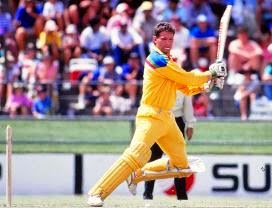
Both teams were, therefore, eager to register a win at the Gabba. The Australians elected to bat. But they were jolted by Kapil Dev as he removed both openers Geoff Marsh and Mark Taylor with just 31 on the board. David Boon and Dean Jones settled down to a fine partnership. They added 71 for the third wicket. Jones hit a typical 90 off 108 balls, characterised by hard running and flashing shots. He crashed 6 fours and 2 sixes. He explained his approach: "I try to come across as a player who enjoys the game and has a good time. The kids who see that will want to play the game as well. If you are full-on aggressive it gets through to people." Steve Waugh and Tom Moody also made valuable contributions. Then the Indian medium-pacers led by Manoj Prabhakar got into the swing of things. From 230 for five, Australia slumped to 237 for nine at the end of their 50 overs.

It was then that a flawed rule regarding interruption of play by rain began to cast a shadow over the tournament. As the weather gods intervened, three overs were lopped off the Indian innings, but the target score was reduced by only two runs. The reasoning behind this absurd rule was that while deducting the number of overs, the ones to be taken into account were those in which the team batting first had scored the least number of runs. So going through the scoring pattern of the Aussies it was found that in the three overs that they had scored the least, a sum total of two runs had accrued. This rule was to provoke much derisive laughter and anguish later in the tournament. Conventional logic, taking average scoring-rate into consideration, would have reduced India’s target to 224. But now India's target was 236 off 47 overs.

India made a dismal start as Krish Srikkanth was bowled for a duck. But skipper Mohammad Azharuddin was in prime form. On either side of the rain break, he was helped by Ravi Shastri and Sachin Tendulkar in rebuilding the innings. Kapil Dev, promoted up the order, scored a quick-fire 21. Then Sanjay Manjrekar joined his captain, and the two put on 66 for the fifth wicket.

Azharuddin was run out for a brilliant 93 off 103 balls with ten boundaries. Then the Indian innings began to come unstuck. Ajay Jadeja went for one, and Manjrekar too was run out for 47 off 42 balls with 3 fours and a six. India needed 13 off the final over with three wickets in hand. Strangely, the 6 feet 8 inches non-regular bowler Tom Moody sent down the pulsating last over. Kiran More flicked the first two balls to square-leg for fours. Now five runs were required off four deliveries. More got carried away, missed, and his middle stump broke into two. A single was scampered off the fourth ball. But Prabhakar was run out off the fifth.


Four runs were needed off the last ball. Javagal Srinath swung hard and high but straight to Steve Waugh who dropped the catch. But he recovered quickly and threw the ball back. Venkatapathy Raju was going for the run that would have tied the scores. The throw beat him and Australia won a dramatic match by one run. For the second time in the World Cup, Australia pipped India by this razor-thin margin.

Australia        : 237 for 9 wickets (50 overs)
India               : 234 all out (47 overs)

(Author Indra Vikram Singh can be contacted on email singh_iv@hotmail.com).

The Big Book of World Cup Cricket 1975-2011

ISBN 978-81-901668-4-3

Distributed in India by Variety Book Depot, Connaught Place, New Delhi, Phones + 91 11 23417175, 23412567

Available in leading bookshops, and online on several websites.