Showing posts with label Lala Amarnath. Show all posts

Sunday, November 17, 2024

On the eve of the Australia-India Test series 2024-25, flashback to Don Bradman’s 100th First-class hundred in 1947-48. Excerpt from Indra Vikram Singh’s book ‘Don’s Century’


K.S. Duleepsinhji, Don Bradman and Lala Amarnath during India's tour of Australia in 1947-48.  

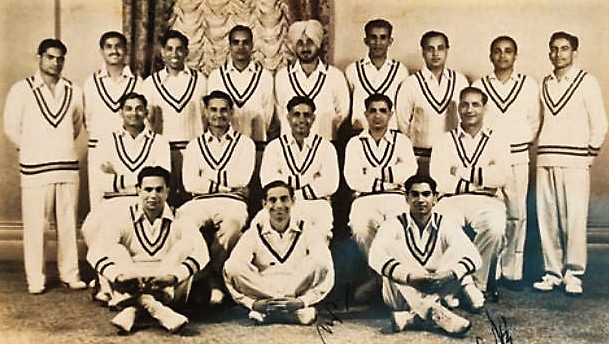
Appropriately, independent India’s first Test series was against Bradman’s Australians. The Don was a much loved and worshipped figure in India. It was said that apart from his own country, Bradman received the most letters from India. A succession of Indian cricketers from the captain of the 1947-48 team Lala Amarnath, to the present demi-god Sachin Tendulkar, spoke about their admiration and awe of Bradman, and many of them kept in regular touch with him, exchanging greetings and letters and speaking over the phone.

The Indian team missed a few of its top players. Vijay Merchant, who was designated captain, had to withdraw owing to health problems, as did Rusi Modi. Mushtaq Ali had a bereavement, while Fazal Mahmood, based in Lahore, was now a citizen of newly-created Pakistan. A fortnight before the Test series, there was a match between an Australian XI and the touring Indians at Sydney. Prior to this Bradman had scored his 99th first-class century in a Sheffield Shield game. A huge crowd congregated at the Sydney Cricket Ground in anticipation of the great man’s 100th hundred. The Indian team batted first and was all out for 326 on the second morning. Rob Lurie, Australian High Commissioner in India more than half a century later, was a wide-eyed young spectator on that historic occasion.

He wrote in a special issue of Cricket Talk in September 2000 to commemorate the 92nd (and as it, sadly, turned out, last) birthday of Sir Donald Bradman: “The day was overcast. Bradman, by his standards at least, started sedately and for much of the pre and early after lunch sessions Miller was the dominant partner. So much so that when he reached his half-century before Bradman and to a rapturous reaction from the crowd, it looked as though the day belonged to Miller rather than to his captain. But a remarkable change came over the game as Miller suddenly seemed to appreciate this fact and went into his shell, working the strike so that Bradman had a good deal of the bowling and limiting his own flamboyant strokeplay to the occasional trademark and sublime cover drive. Bradman meanwhile got on with things with superb judgement, placement and running between the wickets until he reached 99 in the last over before tea. You can imagine how we all felt - Bradman later wrote ‘even in the most exciting Test match I can never remember a more emotional crowd nor a more electric atmosphere’.“

The High Commissioner continued: “Amarnath threw the ball to (Gogumal) Kishenchand. In my view this was a very shrewd move as Bradman like most of us in the crowd, had never seen him bowl, and the element of surprise can be critical at such a moment. Bradman was very careful with the first ball but the second he played off his pads on the on-side. As he and Miller ran through for the single, a huge cheer engulfed the ground and the Indian team rushed to congratulate a man they admired and liked. My family and I joined with many thousands in repeated singing of the refrain ‘For He’s a Jolly Good Fellow’.” Bradman himself recalled that cherished instant in his Farewell to Cricket: “Finally, with my score on 99, Amarnath called on G. Kishenchand, who was fielding on the boundary. He had not bowled before and I had no idea what type of bowler he was. It was a shrewd move, as one could have so easily been deceived but I treated him with the greatest respect until eventually came a single to mid-on and the great moment had arrived.”

Don Bradman sprinting for the 100th run of his 100th First-class hundred.


High Commissioner Lurie added, “After tea Bradman cut loose and in 45 minutes scored an extraordinary, even by his standards, 72 runs marred only by the injury to a spectator by a very big six over long-on.“ Bradman revealed in Farewell to Cricket that he felt obliged to give the crowd which had so cheered his achievement some reward for its wonderful feelings towards him. 

It was unheard for anyone except those who played in English first-class cricket to log up a hundred centuries because nowhere else were sufficient matches played to enable a batsman achieve the feat. That Bradman reached the landmark is hardly surprising, and this only underlines the huge gulf between him and the others. Indeed Amarnath, in his brusque and inimitable way wrote in The Sportstar, “I always considered him a Derby horse; the others were horses before the cart.” Of the hundredth run of that famous innings, Raymond Robertson-Glasgow stated, “at the historical statistical moment, when Bradman was about to go from 99 to 100 there was the Indian bowler trying to deliver the ball with one hand and applaud with the other, a feat that is beyond the most enthusiastic practitioner.”

To give an idea of how difficult it was for non-English first-class batsmen to score a hundred centuries, Bradman scored 41 tons in four English seasons, but 72 three-figure knocks in his 14 full Australian seasons, not considering his first and last seasons, and two seasons during the war when he played just a few games. In England he scored more than 10 hundreds per season, while in Australia he averaged just above five centuries in a season. That was because he played 120 innings in those four English seasons, but only 197 innings in his 14 full Australian seasons. If Bradman was English he would have scored 200 centuries, wet wickets or otherwise. Hobbs - whose career was about a decade longer - scored 197 hundreds in 1315 innings (a century every 6.67 innings); Bradman hit up 117 hundreds in 338 innings (a century every 2.88 innings). (Hobbs’ tally was revised to 199 centuries later).

Back to his 100th hundred, Bradman was determined to get it in that innings. That is why he began slowly, got his eye in, assessed the wicket and the bowling, and accelerated when well set. That is what he usually did, but on this occasion it might have been a bit more exaggerated. Indian vice-captain Vijay Hazare observed this tendency, and he said in an interview with Cricket Talk: “He used to take a lot of singles and rotate the strike in the initial phase of his innings.” C.S. Nayudu supplemented this as he told The Sportstar, “His footwork was lightning fast and I have not known a batsman with a better technique and class. After the initial period when he would gauge the pitch and the attack, it was almost impossible to contain him.”

Thursday, January 3, 2019

With the Indian team endeavouring to win their first Test series in Australia, a glimpse into the cordial relations between Don Bradman and the Indian players during the first tour Down Under in 1947-48. Excerpt from Indra Vikram Singh’s book ‘Don’s Century’


Indian team arriving at Adelaide for the 1947-48 tour to Australia.
In his Farewell to Cricket, Bradman paid compliments to Amarnath: “I look back on the season with him as my opposite number as one of my most pleasant years. Lala, as he was called, certainly believed in speaking his mind at all times and was not averse to expressing his opinion in regard to a controlling authority or an individual but in Australia he always did with the utmost courtesy and tact. Amarnath was such a splendid ambassador and throughout the tour, I found him and (Pankaj) Gupta (manager) absolutely charming in every respect. They co-operated in all conceivable ways to try and make the games enjoyable and the most wonderful spirit of camaraderie existed between the Australian and Indian players.”

Amarnath, on his part, was unstinted in his praise for Bradman. He wrote in The Sportstar: “I am yet to see another Bradman. Probably none would in the times to come. When people make comparisons between Bradman and others, I laugh. Such was Bradman’s mastery that even Test cricket was One-day cricket for him. Has anyone made 300 in a day in a Test? So please don’t insult The Don by making silly comparisons. I know he never came to India but then it was good for our bowlers. On our pitches, where the ball does nothing, it would have been like going shopping for him and he would have batted day and night.”

Regarding the characteristics of Bradman’s batting, Amarnath observed: “Bradman’s eyesight was remarkable. He would spot the ball so easily, when batting or fielding. Bradman was essentially a back-foot player. And an absolute delight to watch. Among the shots he played, the pull obviously was the most outstanding. He could pull any ball from anywhere, even those going away on the off-stump. His square-cut came from the middle of the bat and the speed with which the ball travelled to the boundary was amazing. I remember in the first Test at Brisbane, he played a square-cut off (S.W.) Sohoni and the ball came back five yards after hitting the fence.”

Hazare referred to Bradman’s tendency to often run, or jog, back to the pavilion after being dismissed. In an article in The Week, Hazare stated: “Whenever he got out, he always used to run to the pavilion! He never questioned the umpire’s decision. Most of the time he started running to the pavilion even before the umpire’s finger went up. We didn’t find him getting angry on the field. He was a cool person. He didn’t want to waste energy on anger.” Bradman’s exit was quite in contrast to his entry towards the crease. Then he would walk in slowly, collecting his thoughts, taking in the atmosphere, getting used to the light. When his job was done he would depart hurriedly, getting away from the heat of battle to relax and rejuvenate in the dressing room.

Sarwate spoke more about the personal qualities of Bradman. He said in The Sportstar: “He was a great tactician, a great captain. But he was also a great sportsman, a perfect gentleman and a true ambassador for cricket. I have not seen many opponents appreciating a good stroke or a good ball. The Don always had nice words if you played a good shot or bowled a good ball to him. Signs of a good sportsman who appreciates a good act and it did not really matter to him if the player was on his side or the other.” Sarwate also recalled in The Week, “Don was very confident but not arrogant and that was the way he behaved with us. He never tried to show that they were playing against a very inferior side.” All this may sound bizarre and outlandish in the modern age of sledging. True, this is a very different era, of cut-throat commercialism, but abuse on the field is certainly a bane of present-day cricket. If players find it difficult to be gentlemanly nowadays, they should at least refrain from being loutish, particularly in this electronic age when impressionable minds watching on live television are quick to imbibe crass behaviour as being an acceptable way of life.    

Equally effusive in his appreciation of The Don, C.S. Nayudu also told The Sportstar: “As a cricketer he had no match and he was simply a lovable character as a down-to-earth human being. I know people said he was aloof at times, but we all found him such an easily approachable man.” The verdict was unanimous. Bradman and the Indians got along very well.

Author Indra Vikram Singh can be contacted on email singh_iv@hotmail.com.
Follow him on:


Don’s Century is available at an attractive price on Amazon: https://www.amazon.in/dp/8190166859

Other books by Indra Vikram Singh available on Amazon:
A Maharaja’s Turf  https://www.amazon.in/dp/8190166832
The Big Book of World Cup Cricket  https://www.amazon.in/dp/8190166840

Wednesday, December 12, 2018

As the Indian cricket team tours Down Under, a flashback to Don Bradman’s 100th first-class hundred that he scored against the first Indian team to visit Australia in 1947-48. Excerpt from Indra Vikram Singh’s book ‘Don’s Century’


Appropriately, independent India’s first Test series was against Bradman’s Australians. The Don was a much loved and worshipped figure in India. It was said that apart from his own country, Bradman received the most letters from India. A succession of Indian cricketers from the captain of the 1947-48 team Lala Amarnath, to the present demi-god Sachin Tendulkar, spoke about their admiration and awe of Bradman, and many of them kept in regular touch with him, exchanging greetings and letters and speaking over the phone.

The Indian team missed a few of its top players. Vijay Merchant, who was designated captain, had to withdraw owing to health problems, as did Rusi Modi. Mushtaq Ali had a bereavement, while Fazal Mahmood, based in Lahore, was now a citizen of newly-created Pakistan. A fortnight before the Test series, there was a match between an Australian XI and the touring Indians at Sydney. Prior to this Bradman had scored his 99th first-class century in a Sheffield Shield game. A huge crowd congregated at the Sydney Cricket Ground in anticipation of the great man’s 100th hundred. The Indian team batted first and was all out for 326 on the second morning. Rob Lurie, Australian High Commissioner in India more than half a century later, was a wide-eyed young spectator on that historic occasion.

He wrote in a special issue of Cricket Talk in September 2000 to commemorate the 92nd (and as it, sadly, turned out, last) birthday of Sir Donald Bradman: “The day was overcast. Bradman, by his standards at least, started sedately and for much of the pre and early after lunch sessions Miller was the dominant partner. So much so that when he reached his half-century before Bradman and to a rapturous reaction from the crowd, it looked as though the day belonged to Miller rather than to his captain. But a remarkable change came over the game as Miller suddenly seemed to appreciate this fact and went into his shell, working the strike so that Bradman had a good deal of the bowling and limiting his own flamboyant strokeplay to the occasional trademark and sublime cover drive. Bradman meanwhile got on with things with superb judgement, placement and running between the wickets until he reached 99 in the last over before tea. You can imagine how we all felt - Bradman later wrote ‘even in the most exciting Test match I can never remember a more emotional crowd nor a more electric atmosphere’.“

The High Commissioner continued: “Amarnath threw the ball to (Gogumal) Kishenchand. In my view this was a very shrewd move as Bradman like most of us in the crowd, had never seen him bowl, and the element of surprise can be critical at such a moment. Bradman was very careful with the first ball but the second he played off his pads on the on-side. As he and Miller ran through for the single, a huge cheer engulfed the ground and the Indian team rushed to congratulate a man they admired and liked. My family and I joined with many thousands in repeated singing of the refrain ‘For He’s a Jolly Good Fellow’.” Bradman himself recalled that cherished instant in his Farewell to Cricket: “Finally, with my score on 99, Amarnath called on G. Kishenchand, who was fielding on the boundary. He had not bowled before and I had no idea what type of bowler he was. It was a shrewd move, as one could have so easily been deceived but I treated him with the greatest respect until eventually came a single to mid on and the great moment had arrived.”

Don Bradman sprinting for his 100th run to complete 100 First-class Hundreds.

High Commissioner Lurie added, “After tea Bradman cut loose and in 45 minutes scored an extraordinary, even by his standards, 72 runs marred only by the injury to a spectator by a very big six over long-on.“ Bradman revealed in Farewell to Cricket that he felt obliged to give the crowd which had so cheered his achievement some reward for its wonderful feelings towards him. 

It was unheard for anyone except those who played in English first-class cricket to log up a hundred centuries because nowhere else were sufficient matches played to enable a batsman achieve the feat. That Bradman reached the landmark is hardly surprising, and this only underlines the huge gulf between him and the others. Indeed Amarnath, in his brusque and inimitable way wrote in The Sportstar, “I always considered him a Derby horse; the others were horses before the cart.” Of the hundredth run of that famous innings, Raymond Robertson-Glasgow stated, “at the historical statistical moment, when Bradman was about to go from 99 to 100 there was the Indian bowler trying to deliver the ball with one hand and applaud with the other, a feat that is beyond the most enthusiastic practitioner.”

To give an idea of how difficult it was for non-English first-class batsmen to score a hundred centuries, Bradman scored 41 tons in four English seasons, but 72 three-figure knocks in his 14 full Australian seasons, not considering his first and last seasons, and two seasons during the war when he played just a few games. In England he scored more than 10 hundreds per season, while in Australia he averaged just above five centuries in a season. That was because he played 120 innings in those four English seasons, but only 197 innings in his 14 full Australian seasons. If Bradman was English he would have scored 200 centuries, wet wickets or otherwise. Hobbs - whose career was about a decade longer - scored 197 hundreds in 1315 innings (a century every 6.67 innings); Bradman hit up 117 hundreds in 338 innings (a century every 2.88 innings). 

Back to his 100th hundred, Bradman was determined to get it in that innings. That is why he began slowly, got his eye in, assessed the wicket and the bowling, and accelerated when well set. That is what he usually did, but on this occasion it might have been a bit more exaggerated. Indian vice-captain Vijay Hazare observed this tendency, and he said in an interview with Cricket Talk: “He used to take a lot of singles and rotate the strike in the initial phase of his innings.” C.S. Nayudu supplemented this as he told Vijay Lokapally of The Sportstar, “His footwork was lightning fast and I have not known a batsman with a better technique and class. After the initial period when he would gauge the pitch and the attack, it was almost impossible to contain him.”

Author Indra Vikram Singh can be contacted on email singh_iv@hotmail.com.
Follow him on:
Blogs: singhiv.wordpress.com  and indravikramsingh.blogspot.in
Facebook: https://www.facebook.com/ivsingh and https://www.facebook.com/Indra-Vikram-Singh-478036209195171/
Twitter: https://twitter.com/IVRajpipla

Don’s Century is available at an attractive price on Amazon: https://www.amazon.in/dp/8190166859

Other books by Indra Vikram Singh available on Amazon:
The Big Book of World Cup Cricket  https://www.amazon.in/dp/8190166840

Thursday, July 27, 2017

What Indian cricketers from the Australian tour of 1947-48 felt about Don Bradman. Excerpt from Indra Vikram Singh’s book ‘Don’s Century’


Amarnath, on his part, was unstinted in his praise for Bradman. He wrote in The Sportstar: “I am yet to see another Bradman. Probably none would in the times to come. When people make comparisons between Bradman and others, I laugh. Such was Bradman’s mastery that even Test cricket was One-day cricket for him. Has anyone made 300 in a day in a Test? So please don’t insult The Don by making silly comparisons. I know he never came to India but then it was good for our bowlers. On our pitches, where the ball does nothing, it would have been like going shopping for him and he would have batted day and night.”

Regarding the characteristics of Bradman’s batting, Amarnath observed: “Bradman’s eyesight was remarkable. He would spot the ball so easily, when batting or fielding. Bradman was essentially a back-foot player. And an absolute delight to watch. Among the shots he played, the pull obviously was the most outstanding. He could pull any ball from anywhere, even those going away on the off-stump. His square-cut came from the middle of the bat and the speed with which the ball travelled to the boundary was amazing. I remember in the first Test at Brisbane, he played a square-cut off (S.W.) Sohoni and the ball came back five yards after hitting the fence.”

Hazare referred to Bradman’s tendency to often run, or jog, back to the pavilion after being dismissed. In an article in The Week, Hazare stated: “Whenever he got out, he always used to run to the pavilion! He never questioned the umpire’s decision. Most of the time he started running to the pavilion even before the umpire’s finger went up. We didn’t find him getting angry on the field. He was a cool person. He didn’t want to waste energy on anger.” Bradman’s exit was quite in contrast to his entry towards the crease. Then he would walk in slowly, collecting his thoughts, taking in the atmosphere, getting used to the light. When his job was done he would depart hurriedly, getting away from the heat of battle to relax and rejuvenate in the dressing room.

Sarwate spoke more about the personal qualities of Bradman. He said in The Sportstar: “He was a great tactician, a great captain. But he was also a great sportsman, a perfect gentleman and a true ambassador for cricket. I have not seen many opponents appreciating a good stroke or a good ball. The Don always had nice words if you played a good shot or bowled a good ball to him. Signs of a good sportsman who appreciates a good act and it did not really matter to him if the player was on his side or the other.”

Sarwate also recalled in The Week, “Don was very confident but not arrogant and that was the way he behaved with us. He never tried to show that they were playing against a very inferior side.” All this may sound bizarre and outlandish in the modern age of sledging. True, this is a very different era, of cut-throat commercialism, but abuse on the field is certainly a bane of present-day cricket. If players find it difficult to be gentlemanly nowadays, they should at least refrain from being loutish, particularly in this electronic age when impressionable minds watching on live television are quick to imbibe crass behaviour as being an acceptable way of life.    

Equally effusive in his appreciation of The Don, C.S. Nayudu also told The Sportstar: “As a cricketer he had no match and he was simply a lovable character as a down-to-earth human being. I know people said he was aloof at times, but we all found him such an easily approachable man.” The verdict was unanimous. Bradman and the Indians got along very well.

(Author Indra Vikram Singh can be contacted on email singh_iv@hotmail.com. Follow Indra Vikram Singh on Twitter @IVRajpipla).

Don’s Century
Published by Sporting Links
ISBN 978-81-901668-5-0, Fully Illustrated
French Fold 21.5 cm x 28 cm, 188 Pages
Price Rupees 995

Indra Vikram Singh’s latest books published by Sporting Links:
A Maharaja’s Turf  ISBN 978-81-901668-3-6
The Big Book of World Cup Cricket  ISBN 978-81-901668-4-3
Don’s Century  ISBN 978-81-901668-5-0
Crowning Glory  ISBN 978-81-901668-6-7
Distributed in India by:  Variety Book Depot, AVG Bhawan, M-3 Middle Circle, Connaught Circus, New Delhi-110001, India. Tel. + 91 11 23417175, 23412567, Email varietybookdepot@gmail.com.