Showing posts with label Charles Macartney. Show all posts

Saturday, May 14, 2022

Don Bradman’s astounding record triple century in the Leeds Test of 1930. Excerpt from Indra Vikram Singh's book 'Don's Century'

 
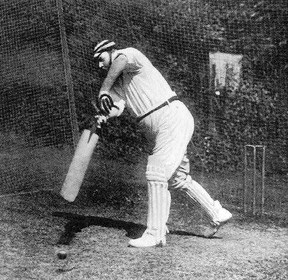
Young Don Bradman in action during the course of his matchless triple hundred in a day in the Leeds Test of 1930. On the second day he broke Andy Sandham’s Test record by hitting up 334 runs, and became the first to notch up the highest scores in first-class as well as Test cricket. Brian Lara emulated him 64 years later. 
 
It was Maurice Tate again who should have bowled Don Bradman with a vicious in-cutter for a duck at Headingley. “My first ball missed the off-peg by a coat of varnish,” rued Tate. Wicketkeeper George Duckworth threw up his hands in jubilation only to let the ball through for four byes. Bradman had walked in to face the twelfth ball of the match after Archie Jackson had been dismissed cheaply. 

Unfazed by the close shave, Bradman went on the attack. He reached his fifty in 49 minutes, out of a total of 61. His partner Woodfull was, for the most part, a bystander. The Australian hundred was up in 80 minutes, with Bradman on 81 and Woodfull 17. The skipper did the sensible thing, taking singles and giving his young star most of the strike. Bradman pulled Larwood to reach his hundred, fourth in consecutive Test matches. 

At lunch he was on 105, with Woodfull having advanced to 29, out of a total of 136. Only two others had hit up a century before lunch on the first day of a Test, both Australians against England, Victor Trumper at Manchester in 1902, and Charlie Macartney, who like Bradman had Woodfull as partner on the same ground at Leeds four summers earlier in 1926. Pakistan’s Majid Khan joined the club in 1976-77 against New Zealand at Karachi. Four decades later, Australian David Warner achieved the feat against Pakistan in 2016, followed by India’s Shikhar Dhawan off the Afghan attack in 2018.
Hundred before lunch. Bradman coming in for lunch with a century already under his belt on the first day, emulating the feats of compatriots Victor Trumper and Charlie Macartney. Pakistan’s Majid Khan, Australian David Warner and India’s Shikhar Dhawan joined the club later.

Woodfull departed at 194, having reached a customary sedate 50. Bradman rattled up the fastest Test double century in 214 minutes, quicker than Trumper’s 226-minute effort against South Africa at Adelaide in 1910-11, and his own 234 minutes of brilliance in the previous Test at Lord’s. It is reckoned that Bradman played uppishly only twice, when he was on 141 and 202, eluding mid-on, but was otherwise in total command. By tea he was on 220, his partner now being Alan Kippax. 

Bradman got his first chance of the series after 15 hours of batting when the weary Duckworth dropped a difficult one off George Geary. He was then on 273. With Kippax he put on 229 for the third wicket. Bradman reached his triple century in 336 minutes. It is still the second-quickest ever recorded in terms of time after Hammond who clocked up the coveted figure in 288 minutes against New Zealand at Auckland in 1932-33. At stumps The Don was unbeaten on 309, the only instance in Test history of a batsman scoring three hundred runs in a day. Australia were 458 for three. During the course of this exciting day, Bradman passed 1000 runs in only the 13th innings of his 7th Test match. 

That evening Bradman noted: “My feet are awfully tired, but I could have gone on if it hadn’t been the close. I am happy to have beaten the record (Englishman R.E. Foster’s 287 in Ashes contests), but happier still to think Australia is in such a good position. I believe I have been credited with the intention of going on to score 500! Nothing so ambitious crossed my mind. I consider I was lucky to strike my best form on an ideal batsman’s wicket.” 

On the second morning Bradman surpassed Andy Sandham’s Test record of 325 achieved against the West Indies at Kingston the previous winter. He was finally taken by Duckworth, Tate claiming his wicket for the fifth and last time. It was obviously a tremendous innings lasting 383 minutes, his 334 off 448 balls studded with 46 boundaries, and containing 6 threes, 26 twos and 80 singles. The next highest was Kippax’s 77. Bradman was sixth out at 508; Australia folded up for 566. 

A delighted admirer, England-based Australian businessman Arthur Whitelaw, presented Bradman a purse of ₤ 1000 for the record innings. It was a princely sum considering that each of the Australian players received ₤ 600 for the entire tour. That Bradman did not share his bounty, or any part of it, with his teammates caused considerable heartburn. The new record-holder, prudent as ever in matters financial, wasted no time in depositing the windfall in his future wife Jessie’s account in the Commonwealth Bank, where she was employed. 

“It was an innings that will be remembered not only for its magnitude but for its magnificence,” wrote former England captain Pelham Warner. “It is impossible,” he continued, “to imagine greater batting. It was glorious. To call him a run-getting machine, as he has been called, is a poor compliment that rather implies that the runs are ground out with a roar and a clash and a clatter, while as a fact he makes his runs easily, smoothly and naturally with the mark of genius throughout. He is never flurried or in any apparent hurry, and yet runs come from his bat almost as fast as bullets from a machine gun; there has never been a batsman who in match after match had claimed such a huge proportion of the runs scored.” Ominously and, as it turned out, ironically, Warner concluded, “We must if possible, evolve a new type of bowler and develop fresh ideas on strategy and tactics to curb his almost uncanny skill.” 

He may have mesmerised the onlookers, but Bradman himself was not entirely impressed by his own feat. In his autobiography Farewell to Cricket that he wrote after retirement, Bradman reflected: “Whilst admitting that my form was excellent, I have always maintained it was not such a good innings as the previous one at Lord’s. It was made perhaps at a slightly faster rate and included a century before lunch on the first day after Jackson had been dismissed for 1, but there were blemishes in strokeplay of which I was well aware.” Clearly, the perfectionist that he was, Bradman was not satisfied with his record-shattering effort. That is what made him the champion that he was. 

A boy of fourteen from Pudsey, Yorkshire, was also at Headingley on that pulsating opening day. His name: Len Hutton. He already hero-worshipped Bradman and as he wrote 58 years later in The Observer, paying tribute to The Don on his 80th birthday, “Bradman made his way to the wicket very slowly on that sunny morning.” Ruminating on the day’s play, Hutton observed: “This was batsmanship of a class never seen before; a ruthless, systematic destruction of an English attack that included Larwood, Tate, Geary, Dick Tyldesley and Hammond. Even when he made an error in that astonishing 334 at Leeds he was quick enough to profit. He charged at one of Tyldesley’s slow leg-breaks, slipped when well out of his crease and just as Duckworth was waiting to collect the ball to effect the stumping, Bradman somehow got his bat to the ball as he fell, cut it down to third man and, instead of being out, got away with a single.” That is called a stroke of genius. 

In his book Fifty Years in Cricket, Hutton wrote: “The speed of Bradman’s footwork and the ease with which he found, and even created gaps in the field were a revelation, and an abiding memory. He put the ball exactly where he wanted it to go – and that is no exaggeration. England’s captain Percy Chapman admittedly did not have the fleetest of fielding sides, but no matter how he tried, he could not plug the holes. They appeared everywhere, and no sooner was one filled than another was exposed. For example, if third-man was placed square, Don would steer between slip and gully. If Chapman tried to move third-man finer, Don would thump the move with a fierce square cut, a stroke he played to perfection. And so it went on. Bradman aimed for the maximum result from every stroke, and he saw no advantage in hitting hard and straight to a fielder.” That evening the wide-eyed Hutton rushed back to Pudsey, found two bowlers to practise against and tried to emulate Bradman till the midsummer light faded completely. 

The doyen of writers, Neville Cardus, was in the press box, and he wrote later in his book Play Resumed with Cardus: “At Leeds Bradman announced his rights to mastership in a few swift moments. He made 72 runs in his first hour at the wicket, giving to us every bit of cricket excepting the leg-glance. Every fine point of batsmanship was to be admired; strokes powerful and swift and accurate and handsome; variety of craft controlled with singleness of mind and purpose. Bradman was as determined to take no risks, as was to hit boundaries from every ball the least loose. And his technique is so extensive and practised that he can get runs at the rate of 50 an hour, without once needing to venture romantically into the realms of the speculative or the empirical.” In simple terms it meant that Bradman had the ability to turn good balls into bad, and never failed to punish the bad ones. 

Lest we forget, there was still a match on. Rain permitted only 45 minutes’ play on the third day, and though England were forced to follow on despite a Hammond hundred, there was never a chance of a result thereon. That was maybe another reason why Bradman was a little bit less than satisfied with this innings. So far in this series he had scored a century, double century and triple century in consecutive Tests. 

(Author Indra Vikram Singh can be contacted on email singh_iv@hotmail.com).

Don’s Century
 
Published in India by Sporting Links 
ISBN 978-81-901668-5-0 
Fully illustrated 
Paperback French Fold 
11 x 8.5 x 0.4 inches 
Weight 480 grams 
188 pages 


Available on Amazon at an attractive price: https://www.amazon.in/dp/8190166859 

Indra Vikram Singh's other books available on Amazon: https://www.amazon.in/s?k=Indra+Vikram+Singh&i=stripbooks&rh=p_6%3AA3HSV0N9AV7NOK&dc&qid=1602408830&rnid=1318474031&ref=sr_nr_p_6_1

Friday, March 11, 2022

Observations of the doyen of writers Neville Cardus on Don Bradman


The doyen of writers, Sir Neville Cardus, was in the press box when Don Bradman scored his 334 at Leeds in 1930. He wrote later in his book Play Resumed with Cardus: “At Leeds Bradman announced his rights to mastership in a few swift moments. He made 72 runs in his first hour at the wicket, giving to us every bit of cricket excepting the leg-glance. Every fine point of batsmanship was to be admired; strokes powerful and swift and accurate and handsome; variety of craft controlled with singleness of mind and purpose. Bradman was as determined to take no risks, as was to hit boundaries from every ball the least loose. And his technique is so extensive and practised that he can get runs at the rate of 50 an hour, without once needing to venture romantically into the realms of the speculative or the empirical.”

Countering the criticisms of Bradman, Neville Cardus put forward his argument with customary finesse: “People say ‘Oh, but he hasn’t the charm of McCabe, or the mercury of MacCartney, or the dignity of Hammond; the objection is a little unintelligent, as though a lion was criticized for lacking the delicacy of the gazelle, the worrying tenacity of the terrier and the disdainful elegance of a swan or a camel.”

Cardus summed up his views of Bradman with his famous observation, “Bradman’s achievements stagger the imagination. No writer of boys’ fiction would dare to invent a hero who performed with Bradman’s continual consistency. His batsmanship delights one’s knowledge of the game, his every stroke is a dazzling and precious stone in the game’s crown”.

(Source: Indra Vikram Singh’s book ‘Don’s Century’, a cricketing biography of Don Bradman and a panorama of batting from the 1860s to present times).

Don’s Century

Published in India by Sporting Links

ISBN 978-81-901668-5-0

Fully illustrated

Paperback French Fold 11 x 8.5 x 0.4 inches

Weight 480 grams

188 pages


Available on Amazon at an attractive price: https://www.amazon.in/dp/8190166859  

Indra Vikram Singh's other books available on Amazon: 

https://www.amazon.in/s?k=Indra+Vikram+Singh&i=stripbooks&rh=p_6%3AA3HSV0N9AV7NOK&dc&qid=1602408830&rnid=1318474031&ref=sr_nr_p_6_1

Thursday, September 12, 2019

The three great innings of Stan McCabe. Excerpt from Indra Vikram Singh’s book ‘Don’s Century’


One of Bradman’s compatriots in the Australian middle-order through the 1930s was Stan McCabe. He was every bit a top-class player, orthodox yet aggressive, and one of the least heralded. His status was perhaps akin to V.V.S. Laxman of modern times, ever the artist but forced to live in the shadows of the mighty Sachin Tendulkar, the reliable Rahul Dravid, the delightful Sourav Ganguly and the maverick Virender Sehwag. McCabe’s deeds were eclipsed by the prodigious run-getting of Bradman and Ponsford.

187 not out versus England at Sydney, 1932-33
Just as Laxman’s memorable knocks against the world’s best team, Australia, notably his astonishing 281 at Kolkata in 2001 will ever remain etched in the minds of the public and critics alike, so have been brilliant innings of McCabe for over 80 years already. His courageous, defiant unbeaten 187 at Sydney in the first Test of the 1932-33 Bodyline series was a terrific riposte under daunting circumstances. Bradman did not play that Test due to his dispute with the Australian Board of Control. As McCabe stood up boldly to the short-pitched stuff and hooked it disdainfully, critics concluded that he handled Douglas Jardine’s abominable leg-theory with greater finesse than Bradman.

Learie Constantine in his The Young Cricketer’s Companion wrote: “When Larwood went to Australia and tied Bradman and most of the rest of them in sheep bends and clove hitches and made some batsmen drop their bats and others sit on their wickets, it was McCabe who improvised a daring hook to the leg boundary and made a brilliant century against bodyline as he has done against most other kinds of bowling without the least favouritism.”

189 not out versus South Africa at Johannesburg, 1935-36
If his display at Sydney revealed a tough mind, McCabe’s performance at high altitude at Johannesburg’s Old Wanderers in 1935-36 was a triumph of skill over limitations imposed by physical distress. With Australia at 85 for one, chasing another 314 for a win on the fourth and final day, McCabe, short of breath as a result of the rarefied air, and bleary of eye for the sleepless night he had spent, was in no condition to bat. He informed Vic Richardson of his discomfort. The skipper, in no position to oblige, urged his star batsman - Bradman could not join the tour - to continue his innings, then anchored at 59: “If the altitude gets to you, don’t run. Just hit fours.”

Left with no option, McCabe breezed out to the crease with the other not out, Jack Fingleton. Deliveries leapt and turned square on the dusty wearing track, but McCabe’s elegant shots found the gaps time and time again. He raised his hundred in 91 minutes, fourth quickest at the time after the feats of Jack Gregory (70 minutes in 1921-22 at this very venue), Gilbert Jessop (75 minutes in 1902) and James Sinclair (80 minutes in 1902-03). He clocked up an exact 100 before lunch, carving out 20 boundaries. Australia now needed 182 runs to win in two full sessions. Fingleton offered a broad blade and when he was castled for 40, the partnership was worth 177, of which McCabe’s share was 148. Fingleton recalled, “McCabe’s innings seemed like a crazy dream to me.”

As the thunderclouds drifted in from the northwest, the South African captain Herbert Wade appealed against the light on the plea that McCabe’s ferocious strokeplay was endangering his fielders! It was still only 2.45 in the afternoon and soon the heavens opened up with McCabe on 189, and Australia poised at 274 for two.

Ray Robinson wrote in Between the Wickets: “McCabe’s brilliance had so transformed the situation that, instead of struggling to stall off defeat, the Australians were playing like winners with 125 more to get and eight wickets in hand. He had batted three and a quarter hours for his 189, while 66 were scored at the other end. He hit 29 4s, probably a record for a Test innings under 200.” He was indeed following his skipper’s instructions to a tee, and in the process South African Dudley Nourse’s second innings 231 was forgotten.

Don Bradman (left) and Stan McCabe walking out to bat.

232 versus England at Nottingham, 1938
The third signature McCabe knock was at Trent Bridge in 1938, marked by exquisite strokeplay. He came to the crease at the fall of Bradman’s wicket. It was a breathtaking innings of 232 in only 230 minutes, during which eight of his partners departed, having managed a mere 68 all told, extras included. The next highest was Bradman’s 51. It was then the second-fastest double century in 223 minutes, after Bradman’s (in 214 minutes in 1930), and a shade quicker than Trumper’s (226 minutes in 1910-11).

Vic Marks noted: “The wicket was a lot easier than the time Jessop turned the tide, but McCabe’s strokeplay was purer with scarcely a hint of risk, and accompanied by masterly manipulation of the strike.” So awesome was the strokemaking that Bradman summoned his players - some of whom were playing cards - to the balcony, telling them: “You won’t see strokeplay like this again. McCabe hit 72 out of the last-wicket stand of 77 with Fleetwood-Smith in a matter of 28 minutes.”

The full significance of the innings was elaborated by Denzil Batchelor, when he observed: “McCabe had done a unique thing. Many men have won matches off their own bat. On this wicket, and with England’s skyscraping score, such a feat was not possible - so McCabe had done more. He had come in at a moment in history when it seemed certain that the sun was about to set on a long period in Australian ascendancy. McCabe, by his own efforts, had stopped the sun, and saved the Australian empire.” The series was ultimately drawn 1-1.

Nicknamed ‘Napper’ for his striking resemblance to Napolean, he rekindled nostalgia for the strokeplay of Trumper and Macartney. As Ken Piesse wrote, “Impeccable footwork and his indomitable spirit in adversity made him one of Australia’s true greats.”

Constantine was of the opinion that “McCabe had a great range of strokes, and, though not such a complete master of the balls on the off-stump and just outside as Wally Hammond was, he was very strong at forcing strokes towards the on-side. I remember watching McCabe in a Test hitting across Verity’s leg-break and carting it round to the on-side. Hardly any batsman who has ever lived could have done it; yet McCabe brought stroke after stroke. They all came off, and the result was a spectacular and sparkling innings. If he had missed one of those patient, penetrating balls by the slightest bit of mistiming the result would have been a dismissal that looked terrible - the village blacksmith trying his arts on the past master of English bowling. Success, you see, excuses itself - ‘the head of the table is wherever McGregor sits’.” 

McCabe made 2748 runs in 39 Tests at an average of 48.21 with 6 hundreds, and he scored at a very rapid rate. When he died in 1968 at the age of 58 after falling from a cliff in Sydney, the game lost one of its most popular figures.

(Author Indra Vikram Singh can be contacted on email singh_iv@hotmail.com).

Don’s Century
Published in India by Sporting Links
ISBN 978-81-901668-5-0
Fully illustrated
Paperback French Fold 11 x 8.5 x 0.4 inches
188 pages

Thursday, November 9, 2017

The legendary writer Neville Cardus’ comments on some great cricketers

Sir Neville Cardus (1888-1975) was a famous English cricket writer, music critic and long-timecorrespondent of The Manchester Guardian. His comments on some great cricketers make interesting reading.


On W.G. Grace and K.S. Ranjitsinhji, in his book Good Days (1934): “In the ‘nineties the game was absolutely English; it was even Victorian. W.G. Grace for years had stamped on cricket the English mark and the mark of the period. It was the age of simple first principles, of the stout respectability of the straight bat and the good-length balls. 
And then suddenly this visitation of dusky, supple legerdemain happened; a man was seen playing cricket as nobody in England could possibly have played it. The honest length ball was not met by the honest straight bat, but there was a flick of the wrist, and lo! The straight ball was charmed away to the leg-boundary. And nobody quite saw or understood how it all happened.”


On Victor Trumper, Charles Macartney  and Don Bradman: “Macartney, perfect of technique, none the less used his bat with an unmistakable pugnacity. He was less courtly in his stroke-play than Trumper, whose masterful innings had a certain effortless charm. Sir Donald Bradman annihilated all bowlers as though he was just performing the day’s work with a deadly efficiency. Macartney slaughtered bowling quite rapaciously. If he was obliged to bat through a maiden over he looked annoyed with himself at the end of it; and he would gnaw his glove. His forearms were formidably strong, his chin was aggressive and his eyes perpetually alive. They looked you in the face; they looked the best bowlers in the world in the face. Macartney employed a defensive stroke as a last resort. Nothing could daunt him. Before the start of a Lord’s Test match he came down to breakfast in a London hotel, looking through the window at the June sunshine and said:- ‘Lovely day, Cripes, I feel sorry for any poor cove who’s got to bowl at me today’.”


On Don Bradman’s 334 in the Leeds Test of 1930, in his book Play Resumed with Cardus: “At Leeds Bradman announced his rights to mastership in a few swift moments. He made 72 runs in his first hour at the wicket, giving to us every bit of cricket excepting the leg-glance. Every fine point of batsmanship was to be admired; strokes powerful and swift and accurate and handsome; variety of craft controlled with singleness of mind and purpose. Bradman was as determined to take no risks, as was to hit boundaries from every ball the least loose. And his technique is so extensive and practised that he can get runs at the rate of 50 an hour, without once needing to venture romantically into the realms of the speculative or the empirical.”

On Don Bradman: “People say ‘Oh, but he hasn’t the charm of McCabe, or the mercury of MacCartney, or the dignity of Hammond’; the objection is a little unintelligent, as though a lion was criticized for lacking the delicacy of the gazelle, the worrying tenacity of the terrier and the disdainful elegance of a swan or a camel.”

On Don Bradman: “Bradman’s achievements stagger the imagination. No writer of boys’ fiction would dare to invent a hero who performed with Bradman’s continual consistency. His batsmanship delights one’s knowledge of the game, his every stroke is a dazzling and precious stone in the game’s crown.”


On Gary Sobers: “He makes a stroke with moments to spare. The sure sign of mastery, of genius of any order, is absence of strain, natural freedom of rhythm.”


(These comments are reproduced in Indra Vikram Singh’s book ‘Don’s Century’, written in the centenary year of Sir Donald Bradman, celebrating his life and cricket career, and also presenting a panorama of batting from the 1860s to present times).  


Don’s Century
Published by Sporting Links
ISBN 978-81-901668-5-0, Fully Illustrated
French Fold 21.5 cm x 28 cm, 188 Pages
Price Rupees 995

Indra Vikram Singh’s latest books published by Sporting Links:
A Maharaja’s Turf  ISBN 978-81-901668-3-6
The Big Book of World Cup Cricket  ISBN 978-81-901668-4-3
Don’s Century  ISBN 978-81-901668-5-0
Crowning Glory  ISBN 978-81-901668-6-7

Distributed in India by:  Variety Book Depot, AVG Bhawan, M-3 Middle Circle, Connaught Circus, New Delhi-110001, India. Tel. + 91 11 23417175, 23412567, Email varietybookdepot@gmail.com.

Available online at amazon.in:
https://www.amazon.in/s/ref=sr_hi_eb?rh=k%3AIndra+Vikram+Singh%2Cn%3A976389031&ie=UTF8&qid=1508325652&keyword=Indra+Vikram+Singh