Saturday, June 21, 2014

The Cricket World Cup - Classic Matches…..9 : Excerpt from ‘The Big Book of World Cup Cricket 1975-2011’ by Indra Vikram Singh

UNPRECEDENTED FEAT 
LIGHTS UP BRAND NEW STADIUM

South Africa v Sri Lanka  •  Providence Stadium,
28 March 2007


The first international match in the Providence Stadium, just outside Georgetown, the capital of Guyana, produced one of the most exciting matches in World Cup history. With the weather uncertain as well, Mahela Jayawardene took a brave call by electing to bat.

Sri Lanka lost wickets regularly with Charl Langeveldt forcing Sanath Jayasuriya and Jayawardene to hole out. Then Herschelle Gibbs flew into the stumps Jonty Rhodes-style to run out Chamara Silva. At 98 for five in the 25th over, South Africa were on top. Tillakaratne Dilshan and Russel Arnold put together a fighting 97-run stand off 130 deliveries. Dilshan (58) fell at 195 off the penultimate delivery of the 46th over, and then followed a veritable procession. In their bid to rev up the scoring rate, the Sri Lankans swung their bats, only to hit steepling catches. The beneficiary on three occasions was Langeveldt who returned with neat figures of five for 39 off his 10 overs. The last five Sri Lankan wickets fell for 14 runs in the space of 17 balls.

Chaminda Vaas struck back immediately, bringing in the last delivery of his first over sharply to castle Abraham de Villiers for a duck. Graeme Smith and Jacques Kallis settled into a long partnership. The skipper looked in ominous form, raising a-run-a-ball fifty. Muttiah Muralitharan had him caught behind but by then he had cracked 7 fours besides a six off Chaminda Vaas over long-off. Gibbs helped Kallis put on 65 runs. Magical Murali took a smart return catch to send back Gibbs, and then trapped Mark Boucher leg-before first ball. Justin Kemp scratched around for a while before perishing but Shaun Pollock helped Kallis take the Proteas to the doorstep of victory.

Four runs were required off 32 deliveries with five wickets in hand when Lasith Malinga’s pin-point yorker crashed into Pollock’s stumps. Next ball, Andrew Hall lobbed another slower one into the hands of Upul Tharanga in the covers. That was the end of ‘Slinger’ Malinga’s over. Just one run was scored off the next over but that ensured that Kallis would face Malinga’s hat-trick ball. The perky little paceman steamed in, his mop of ringlets bouncing up and down, and with his low round arm put the ball in just the right place. Kallis edged it into the gloves of Kumar Sangakkara. There was frenzy all around as Daryl Harper pointed his finger skywards. It was the fifth hat-trick in the World Cup following the feats of Chetan Sharma, Saqlain Mushtaq, Chaminda Vaas and Brett Lee.

Malinga was now a man possessed. He produced another yorker that whistled into Makhaya Ntini’s stumps, achieving a feat that no other bowler had done before in international cricket – four wickets in four balls. It was now 207 for nine. The next 11 deliveries produced just a single. With two runs required for a win, Robin Peterson edged Malinga to the third-man boundary. The tension released, Peterson went delirious as he sprinted towards the pavilion, knocking the stumps at the non-striker’s end with a wave of his bat. There was just a tinge of regret as Malinga relived those pulsating moments: “The old ball was reverse-swinging and I got the wickets. I tried to get five-in-a-row, but unfortunately couldn’t. I think we didn’t have enough runs.” Even so, he nearly achieved the impossible.   

Sri Lanka       : 209 all out (49.3 overs)
South Africa : 212 for 9 wickets (48.2 overs)

(Author Indra Vikram Singh can be contacted on email singh_iv@hotmail.com).

The Big Book of World Cup Cricket 1975-2011

ISBN 978-81-901668-4-3

Distributed in India by Variety Book Depot, Connaught Place, New Delhi, Phones + 91 11 23417175, 23412567

Available in leading bookshops, and online on several websites.

Friday, June 13, 2014

The Cricket World Cup - Classic Matches…..8 : Excerpt from ‘The Big Book of World Cup Cricket 1975-2011’ by Indra Vikram Singh

AUSSIE RESILIENCE ON SHOW

Australia v England  •  St. George’s Park,
Port Elizabeth, 2 March 2003


Even given that an Australia-England face-off invariably has the adrenalin pumping, this match had enough excitement to make a whole tournament memorable. An old hand and a new star – albeit not-so-young – eked out an improbable victory for the defending champions just when they seemed vulnerable. It was indeed a classic contest, reminiscent of the thrilling Pakistan-West Indies encounter at Edgbaston in 1975.

England openers Nick Knight and Marcus Trescothick raced to 50 off 7.1 overs. A 160.1 kph (99.4 mph) thunderbolt from Brett Lee to Knight, the fastest of the event thus far, made no impact. The tide turned as Andy Bichel came on in the 10th over. At 66, he had Knight caught in the gully by Damien Martyn. In his next over, Bichel had Michael Vaughan caught behind, and spread-eagled Nasser Hussain’s stumps. Glenn McGrath removed Trescothick. Bichel had Paul Collingwood nicking to Adam Gilchrist. In eight overs England lost five wickets for 19 runs. Bichel had four for 12 from a six-over spell.

Alec Stewart and Andrew Flintoff effected another twist. They battled for nearly 25 overs to put on 90. The irrepressible Bichel again broke through. He had Flintoff snapped up by Gilchrist, and castled Stewart too. He added Giles to his bag, finishing with seven for 20, second-best in the World Cup after McGrath’s effort against Namibia three days earlier.

Any Australian complacency was ripped away by Andy Caddick. He picked up Matthew Hayden early, and though Gilchrist and Ricky Ponting tried to dominate, he dismissed the wicketkeeper. He trapped Martyn for a duck and sent back the skipper too. Australia reeled at 48 for four. Darren Lehmann and Michael Bevan staged a rearguard before another spate of wickets. At 114 for seven, Australia seemed to be faltering at last. Soon it was 135 for eight as Lee was run out.

Bevan and Bichel dug themselves in. Could ‘Terminator’ Bevan do it again? Would he get necessary support? Bichel was a man inspired. He had come through the ranks. A perpetual reserve, he was in only due to Jason Gillespie’s Achilles tendon injury. He bowled with abandon in this match, as always. Now he batted with determination.

The pair stood firm but the overs were running out. With 14 runs to get off two overs, Bichel chanced his arm against James Anderson. He clouted a slower ball over mid-wicket for six, and on-drove a boundary. Eleven runs came off the over. Finally, Bevan hit Flintoff’s fourth ball to the mid-wicket fence to raise an amazing victory. The stand was worth 73 runs off 74 balls. It was a stupendous turnaround. Bichel would no longer be an aspirant relegated to the bench. There was glee on his face: “To get seven wickets, then be there when the winning runs are scored and walk off having scored 34 not out from no.10. It’s hard to even dream about those days.” Ponting offered another perspective, “England allowed a lot of doubt to creep into their minds and asked themselves: Is this going to be another day when the Australians get up and steal the game away from us just like before.” Actually, for Australia defeat was never an option. 

England          : 204 for 8 wickets (50 overs)
New Zealand : 208 for 8 wickets (49.4 overs)

(Author Indra Vikram Singh can be contacted on email singh_iv@hotmail.com).

The Big Book of World Cup Cricket 1975-2011

ISBN 978-81-901668-4-3

Distributed in India by Variety Book Depot, Connaught Place, New Delhi, Phones + 91 11 23417175, 23412567

Available in leading bookshops, and online on several websites.

Monday, June 9, 2014

Feature on my book 'A Maharaja's Turf' in Majesty magazine, UK, June 2014

My book ‘A Maharaja’s Turf’ is about the triumph of my grandfather Maharaja Sir Vijaysinhji of Rajpipla's horse Windsor Lad in the Epsom Derby of England in 1934, still the only Indian owner to achieve this coveted feat.

Eighty years ago King George V and Queen Mary saw my grandfather's Irish-bred colt Windsor Lad win The Derby. On 7th June their grand-daughter Queen Elizabeth II was at Epsom to witness this year's Derby.


Just after my grandfather led Windsor Lad to the unsaddling area, King George V invited him to the royal box and raised a toast to this popular win, amid cheers of “Good Old Pip” (as my grandfather was referred to by race-goers) from the crowd, estimated to be between a quarter and a half million.

Incidentally, Windsor Lad was trained by Marcus Marsh, son of Richard Marsh who trained Derby winners for King George V and his father King Edward VII.

Windsor Lad was ridden by Charlie Smirke. In 1952, the same combination of Marcus Marsh and Charlie Smirke won the Derby for my grandfather’s friend the Aga Khan whose horse Tulyar finished at the head of the field.

(Author Indra Vikram Singh can be contacted on email singh_iv@hotmail.com and teddy.rajpipla@gmail.com).

A Maharaja’s Turf

ISBN 978-81-901668-3-6

Published by Sporting Links, India.


Saturday, June 7, 2014

The Cricket World Cup - Classic Matches…..7 : Excerpt from ‘The Big Book of World Cup Cricket 1975-2011’ by Indra Vikram Singh

HEART-STOPPING TIE

Australia v South Africa (Semi-Final)  •  
Edgbaston, Birmingham, 17 June 1999


Just four days earlier the two teams had fought a high-scoring cliffhanger. Australia had advanced to the semi-final with just two balls to spare. It was clear that not much separated these sides. Excitement was running high as they clashed again at Edgbaston. Yet none could have imagined that the match would end the way it did. 

Pacemen Shaun Pollock and Allan Donald were in devastating form. Pollock made a delivery jump, and Mark Waugh gloved it to Mark Boucher. Adam Gilchrist and Ricky Ponting put on 51 but South Africa struck back. Three wickets fell for 14 runs, and at 68 for four in the 17th over, Australia were looking down the barrel.

That man Steve Waugh fought another valiant battle. He put on 90 for the fifth wicket with Michael Bevan. Waugh was caught by Boucher, trying to glide the ball to third-man. He scored 56 off 76 balls with a six and 6 fours. Thereafter only Shane Warne offered resistance. Bevan was last out in the final over for 65. Pollock took five for 36 off 9.2 overs, while Donald bagged four for 32 off 10 overs. They shot out Australia for 213.

Gary Kirsten and Herschelle Gibbs put on 48 before an inspired Warne struck. He beat Gibbs in the air and bowled him. Kirsten tried to heave him and was also bowled. Warne beat Hansie Cronje second ball with a vicious turner. David Shepherd declared him caught at slip by Mark Waugh. The ball had apparently missed the bat. Misfortune struck again as Daryll Cullinan was run out. South Africa were 61 for four off 21.2 overs.

Jacques Kallis and Jonty Rhodes put on 84 for the fifth wicket. Kallis scored a resilient half-century before falling to Warne. Pollock hit 20 off 14 deliveries. But wickets kept falling while the irrepressible Lance Klusener blazed away at the other end. Boucher and Steve Elworthy departed in quick succession. The score then was 198 for nine after 48.4 overs, with 16 runs required off 8 balls. Klusener swung Glenn McGrath high towards long-on. Paul Reiffel on the boundary jumped to catch the ball, but palmed it over the ropes. Klusener then scrambled a single to retain the strike for the final over.

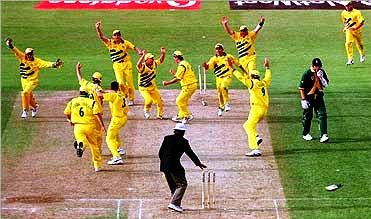
There were now 9 runs needed. Klusener smashed Damien Fleming for boundaries off the first two balls. Just one run was required off 4 deliveries with Klusener still on strike. Steve Waugh brought in all his fielders. Donald at the other end seemed jittery. He was nearly run out off the third ball. Klusener played the next ball towards Mark Waugh in the covers and ran. Donald was confused. He stayed put, then ran, dropping his bat in the process. Mark Waugh back-handed the ball towards the stumps at the bowler's end where both the batsmen were standed. Fleming then rolled the ball to Ian Healy, and Donald was beaten by yards.

It was a tie, the first in the World Cup. Australia advanced to the final, having beaten South Africa by a whisker in the previous match. A relieved Shane Warne exclaimed: "We just got out of jail at the end. I don't know how we did it. It was just a great game of cricket." Sometimes the difference between triumph and tragedy can be very slender indeed.

Australia        : 213 all out (49.2 overs)
South Africa : 213 all out (49.4 overs)

(Author Indra Vikram Singh can be contacted on email singh_iv@hotmail.com).

The Big Book of World Cup Cricket 1975-2011

ISBN 978-81-901668-4-3

Distributed in India by Variety Book Depot, Connaught Place, New Delhi, Phones + 91 11 23417175, 23412567

Available in leading bookshops, and online on several websites.

Friday, May 30, 2014

The Cricket World Cup - Classic Matches…..6 : Excerpt from ‘The Big Book of World Cup Cricket 1975-2011’ by Indra Vikram Singh

 A TWIST IN THE TAIL

Australia v West Indies (semi-final)  • PCA Stadium, 
Mohali (Day/Night), 14 March 1996


West Indies were unlikely semi-finalists, Australia the favourites. Even in decline the West Indies were not a team to be trifled with. An extra effort from someone could tilt the balance. That effort, at the outset, came from the Caribbean pacemen.

Curtly Ambrose began ominously with a huge in-swinger that drew a gasp all around. Next ball, the prolific Mark Waugh was trapped leg-before, hopelessly late on his elegant defensive stroke. Brian Lara dropped Mark Taylor in the slips off Ian Bishop. But Taylor edged a Bishop delivery on to the stumps in the fourth over. Two down for 7, and only one run from the bat. That was off the dropped catch. Ricky Ponting was stranded in front of the sticks by another Ambrose special. Three down for 8 off 4.5 overs. Bishop had the resolute Steve Waugh’s bails flying. It was disaster at 15 for four after 9.1 overs.

Stuart Law and Michael Bevan dug in as Courtney Walsh bowled a thrifty spell. The wicket lost its bite, so did the bowling. Rookie Otis Gibson was hit for 13 runs in two overs. The pressure eased. The pair posted 138 in 32 overs, Australian fifth-wicket World Cup record. Law was run out for 72. As often happens, Bevan left soon for 69. Ian Healy hit 31 off 28 balls. But a score of 207 did not seem enough.

Despite the early loss of makeshift opener Courtney Browne off Shane Warne's first delivery, left-handers Shivnaraine Chanderpaul and Lara batted untroubled, keeping pace with the asking-rate. Lara was in sparkling form, scoring 45 at a run-a-ball and carving out four boundaries. He got a beauty from Steve Waugh that dislodged the off bail. The stand was worth 68 runs in 16.5 overs. Skipper Richie Richardson filled the breach admirably. Chanderpaul got cramps. Soon Glenn McGrath had him caught for 80 off 126 balls with 7 fours. Another 43 were required off 50 balls.

Dew had begun to fall as the evening wore on. McGrath had Roger Harper leg-before. Skipper Taylor pulled out his last trick, Shane Warne. Gibson was promoted to hit out but Warne was too wily. Even the unflappable Jimmy Adams could not bear the pressure. The fabled Warne flipper fooled him. Keith Arthurton, woefully out of touch, had collected two runs in four innings. He was far too nervous, swung wildly at Damien Fleming, edged to a jubilant Healy, and failed to add to his miserable tally. With 20 required off 14 balls, Richardson had just nine, ten and jack for company. Warne’s perfectly pitched flipper in the 49th over left Bishop clueless.

Warne grabbed three wickets for 6 runs in his third spell of 3 overs. He recounted later: "I was really pumped up. When we got Chanderpaul we knew we had a very good chance. It is important to bowl a tight line and length under the circumstances rather than spin the ball prodigiously."

West Indies needed 10 runs in the final over with two wickets left. Richardson blasted the first ball to the mid-wicket boundary. Excitement reached fever pitch. There were six runs to win off 5 balls. Surely the captain would see them through. But this was not a situation for rational acts. As the ball streaked to the wicketkeeper, Ambrose took off for a single and just failed to make it. Six to get off 4 balls. The role did not suit last man Walsh. Richardson watched helplessly. Fleming, accurate and nippy, made the ball skid. Walsh had no idea what he was supposed to do. Before he could decide, the ball crashed into his stumps. Australia had conjured another of cricket’s legendary tales. West Indies were in control for 91 overs. They did not know how to handle the final nine.

Australia        : 207 for 8 wickets (50 overs)
West Indies    : 202 all out (49.3 overs)

(Author Indra Vikram Singh can be contacted on email singh_iv@hotmail.com).

The Big Book of World Cup Cricket 1975-2011

ISBN 978-81-901668-4-3

Distributed in India by Variety Book Depot, Connaught Place, New Delhi, Phones + 91 11 23417175, 23412567

Available in leading bookshops, and online on several websites.

Sunday, May 25, 2014

The Cricket World Cup - Classic Matches…..5 : Excerpt from ‘The Big Book of World Cup Cricket 1975-2011’ by Indra Vikram Singh

JUST A RUN AGAIN BETWEEN TWO OLD CHAMPIONS

Australia v India  •  Woolloongabba, Brisbane, 
1 March 1992


The winners of the last two World Cups did not begin the present tournament on a happy note. Australia, who started as one of the fancied teams, were beaten by New Zealand and South Africa to the dismay of the home crowds. India lost narrowly to England, and a supposedly easy match against Sri Lanka was washed out.

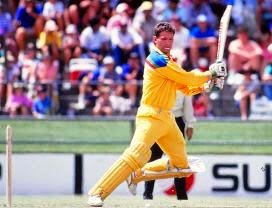
Both teams were, therefore, eager to register a win at the Gabba. The Australians elected to bat. But they were jolted by Kapil Dev as he removed both openers Geoff Marsh and Mark Taylor with just 31 on the board. David Boon and Dean Jones settled down to a fine partnership. They added 71 for the third wicket. Jones hit a typical 90 off 108 balls, characterised by hard running and flashing shots. He crashed 6 fours and 2 sixes. He explained his approach: "I try to come across as a player who enjoys the game and has a good time. The kids who see that will want to play the game as well. If you are full-on aggressive it gets through to people." Steve Waugh and Tom Moody also made valuable contributions. Then the Indian medium-pacers led by Manoj Prabhakar got into the swing of things. From 230 for five, Australia slumped to 237 for nine at the end of their 50 overs.

It was then that a flawed rule regarding interruption of play by rain began to cast a shadow over the tournament. As the weather gods intervened, three overs were lopped off the Indian innings, but the target score was reduced by only two runs. The reasoning behind this absurd rule was that while deducting the number of overs, the ones to be taken into account were those in which the team batting first had scored the least number of runs. So going through the scoring pattern of the Aussies it was found that in the three overs that they had scored the least, a sum total of two runs had accrued. This rule was to provoke much derisive laughter and anguish later in the tournament. Conventional logic, taking average scoring-rate into consideration, would have reduced India’s target to 224. But now India's target was 236 off 47 overs.

India made a dismal start as Krish Srikkanth was bowled for a duck. But skipper Mohammad Azharuddin was in prime form. On either side of the rain break, he was helped by Ravi Shastri and Sachin Tendulkar in rebuilding the innings. Kapil Dev, promoted up the order, scored a quick-fire 21. Then Sanjay Manjrekar joined his captain, and the two put on 66 for the fifth wicket.

Azharuddin was run out for a brilliant 93 off 103 balls with ten boundaries. Then the Indian innings began to come unstuck. Ajay Jadeja went for one, and Manjrekar too was run out for 47 off 42 balls with 3 fours and a six. India needed 13 off the final over with three wickets in hand. Strangely, the 6 feet 8 inches non-regular bowler Tom Moody sent down the pulsating last over. Kiran More flicked the first two balls to square-leg for fours. Now five runs were required off four deliveries. More got carried away, missed, and his middle stump broke into two. A single was scampered off the fourth ball. But Prabhakar was run out off the fifth.


Four runs were needed off the last ball. Javagal Srinath swung hard and high but straight to Steve Waugh who dropped the catch. But he recovered quickly and threw the ball back. Venkatapathy Raju was going for the run that would have tied the scores. The throw beat him and Australia won a dramatic match by one run. For the second time in the World Cup, Australia pipped India by this razor-thin margin.

Australia        : 237 for 9 wickets (50 overs)
India               : 234 all out (47 overs)

(Author Indra Vikram Singh can be contacted on email singh_iv@hotmail.com).

The Big Book of World Cup Cricket 1975-2011

ISBN 978-81-901668-4-3

Distributed in India by Variety Book Depot, Connaught Place, New Delhi, Phones + 91 11 23417175, 23412567

Available in leading bookshops, and online on several websites.

Friday, May 23, 2014

The Cricket World Cup - Classic Matches…..4 : Excerpt from ‘The Big Book of World Cup Cricket 1975-2011’ by Indra Vikram Singh

INCREDIBLE LAST OVER

Pakistan v West Indies  •  Gaddafi Stadium, Lahore, 
16 October 1987

This was a battle royale as the former champions West Indies took on the home team and hot favourites, Pakistan. The West Indies had already lost one of their two encounters, so a victory in this game was crucial. Pakistan had won both their matches, and were looking to maintain their winning streak.

The West Indian openers Desmond Haynes and Phil Simmons seemed aware of their responsibility, as they put on 91 runs. But both were dismissed in quick succession. Simmons hit up a free-scoring half-century in his first outing. Left-armer Salim Jaffer got among the wickets as Richie Richardson and Gus Logie too fell soon. Skipper Vivian Richards stemmed the rot in the company of Carl Hooper in a fifth-wicket stand of 47. Hooper was trapped leg-before by Wasim Akram, who accounted for Jeff Dujon in a similar vein. Richards was dismissed by his opposite number, Imran Khan. Bowling a fine spell, Imran did not let the lower-order prosper. The West Indies were bowled out for 216. Imran finished with four for 37.

Pakistan made heavy weather of the run-chase. They lost Mansoor Akhtar and Salim Malik cheaply before Rameez Raja and Javed Miandad steadied the ship. Then three wickets fell in a heap, with the Pakistan score looking a sorry 110 for five off 35 overs. It seemed an impossible task for the lower half to get the remaining 107 runs at more than seven per over. Wicketkeeper Salim Yousuf took matters in his hands and went for the bowling with gusto. The proverbial luck of the brave favoured him and he was dropped thrice. His belligerent 56 off 49 balls with 7 boundaries gave a ray of hope to the hosts. But wickets began tumbling. At the end of 49 overs the Pakistanis were 203 for nine. Fourteen runs were required off the last six deliveries with Abdul Qadir and Salim Jaffer at the crease, as Courtney Walsh came up to bowl.

Walsh had performed splendidly so far. In nine overs he had captured four important wickets for 26 runs. All he had to do now was to be on target. Qadir took a single off the first ball. Jaffer did likewise off the second. The batsmen scrambled two off the third ball. Ten runs were now required off the last three deliveries. Ones and twos would not do.

Incredibly, Qadir swiped a straight six off the fourth delivery. Four were needed off two balls. Qadir again ran two. Two were now required off the last ball, and the tension was unbearable. Walsh ran up to bowl; Jaffer, in his excitement, backed up too far. Walsh did not deliver and nodded a warning to Jaffer. The truant non-striker returned sheepishly to his crease. Walsh came in again and Qadir swung. The batsmen ran for their lives and completed the two runs needed. Pakistan had won by one wicket off the last ball. Amid scenes of wild jubilation Qadir was the hero of the moment, of perhaps the most dramatic finish in One-day cricket.

But the game had also seen another hero, Courtney Walsh, for his tremendous show of sportsmanship, particularly when the match was poised on a razor’s edge. It is acts such as these that make cricket the great game that it is.

West Indies    : 216 all out (49.3 overs)
Pakistan         : 217 for 9 wickets (50 overs)

(Author Indra Vikram Singh can be contacted on email singh_iv@hotmail.com).

The Big Book of World Cup Cricket 1975-2011

ISBN 978-81-901668-4-3

Distributed in India by Variety Book Depot, Connaught Place, New Delhi, Phones + 91 11 23417175, 23412567

Available in leading bookshops, and online on several websites.